

A Gucci dust bag or controllato card can strengthen a coherent story, expose a careless mismatch, or tell me almost nothing. The difference is context. These pieces are separate from the bag, belt or wallet, so they can be lost, replaced, borrowed or deliberately added.
I treat accessories as a version-and-provenance check. First identify the item. Then ask whether the packaging belongs to its likely period, category and purchase story. Finally inspect the accessory itself. That order gives a woven label or printed digit an appropriate role.
I photographed these two close-ups from a historical Gucci dust bag for my authentication reference archive. They document a woven label I examined directly and show one historical construction—not every version Gucci has issued.
Table of Contents
The Fast Answer: Weight the Item Before the Extras
Accessory evidence is useful when it agrees with stronger, item-specific evidence.
| Evidence | What it can answer | Weight in my review |
|---|---|---|
| Bag or belt construction | Whether the model, materials, hardware, labels and workmanship agree | Primary |
| Purchase trail | Whether dates, seller history, receipt details and ownership sequence form a plausible chain | Supporting to strong when verifiable |
| Dust bag | Whether textile, label and design plausibly match the claimed packaging version | Supporting |
| Controllato card | Whether printing and layout resemble a matched insert version | Limited supporting evidence |
A genuine item may have no original extras, while a counterfeit may arrive with convincing-looking ones. Completeness affects desirability and resale presentation; it does not reverse the product evidence.
Read a Woven Dust-Bag Label from Both Sides
The historical example here is a woven rectangular label with a light ground, dark border and GUCCI lettering. It is more informative as a textile structure than as a logo photograph. I compare four layers: the label construction, the weave, the letter shapes and the way the label is attached to the bag.
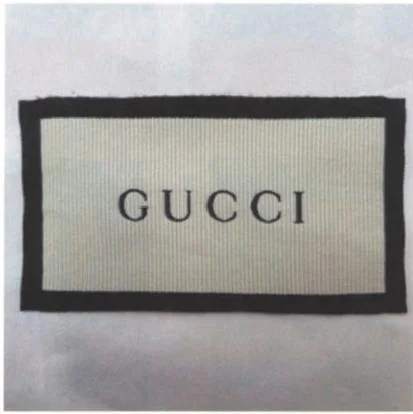
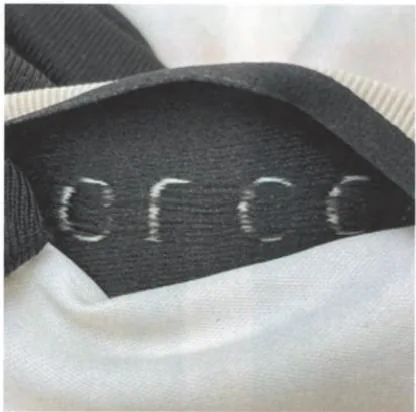
Front: texture belongs to the construction
On the front, the letters sit inside the weave rather than appearing as a smooth surface print. Follow the fine vertical ground, the denser dark border and the small changes where dark letter yarns cross the light field. Minor floats or irregular-looking transitions can be a consequence of weaving; they should not be automatically described as sloppy printing.
Compare the complete system. The G’s opening, the U’s lower turn, the two C forms and the I’s terminals matter, but so do border thickness and the amount of open space around the word. A close logo with the wrong textile construction is not a close match.
Reverse: look for the working side of the weave
The reverse in this example is visibly different from the front. Dark backing yarns cross behind the letter area, so the full word does not appear as a crisp white mirror image. This front/reverse relationship is harder to understand from a seller’s single frontal photograph.
I also inspect the outer edge and attachment seam. A correctly woven loose label attached with an implausible stitch path, fresh adhesive or disturbed fabric creates a provenance question: did this label begin on this dust bag? The answer concerns the accessory first, not yet the Gucci item inside it.
Match the Packaging Period Before Matching the Logo
Dust bags are not timeless. Gucci’s current packaging page says its dust bags and suit carriers are made from recycled cotton, while the brand’s handbag-care page describes storing a bag in the provided flannel dust bag. Those current statements explain the accessory’s purpose and material direction; they do not turn the historical woven-label example above into a rule for current packaging.
That creates a simple checkpoint: compare historical items with documented packaging from the same broad period, and current purchases with current retail presentation. Color, drawstring, fabric hand, logo application and label format all need the right temporal frame.
A Reddit buyer comparing two Gucci dust bags focused on a darker, bolder logo even though one bag reportedly came from a direct Gucci order. The post is not production evidence, but it captures a real buyer problem: visual variation is easily mistaken for a verdict when the packaging versions have not been established.
What a Controllato Card Is—and Is Not
Controllato means “checked” in Italian. The familiar paper insert carries that word and a printed 0–9 sequence; it is best understood as a quality-control insert, not a unique certificate tied to the item’s style number or serial information.
The technical material behind this guide highlights interruptions or small breaks in certain printed numerals, especially 1 and 4. That can be useful when two cards share the same layout and printing family: compare the exact shape, position and edge quality of the interruption under even light.
I do not apply the material’s old “exactly one broken numeral” formulation as a universal rule. Print runs, wear, photography and reproduction can all alter what is visible. A break is a matched-reference feature; a copied card can reproduce it, and a low-resolution image can invent or erase it.
The card photograph available for this guide is too soft to support a truthful numeral or wordmark close-up, so I have not presented it as visual evidence. A usable replacement would need to show the full layout, the numeral row, the wordmark and a paper edge from the same documented card; no version-matched image with clear reuse rights was established.
The word itself deserves the same close reading. Check that controllato is spelled correctly, then compare type weight, spacing, baseline, paper tone and cut. A misspelling is a direct conflict. A plausible spelling is only the start of the comparison. In one buyer report about a returned bag, “controllafo” immediately drew attention; the useful lesson is to read every character instead of letting familiar packaging create trust.
Missing, Mismatched and Suspiciously Complete Are Different States
I sort accessory findings into three states because each calls for a different response.On smaller screens, swipe horizontally to see all columns.
| State | What it may mean | What to ask next |
|---|---|---|
| Missing | The original owner discarded it, a reseller separated it, or the item was sold without the full presentation | Ask what is included and price the listing as item-only; continue with the item assessment |
| Mismatched | A replacement, a household mix-up, reseller stock-room mixing or a deliberate attempt to improve the story | Ask whether the accessory is original to this item and request purchase-history details |
| Suspiciously complete | A genuine full set, or assembled theatre around a weak item | Check whether every document and accessory tells the same date, retailer, model and ownership story |
A PurseForum discussion about black controllato cards shows buyers seeking a yes-or-no shortcut from insert format. Another buyer seeking authentication omitted accessory photos because those pieces could be copied. The useful distinction is simple: inspect extras for coherence, but authenticate the product through product evidence.
Translate Seller Language into Verifiable Claims
Before paying a premium, convert listing language into something the seller can demonstrate.A useful claim names both the accessory and its relationship to the item.
| Seller phrase | What it actually establishes | Useful follow-up |
|---|---|---|
| “Full set” | A group of extras | Request one group photo and a written inventory |
| “Original dust bag” | Could mean genuine, period-correct or original to this item | Ask which meaning the seller can document |
| “Authenticity card” | A seller’s name for an insert | Identify the card and request both sides |
| “New packaging” | A recency claim | Ask when and where it was purchased |
If the price includes a “full set” premium, preserve the written claim. It gives the buyer a basis if accessories arrive missing or materially different.
My Accessory Anomaly Decision Tree
- Identify the product. Use the Gucci bag model guide to establish family and version.
- Date and name each extra. Separate historical from current packaging, and a controllato card from care or product inserts.
- Compare the right version. Read the woven label front and reverse, or the card’s complete print layout.
- Test the relationship. Is the accessory only genuine-looking, period-correct, or documented as original to this item?
- Return to the product. Let the leather tag and codes and hardware and zippers control the decision.
Frequently Asked Questions
Does a Gucci controllato card prove authenticity?
No. It is a replaceable quality-control insert, not a unique certificate linked to one item’s serial or style number.
Is a Gucci bag fake if it has no dust bag?
No. A dust bag may be lost or separated in resale. Judge the item itself and price the listing according to what is included.
Should the GUCCI word show clearly on the back of a woven dust-bag label?
Not in the historical example shown here. Dark backing yarns interrupt the reverse, so it is not a clean mirrored wordmark.
Must one digit on every controllato card have a break?
Treat digit breaks as version-matched print details, not a universal count rule. Compare the complete layout and paper with a reliable reference.
Are current Gucci dust bags the same as vintage ones?
No single historical construction covers every period. Gucci currently describes recycled-cotton dust bags, so date the packaging before comparing it.
What should I ask when a seller says “full set”?
Ask for a written inventory, one group photo and confirmation of which pieces are original to this specific item.
What Would Make the Accessories Useful to Me?
I want the dust bag or card to fit a story supported by the item: plausible period, suitable category, consistent ownership and no unexplained substitution. If it is absent, I price the purchase as item-only. If it conflicts, I avoid an original-full-set premium. Packaging is most useful as a consistency test, not a shortcut.