
A field guide to reading a Gucci leather tag as a system: front wordmark, reverse code, digit family, row function and era- or category-specific formats.
Written and reviewed by Chloe, ReinaLuxe editor and site owner · Updated September 1, 2026
A Gucci number is useful evidence, but it is not a magic authentication key. The term “serial number” is convenient resale language; on many bags, the stamped digits behave more like style and production-reference information than a unique, one-bag-only serial. A copied code can appear on a counterfeit, while a genuine vintage or small leather item may not follow the modern two-row layout a buyer expects.
I therefore read the leather tag in layers. First I identify the bag family and likely version. Then I compare the tag’s construction, the front GUCCI wordmark, the number shapes and the relationship between the rows. Only after those layers agree do I ask whether the code points to the same product. This prevents a plausible number from overruling a visibly wrong bag.
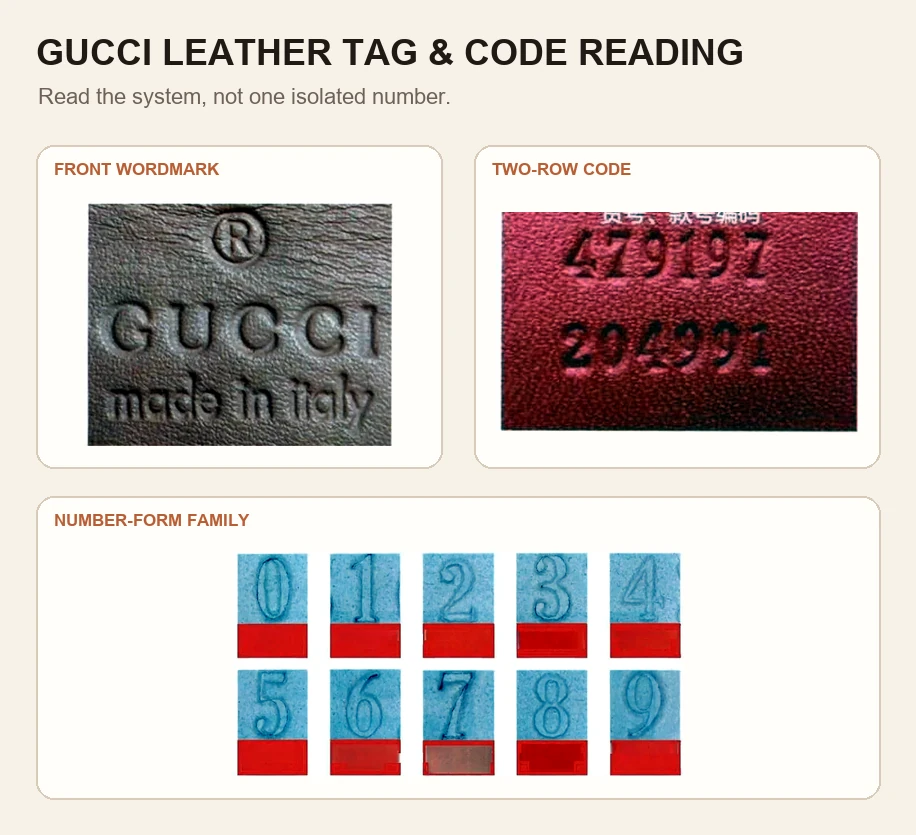
Table of Contents
Quick Answer: What Do Gucci Serial-Number Rows Mean?
In the common two-row bag format represented in the reference examples, the upper row is the item or style reference and the lower row identifies a workshop, supplier or production source. That is a working interpretation, not a universal decoder for every Gucci era and product category. Treat the complete tag as combination evidence, compare it with a period- and model-matched reference, and never regard a successful number search as proof of authenticity.
The Five-Layer Gucci Tag Reading Method
| Layer | What to observe | What it can establish | What it cannot establish alone |
|---|---|---|---|
| 1. Model context | Silhouette, closure, material, size and carrying system | The correct product family and likely version | Authenticity |
| 2. Tag construction | Shape, leather, attachment, edge, stamp position and front/reverse relationship | Whether the label belongs to the expected construction family | A universal pass/fail rule across all years |
| 3. Wordmark | G, U, C and I proportions, spacing, contrast and terminals | Whether the letters behave as one coherent wordmark | A decision from one worn letter |
| 4. Number family | Stroke contrast, bowls, feet, terminals, baseline and repeated digits | Whether the digits appear to come from a compatible stamp family | A permanent master font for every category |
| 5. Code relationship | Upper/lower rows, sequence length, layout and product match | Whether the visible code is plausible for the identified item | A unique ownership history or automatic authentication |
The order matters. If the bag has not yet been identified, begin with my Gucci bag models guide. A code search performed before the silhouette is stable tends to create confirmation bias: the searcher finds a product with similar digits and then overlooks a different closure, proportion or strap system.
What “Gucci Serial Number” Actually Means
Gucci’s public product pages label their catalog reference as Style, not as a consumer authentication serial. A current US product page, for example, presents the GG Emblem small tote as Style 815214 FAD6M 1425. Other current products use letter-led references such as A002LF FAFV2 9651. These live examples establish two important limits:
- Current public style references can be multi-part and alphanumeric.
- The format printed on a product page should not be assumed to reproduce the interior stamp of every earlier bag character for character.
In many pre-owned bags, the interior number is described as a serial number even when the upper row functions as a model or style reference shared by more than one item. In the leather-tag examples I reviewed, the lower row is treated as a workshop or supplier reference. If that lower row is serving as a production-source identifier, seeing it recur is not inherently suspicious; it was never meant to act like a unique passport number.
This distinction changes the question. Do not ask, “Does this number exist?” Ask, “Does this complete tag—construction, wordmark, digit family, row layout and product reference—make sense for this exact Gucci model and period?”
Read the Leather Tag as an Object Before Reading Its Digits
A tag is not just a text carrier. On the common bag construction, the front may carry the registered mark, GUCCI and “made in Italy,” while the reverse carries the numeric information. The useful observation is how all of those elements occupy one piece of leather: the tag outline, the distance between lines, the stamp depth, the letter alignment, the edge and the way the tag is attached to the interior.
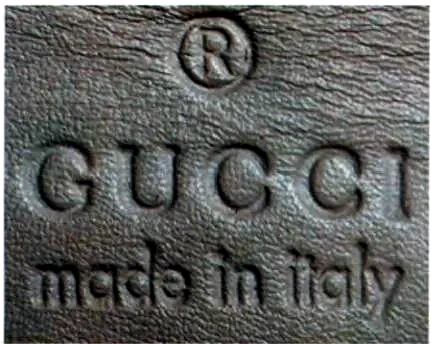
I use four construction questions before zooming into type:
- Does the tag form suit the item? A handbag, wallet and older small leather piece should not automatically be forced into one label template.
- Do the front and reverse belong together? Stamp scale, available space and alignment should make physical sense on the same tag.
- Is the impression compatible with the leather? Grain, wear and uneven pressure can soften a genuine stamp; an unnaturally sharp or uniformly black print can also deserve scrutiny.
- Is the construction period-matched? A current reference is not a safe master for an archival bag, and a vintage tab should not be judged by today’s catalog typography.
There is no benefit in declaring one tag color, corner radius or embossing depth universal. Those observations become useful only after the category and approximate era have narrowed the comparison set.
GUCCI Wordmark Checkpoints: Read G, U, C and I Together
The strongest front-stamp reading is relational. In the reference family, G and C are close to circular, with visible thick–thin contrast rather than monoline geometry. The C has a relatively contained opening. The G retains that circular body while adding an internal horizontal feature. U and I supply different evidence: their vertical structure, curved base or serif-like terminals should agree with the same type family and embossing pressure.
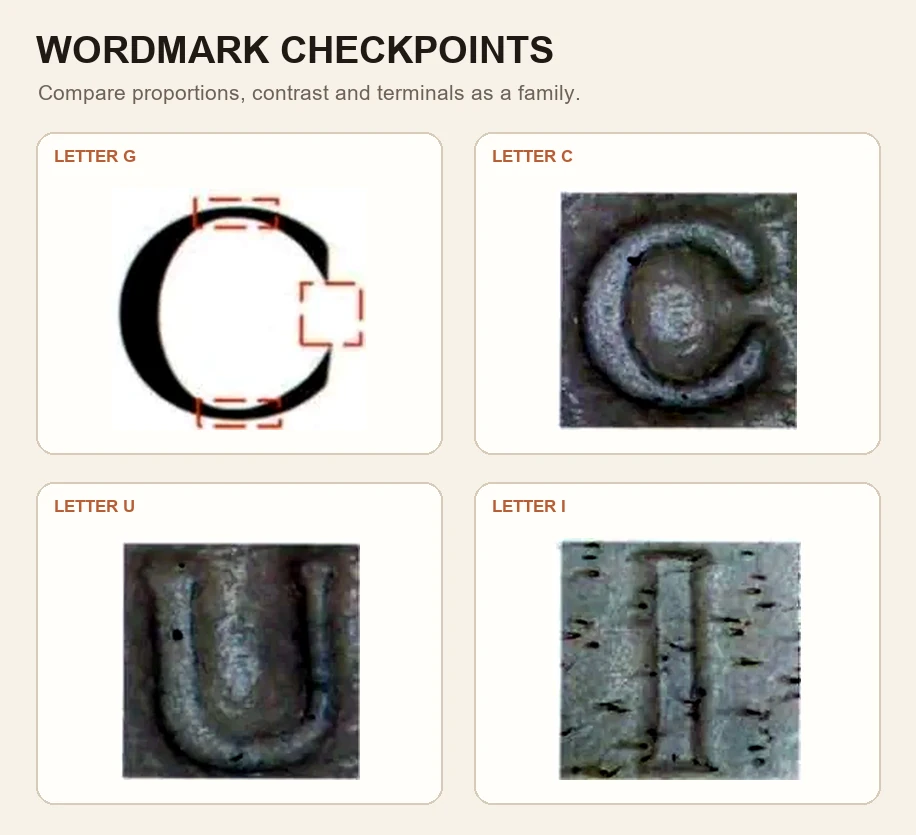
G and C: circular body, opening and stroke rhythm
Compare the outside contour first. The G and C should look related, not like letters borrowed from unrelated fonts. Then inspect the inner white space, the C opening and the G’s internal bar. Leather grain can make a rounded edge look jagged, so the important signal is whether the thick and thin zones remain in the expected relationship across both letters.
U: shoulders, verticals and bottom curve
The U is useful because it combines straighter vertical movement with a curved base. Check whether both sides rise coherently, whether the lower curve is centered and whether the terminal treatment belongs with the I. Do not reject a tag because one shoulder appears lighter; embossing pressure frequently changes across a small leather surface.
I: width and terminals
The I provides a quick check on the wordmark’s serif logic. Compare top and bottom terminals, central-stem width and alignment with the other letters. A very wide block I, a featureless vertical stroke or terminals that conflict with the U may be useful concerns, but only when a model- and period-matched reference supports the comparison.
Spacing belongs in the same analysis. GUCCI should read as a balanced word, not five independently positioned characters. Still, do not measure a tilted photograph as if it were a flat scan. Perspective can compress one side of the word and exaggerate another.
How to Compare Gucci Number Shapes
Number checking is most reliable when it describes a family of stamped forms, not a list of internet slogans such as “the 1 must always have this hook.” The source material preserves a complete 0–9 reference set. It shows meaningful variation in curved bowls, stroke contrast, entry and exit terminals, feet and serifs. Those features are useful checkpoints, but they are not a promise that every Gucci product, supplier and decade used one unchanged die set.
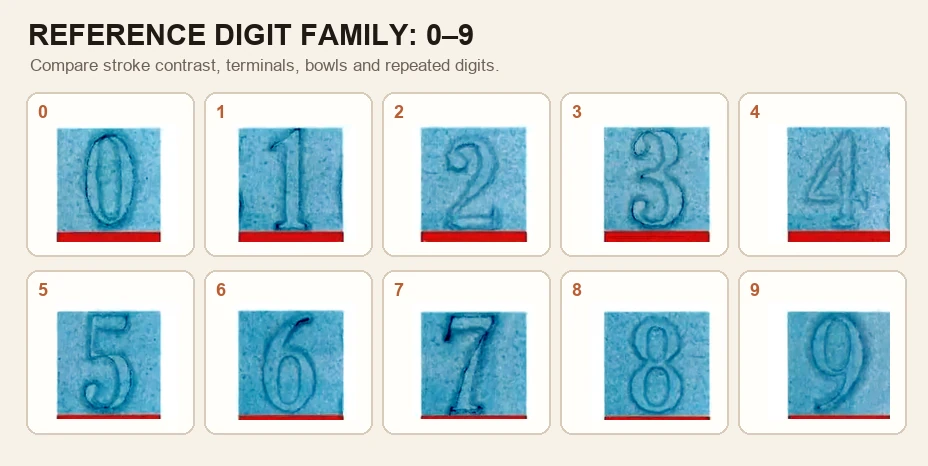
For each digit, record five properties:
- Proportion: Is the digit narrow, broad, tall or compressed relative to neighboring digits?
- Stroke contrast: Where do heavier and lighter parts occur? Does the contrast remain coherent across the row?
- Terminals and feet: Look for hooks, rounded endpoints, angled starts and base serifs without reducing the decision to one feature.
- Bowls and counters: Compare the inner spaces of 0, 6, 8 and 9 and the curved transitions of 2, 3 and 5.
- Repeated digits: Two occurrences of the same number on one tag are a valuable internal control. They should be related, while natural pressure and grain keep them from being mechanically identical.
The baseline is equally important. A genuine-looking 2 does not rescue a row with inconsistent height, erratic spacing and unrelated stroke weight. Conversely, a weak final digit may simply sit over heavier grain or a worn fold. Read the complete sequence before isolating the anomaly.
First Row, Second Row and Alternative Code Layouts
The most familiar arrangement in the reviewed bag examples is two horizontal numeric rows. The upper row is the item or style reference; the lower row is the workshop, supplier or production-source reference. This division is valuable because the rows answer different questions:
- Upper row: Does it point toward the model or style family visible in front of you?
- Lower row: Is its length, stamp family and placement plausible for the tag and period?
Do not assume the upper row captures every retail variant. Color, material and regional information can appear in a longer public style reference, on documentation or in catalog records without being reproduced as a simple numeric line on the tag. The live Gucci product examples above demonstrate how much more complex current catalog notation can be.
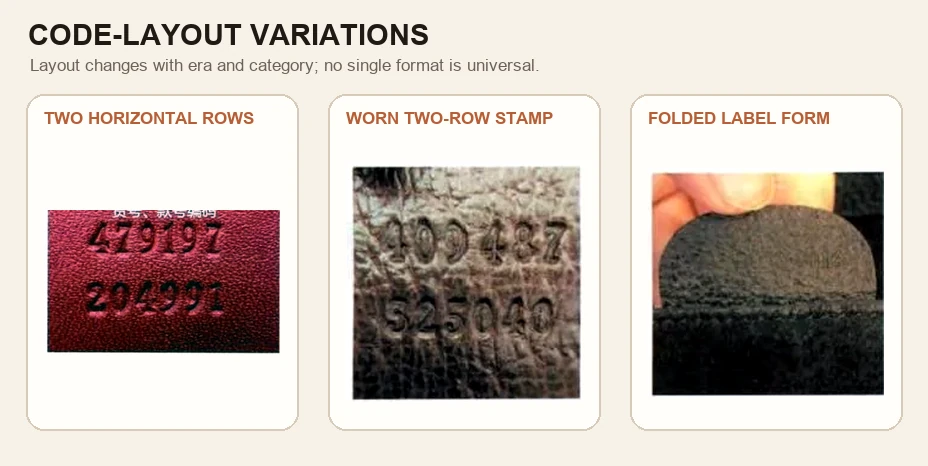
The source set also records layouts in which a sequence turns with the label construction and older narrow or folded leather forms place information differently. Small leather goods can further diverge from handbag expectations. That means these popular rules are unsafe:
- Every genuine Gucci item must have exactly two horizontal rows.
- Every row must contain the same number of digits.
- Any code longer or shorter than one preferred internet example is counterfeit.
- A folded or differently oriented tag is automatically wrong.
Format variation does not mean “anything goes.” It means the comparison must be specific. If a bag is believed to be a late-1990s shoulder style, use documented tags from that period and category—not a current wallet, a 1970s travel piece or an unsourced font chart.
A Gucci Style-Number Check That Avoids the Lookup Trap
- Identify the visible model first. Stabilize the family, closure, material, dimensions and carrying system.
- Transcribe exactly. Preserve both rows, uncertain characters and the observed spacing. Do not silently turn a worn 3 into an 8.
- Separate row functions. Treat the upper row as the style candidate and the lower row as production-source information only when the period/category supports that layout.
- Find a product-matched record. Prefer an official Gucci product page or dated official editorial record. For older pieces, use a documented archive or qualified authentication reference with clear provenance.
- Compare the product, not just the digits. Name, silhouette, closure, material, size and strap architecture must agree.
- Return to the physical stamp. Check wordmark, digit family, spacing, baseline, impression and tag construction.
- Record conflicts. A product mismatch is not erased by a neat code, and a worn digit should not outweigh an otherwise coherent period-matched tag.
A search result is only a lead. Search engines repeat seller listings, and counterfeiters can copy numbers from genuine products. The useful outcome is a model-matched evidence set, not a screenshot that says the number appears online.
Seven Gucci Serial-Number Myths to Reject
- “The number is unique to this bag.” Common style and production references are not equivalent to a vehicle identification number.
- “A Google match proves authenticity.” A copied code can match a real product while the object does not.
- “The lower row is a date code.” In the reviewed two-row system it is read as workshop or supplier information, not a simple manufacture date.
- “All Gucci codes have one fixed digit count.” Era, category, layout and current alphanumeric style notation prevent one universal count.
- “One perfect digit proves the font.” The row’s proportions, terminals, spacing and pressure must behave as a family.
- “No conventional leather tag means fake.” Older items and small leather goods can use different label constructions; repair history can also complicate the interior.
- “No NFC response means fake.” Gucci states that its current Authenticity Tag is available only on selected products.
Gucci Authenticity Tag Is Not the Same as a Stamped Serial Number
Gucci now offers an NFC-based Authenticity Tag on selected products. According to Gucci’s official Authenticity Tag page, the feature is read through the Gucci App and is available only on selected bags, silks, scarves and travel items. Gucci also says the tag cannot be added to or removed from a product.
This is a current digital service, not a retroactive requirement for every Gucci object. Its absence on an older or non-participating item is not proof against the item. Its presence should be handled through the official Gucci App rather than an unofficial “serial checker.” The traditional leather stamp and the Gucci Authenticity Tag answer different questions and should not be conflated.
How I Weight a Gucci Tag Result
| Result pattern | Interpretation | Next action |
|---|---|---|
| Model, tag form, wordmark, number family and style reference agree | Coherent supporting evidence | Continue with construction, hardware and provenance; do not stop at the code |
| Model agrees, but one digit is weak or partly worn | Unresolved local observation | Compare repeated digits and period-matched tags; avoid guessing the character |
| Code points to another model, material or configuration | Material conflict | Recheck transcription and model identification, then escalate if the conflict remains |
| Number appears online, but tag construction and typography conflict | Copied-code risk | Give the physical conflicts more weight than the search match |
| Layout differs from the familiar two-row format | Era/category question | Find a documented reference for the same product type and period |
The decision language is intentionally restrained. A coherent tag supports the object; it does not certify it. A material conflict deserves investigation; it should not be hidden by a matching search result. For the broader evidence sequence, use the designer bag authentication guide. For Gucci’s visual vocabulary before the tag stage, the separate Gucci brand codes guide covers Bamboo, Horsebit, Double G and Web.
Frequently Asked Questions
Can I authenticate a Gucci bag by serial number?
No. A number can support model and production-context checks, but it can be copied. Authentication requires a model-matched review of construction, tag, typography, hardware, materials, condition and provenance.
Is a Gucci serial number unique to one bag?
Usually not in the sense buyers expect. On many bags, the commonly named serial number contains style and production-source information rather than a unique identifier assigned to one physical item.
What do the two rows on a Gucci leather tag mean?
In the common format represented here, the upper row is the item or style reference and the lower row identifies a workshop, supplier or production source. This interpretation must still be matched to the item’s era and category.
How many digits should a Gucci serial number have?
There is no safe universal count for every decade and product category. Two-row numeric formats are common in many bags, while older constructions, small leather goods and current alphanumeric public style references create valid exceptions.
Can I check a Gucci serial number online?
You can use the upper-row style candidate to locate a product-matched reference, preferably from Gucci or a documented archive. A search result is not an authenticity result: the pictured product and the physical tag still need to agree.
Does every Gucci item have a leather serial-number tag?
No. Label construction varies by era and category, and some older or small leather items use alternate formats. Judge the observed label against a comparable product, not a universal handbag template.
Does every Gucci bag have an NFC Authenticity Tag?
No. Gucci states that its Authenticity Tag is available only on selected products. Its absence on a non-participating or older item is not by itself evidence of counterfeit.
Final Rule: A Code Must Agree With the Object
The best Gucci code check is a consistency test. The visible model establishes the comparison set. The leather tag supplies a physical format. The front wordmark and reverse digits should belong to coherent type families. The upper and lower rows should make sense for the item’s category and period, and the style candidate should resolve to the product you can actually see. If those layers disagree, a searchable number does not repair the conflict. If they agree, the tag becomes strong supporting evidence—still one layer within a complete authentication decision.