
My interest in replica bag quality started with a Chanel Classic Flap. A friend had paid a fraction of the boutique price for what she called a “1:1 mirror copy,” and the bag made me curious about the grades, seller codes, and private-market language behind it.
After years of researching, buying, handling, and comparing bags, I no longer judge a piece by the number of A’s in its label. “AAA replica bags,” “1:1 replicas,” “mirror quality,” and “superfakes” are not regulated grades. The same term can describe very different materials, construction, quality control, and service depending on the seller.
This guide explains the framework I actually use: ReinaLuxe’s AAA Tier, Top Tier, and Ultimate Tier. I will show you where the tiers tend to differ, what the seven CarryAll comparison images reveal, which seller claims need evidence, and how I use PSP or QC photos before shipping. I will also share the experiences that changed my own buying decisions, including an in-store comparison, a customs seizure, a five-week delay, and the workflow I now use with Cyan.
The goal is not to make a replica sound authentic or risk-free. It is to help you decide whether a particular bag, at a particular price and tier, is right for you.
Table of Contents
🚨 CHLOE’S LIVE MARKET DISPATCH (UPDATED: JULY 2026)
I separate current external facts from my own observations and Cyan’s partner-side experience. A published authentication report, a seller’s logistics workflow, and my judgment after handling bags are useful in different ways; none should be stretched into a universal market claim.
AI authentication: what the 2026 data supports
Entrupy’s 2026 State of the Fake report says Louis Vuitton represented the largest share of submissions in its dataset. It also reports an unidentified rate of about 18.9% for Goyardine canvas. Those figures describe items submitted to Entrupy, not every authentic or replica bag in circulation.
Entrupy’s current bags and leather goods authentication workflow uses guided, high-resolution image capture and machine learning to return an authentic or unidentified result. That process requires the item and Entrupy’s device or app workflow. Ordinary catalog photos, seller videos, NFC responses, and my PSP checklist are not substitutes for professional authentication.
In my market conversations, I also hear more concern about mixed-component or “Frankenstein” bags. I treat that as a reason to review the complete item and its history. I do not treat it as proof that a named factory, leather, or hardware component has defeated authentication.
Customs and logistics: what Cyan is seeing
During stricter inspection periods, Cyan’s team may change routes, use third-country transit, or recommend reducing or adjusting branded packaging. In more normal periods, branded packaging may still be available. This is a current partner workflow, not a statement about every seller or route, and packaging alone does not determine whether a shipment will be delayed, inspected, or seized.
Triangle shipping changes the route and adds another handoff. It can also add time and make tracking less intuitive. Cyan has used third-country transit for some premium orders when conditions changed, but no route is “100% safe.” I would reject any promise of guaranteed customs clearance or guaranteed three-day international delivery.
Adhesive odor and batch quality
The chemical or adhesive odor buyers often call “fufu” remains one of my quickest practical warning signs. I have handled bags where a sharp odor appeared alongside rushed finishing or a weaker batch. I have also handled acceptable bags that needed time to air after production and shipping. Odor is therefore a quality clue, not an authentication test and not proof of leather origin.
Better tiers should bring more deliberate material selection, finishing, and quality control, but I still assess the exact bag. I do not promise that every AAA, Top Tier, or Ultimate Tier item will use the same leather, feel identical, or arrive with zero odor.
Replica tier labels are starting points for comparison, not guarantees about a specific bag. Our sourcing process and relationship with Cyan explains the commercial context behind optional inquiries; evaluate the item-specific evidence and terms before deciding.
What AAA Replica Bags Mean
AAA is informal market language for a claimed level of replica quality. It is not a certification, a customs category, or a shared factory standard. One seller may use AAA for a decent leather bag with clean finishing; another may apply it to a low-cost item that only looks convincing in edited photos.
At ReinaLuxe, I use AAA Tier as a defined premium everyday baseline. That definition is useful because it creates expectations I can check: appropriate material for the quoted model, balanced structure, clean stitching, controlled edge paint, consistent hardware, useful item-specific photos, and clear service terms. The label does not make a bag authentic, identical to the boutique version, or free from batch variation.
At the low end, bags may use stiff PU, heavily corrected or coated material, simplified construction, light hardware, uneven logos, and rushed edges. At the stronger end, the differences are usually less dramatic and more model-specific: panel proportions, the way a soft bag collapses, hardware geometry, stitch rhythm, lining construction, stamping, and the seller’s ability to catch a flawed item before it ships.
AAA vs. 1:1, mirror quality, and superfake
I translate all four terms into the same questions:
- Which exact bag is being quoted? The brand, model, size, color, configuration, batch, and date should be clear.
- Which materials are visible, and which origins are merely asserted? A tannery name, “original leather,” or “imported calfskin” requires more than a catalog description.
- What does the construction show? Look at shape, panel balance, seams, edge finishing, lining, attachment points, and closure behavior.
- What does the seller service include? Item-specific PSP photos, correction terms, packaging, shipping, and after-sales communication may explain a price difference.
- What remains uncertain? No seller label proves authenticity, factory origin, metal composition, long-term durability, or customs clearance.
“1:1” and “mirror quality” usually signal a claim of close visual matching. “Superfake” often suggests a replica that may survive casual inspection. None has a shared test behind it. Counting A’s or choosing the most dramatic label is less useful than comparing like-for-like quotes and inspecting the exact item.
How I Evaluate Replica Bag Quality
Before I look at micro-details, I check whether the bag makes sense as a whole. A perfect stamp cannot rescue the wrong silhouette, and heavy hardware cannot rescue poor construction.
These are my five core quality checks:
- Material suitability: The surface, flexibility, grain, lining, and odor should suit the quoted model and tier. I separate what I can observe from claims about species, tannery, region, or “original” material.
- Shape and construction: The intended silhouette should look balanced. Structured bags should not twist; soft bags should drape naturally rather than collapse from weak panels.
- Stitching and edges: I look for consistent rhythm, controlled turns, tidy joins, clean thread ends, and edge paint that is neither rough nor unnecessarily thick.
- Hardware and function: Tone, engraving, geometry, alignment, zipper movement, chain behavior, and closure action are more informative than weight alone.
- Brand and model details: Font, spacing, embossing, placement, proportions, pockets, and date-appropriate details should be compared with a reliable model-specific reference.
The timeline I have observed is not a universal history of every factory, but it explains why item-level QC matters more now. From 2016 to 2018, weak shapes, thin materials, noisy zippers, and obvious logo mistakes were common at the low end. From 2019 to 2021, “1:1 factory” language became widespread, often faster than the products improved. From 2022 through 2026, some workshops became better at alignment, packaging, hardware detail, and digital-tag imitation. That made the marketing more convincing, but it did not turn those features into authentication.
NFC, RFID, QR codes, serials, and digital responses can be copied. A phone opening a webpage does not connect a bag to a brand’s private records.
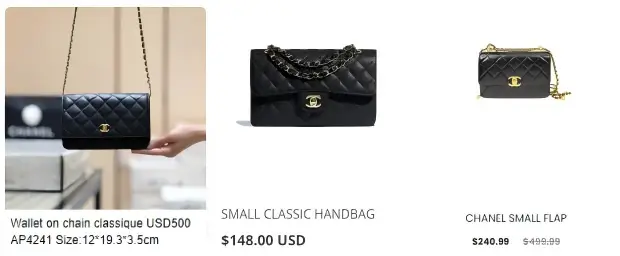
Quality tiers at a glance. Use these labeled samples to compare visible silhouette, stitch rhythm, texture and finishing. Start with the overall shape, then look at the same detail across the images.
Why brand, model, and batch matter more than one global grade
After handling bags across different brands, I do not believe one workshop is best at everything. A source can be strong on a structured Chanel shape and less convincing on an unlined, slouchy design. Even a respected factory name is only a starting filter because material selection and finishing can change between batches.
Cyan and I therefore discuss the current model and batch, not just a factory reputation. Two sellers may circulate the same catalog photos and still deliver different selections, QC coverage, correction handling, or after-sales service. I ask for current, item-specific PSP photos before approval.
For brand-level market context, see The Most Popular Replica Bag Brands of 2026. This page keeps the general quality framework; later brand and model pages should own the specific construction details.
How to Choose the Right Tier
The best tier is not automatically the most expensive one. I match the bag’s intended use, visible construction demands, and service level to the budget.
Entry grade
Entry-grade bags often use PU or heavily corrected material, simplified interiors, light hardware, and inconsistent finishing. They may make sense for a short-lived trend, but they are not what I mean by AAA and they rarely reward close comparison.
AAA Tier: premium everyday
AAA Tier is my practical starting point for a well-made everyday alternative. I expect appropriate leather or clearly described material, a balanced silhouette, clean stitching, solid-feeling hardware, and usable item-specific QC. I still expect some variation between models and batches.
Top Tier: strongest factory production
Top Tier is the level I usually choose for high-rotation bags where leather selection, edge finishing, hardware geometry, lining, and construction need to hold up under closer comparison. “Top Tier” does not mean undetectable, identical, or professionally authenticated. It means the quoted bag should show a meaningful improvement over the AAA option.
Ultimate Tier: limited higher-touch work
Ultimate Tier is for buyers who care most about detailed construction and narrowly supported material claims. It may include limited or slower production, more handwork, or special sourcing, but those are separate claims. “Handmade,” Haas, Weinheimer, “original leather,” upgraded hardware, and factory origin should each be tied to the specific bag rather than bundled into one luxury-sounding label.
Seller labels are not standardized. I use this table as a practical buying framework, not as an official industry certification.
| Grade | Material | Hardware | Accuracy & Details | Price Range | The Verdict (Who is it for?) |
| B/C-Grade (Not Recommended) | Synthetic leather / Stiff PU | Painted alloy, often chips or fades quickly | Rough stamping, bad stitching. Easily recognizable as a fake. | $20 – $80 | Street markets / DHgate stalls. Embarrassing to wear into a boutique. We completely avoid these. |
| AAA-Grade (Budget-Friendly) | Leather may be offered; confirm the actual material and finish. | Check the stated metal and finish, closure movement and visible wear. | Compare silhouette, texture, seams and finishing; the AAA label has no measured accuracy percentage. | $100 – $250 | Great for trying out a trendy style for a season without the heavy investment. |
| Top Tier-Grade (The “Sweet Spot”) | Premium calfskin or cowhide may be claimed; verify species and origin separately. | Inspect geometry, tone and function; steel composition and plating thickness need documentation. | Expect closer attention to model-specific details; compare the actual bag rather than assume it will go unnoticed. | $250 – $500 | The best choice for confident daily wear. This is the top tier of mass-produced premium bags in the Baiyun Market. |
| Ultimate Tier Grade (Handmade Custom) | Named-tannery claims, including Haas or Weinheimer, need item-specific sourcing documentation. | Compare the mechanism and finish on the exact bag; a 1:1 label does not establish matching internal parts. | Handwork and stitch method must be documented for the relevant seams; close resemblance is not perfect equivalence. | $500 – $1500+ | For buyers prioritizing documented construction and material details, with differences from the authentic still to assess. |
My rule after handling multiple bags across tiers is simple: the label sets an expectation, but the batch has to earn the grade. I have seen bags sold under the same tier differ in odor, edge finish, hardware action, and overall balance.
Seven CarryAll Images: The Decision Sequence
These seven CarryAll images remain in their original order. I compared the labeled samples with the authentic bag and gave each image one decision job, moving from overall silhouette to typography and finishing detail. For a separate model-level example, see the Chanel Mini Bag replica vs. authentic comparison.
These are the same CarryAll Vibe MM from different sellers. I compared them with the authentic one and graded them based on my judgment. Below are the detailed comparison charts of different grades.
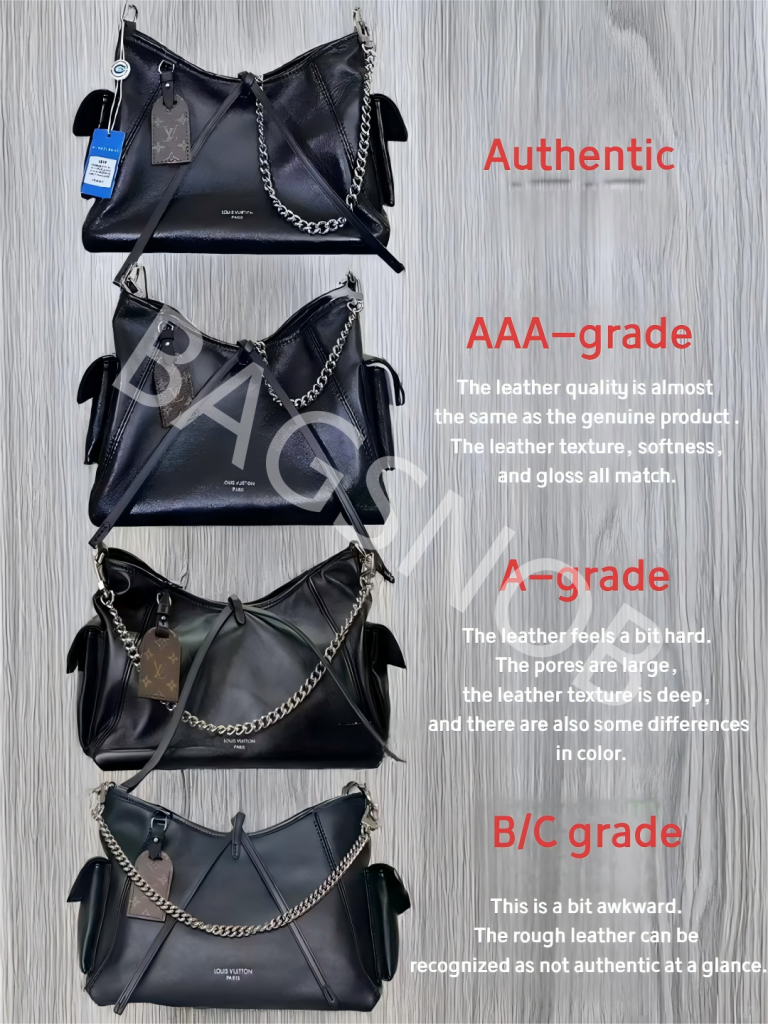
1. Overall silhouette and surface presentation. Compare the outline, panel proportions, handle placement, and the way each surface responds to the recorded lighting. Do not infer leather origin from gloss or grain in one photograph.
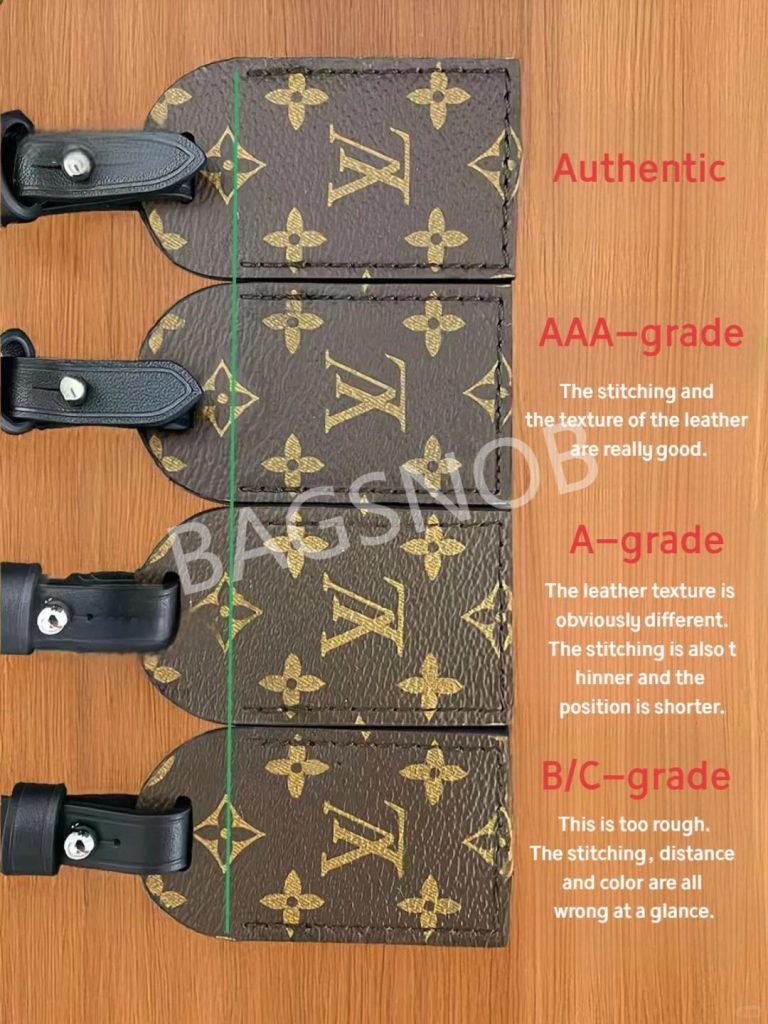
2. Tag, stitching, and visible texture. Look at spacing, stitch alignment, edge definition, and how the tag sits against the body. Compression and lighting can exaggerate texture.
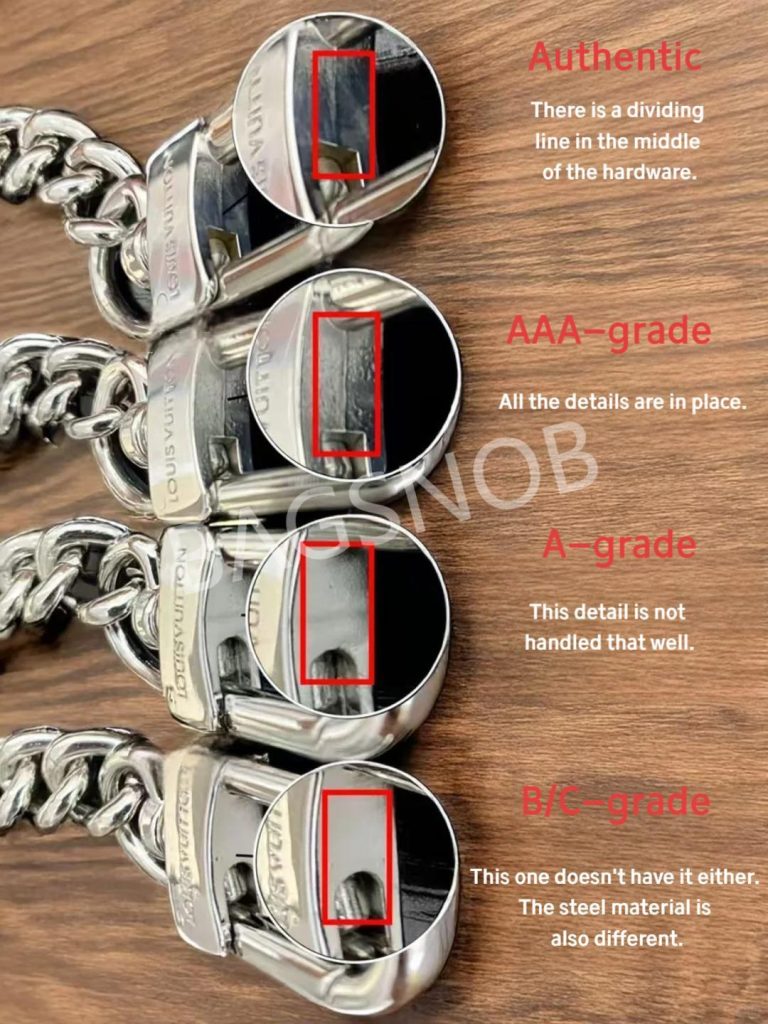
3. Hardware and internal-detail geometry. Compare shape, placement, finish and alignment, then request a function clip for moving parts.
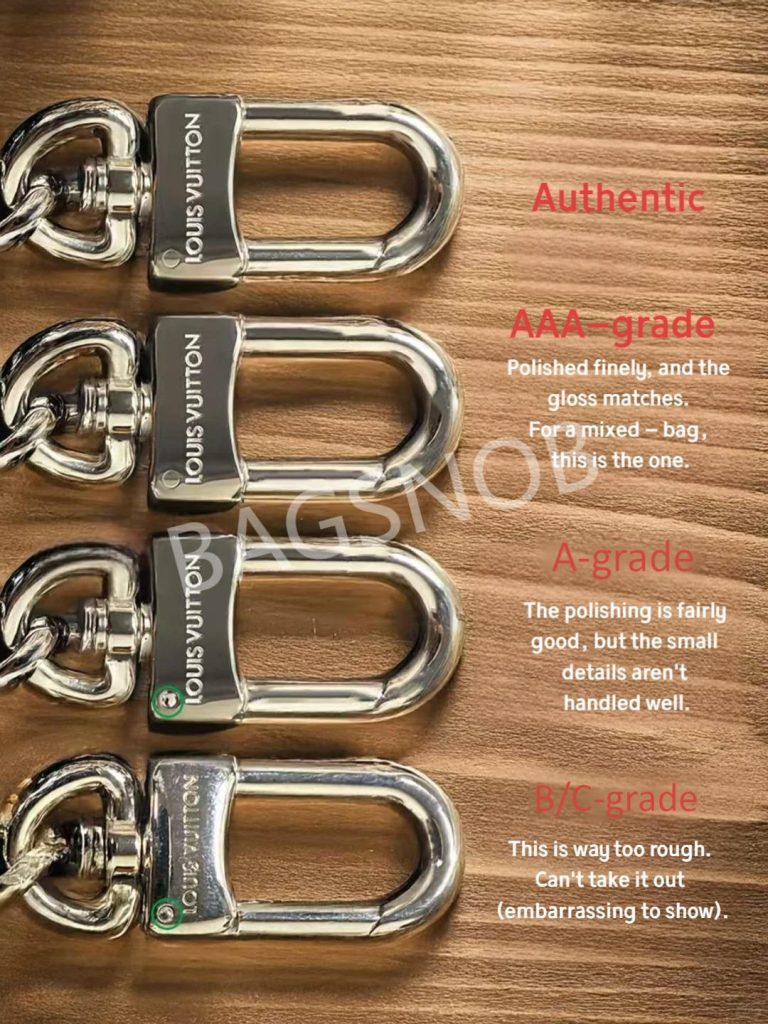
4. Buckle polish and edge detail. Note reflectivity, edge shape, engraving appearance, and alignment while allowing for different angles and light sources.
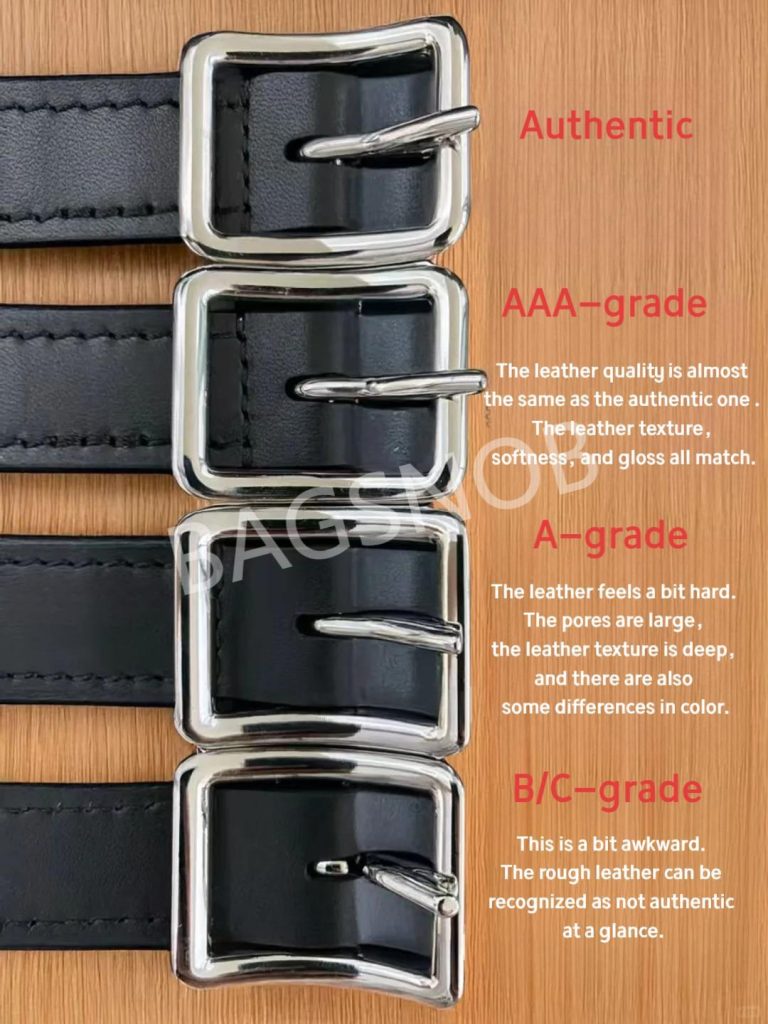
5. Belt buckle and adjacent surface. Separate visible buckle alignment and surface appearance from claims about leather provenance, plating, or future wear.
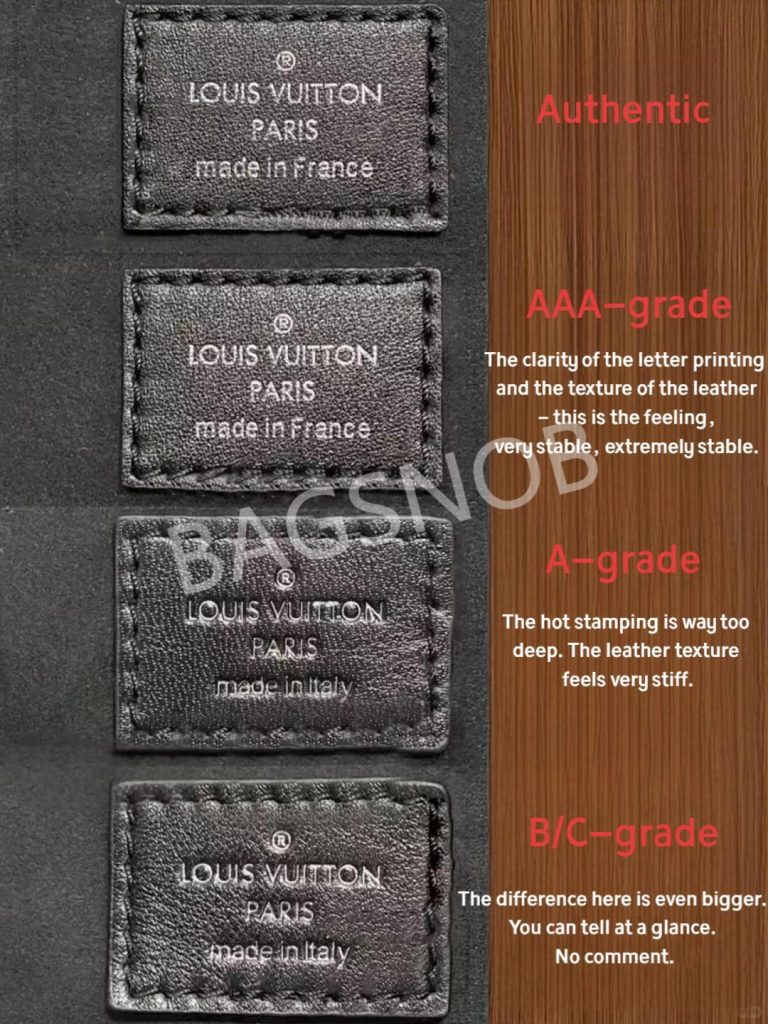
6. Label typography and hot-stamp appearance. Compare character shape, spacing, position, apparent impression depth and nearby edge work.
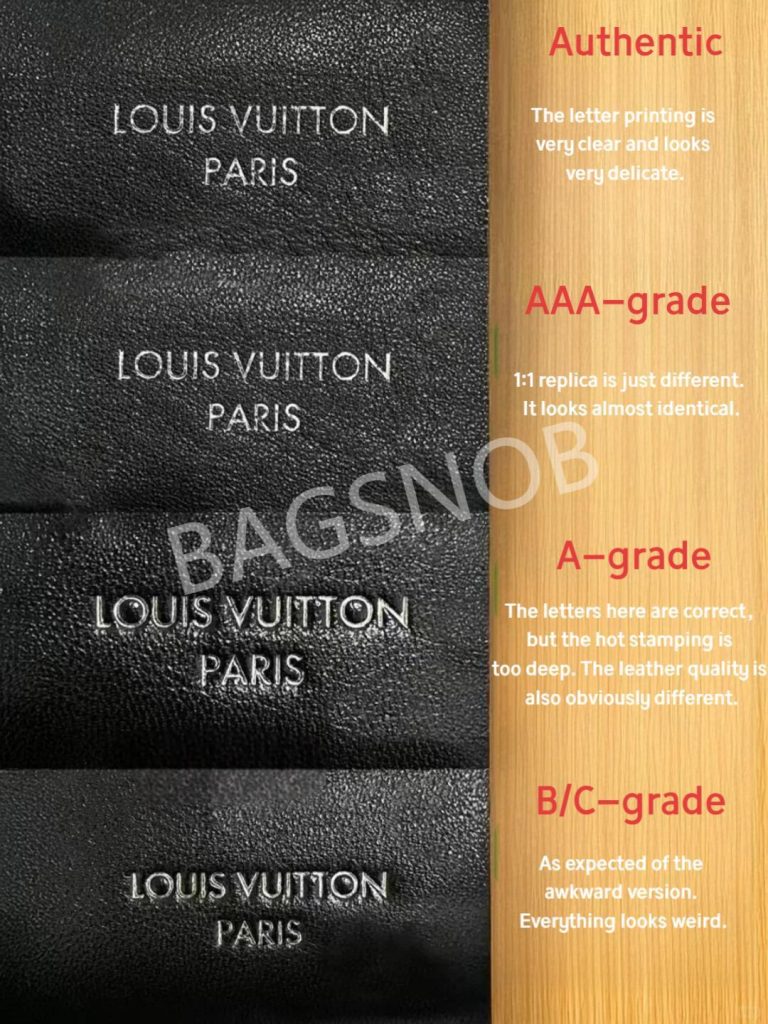
7. Imprinted text and surrounding finish. Finish the sequence by comparing typography, impression consistency, and the construction around the stamp. This is a close-detail check, not a verdict on the complete bag.
What the seven photos can and cannot decide
I use this photo sequence to narrow the questions for a particular bag: alignment, stitch rhythm, edges, typography, proportions and hardware. Material origin and manufacturing claims belong in the supplier’s documentation; current-unit PSPs show which visible details need another look.
Want help choosing between AAA, Top Tier, and Ultimate Tier? Send Cyan the model, size, color, budget, preferred tier, and one clear reference image. Ask which visible differences justify the quote and which PSP angles will be supplied before shipping. Start through the trusted sourcing page.
Legal, Shipping, and Customs Risk
Buying, importing, selling, and advertising counterfeit goods are not the same legal question, and the answer depends on jurisdiction and facts. This is practical context, not legal advice.
In the United States, CBP says goods bearing counterfeit marks may be detained or seized. Its personal-use exemption is narrow: it applies to one article of a type that accompanies a traveler, is for personal use rather than sale, and satisfies the timing rule. It should not be read as an exemption for a mailed replica purchase. CBP’s counterfeit-goods guidance also explains the broader risks of counterfeit trade.
My own experience is why I never describe a familiar route, small parcel, plain packaging, or “personal use” as a guarantee. I once had a shipment containing two replica Chanel bags seized by CBP. The notice said the items would be destroyed for trademark infringement.
That seizure changed my behavior. I avoid large combined orders, do not request fake receipts or false declarations, and ask for shipping and packaging terms before payment. A seller can explain the workflow and communicate through a delay; the seller cannot make an inadmissible shipment lawful or guarantee clearance.
Packaging, triangle shipping, and delays
Three practical distinctions matter:
- Packaging is a choice, not insurance. Cyan may recommend reducing or adjusting branded packaging during stricter periods. At other times it may still be available. Either way, the packaging choice does not determine the customs outcome.
- Triangle shipping changes the route, not the law. It may alter route exposure, but it adds time, handling, and another possible tracking gap.
- Third-country transit needs clear communication. Cyan has used it when conditions changed. I ask who monitors the handoff, what happens if tracking stalls, and how a loss or seizure is handled under the seller’s stated terms.
I once waited nearly five weeks for a bag. The seller explained the delay, kept communicating, and the delivered quality made the wait acceptable to me. The lesson was not that five weeks is normal for everyone; it was that a delivery estimate is only as useful as the communication and remedy behind it.
Where You Buy Changes the Decision
A platform, social account, physical stall, or daigou title is only the front door. I care more about whether I can review the exact bag, compare a clear quote, understand the payment and shipping terms, request corrections, and reach the same seller after delivery.
Local sellers and physical markets
I have visited local replica markets and hidden showrooms in New York out of curiosity. The advantage is obvious: you can handle the bag before paying and may be able to discuss an exchange locally. In the places I visited, prices were often higher and quality varied widely. A physical location did not prove the source, tier, or stability of the seller.
I have also heard reliable partner accounts of sellers connected to physical stalls in Guangzhou, including Baiyun-area operations. I no longer present a stall number or market address as a blanket sign of reliability. A real shop can support continuity, but the current identity, exact item, terms, and follow-through still need to be checked.
Cross-border platforms
Cross-border marketplaces can offer broad selection, visible reviews, and buyer photos. In my own searches, listing photos and delivered quality have not always matched, and public platform presence has not proved factory or material claims. Reviews are most useful when they show the same model, recent delivery, and specific details rather than repeating generic praise.
I would not say these platforms are the primary source for all American buyers. They are one accessible channel, with trade-offs in listing stability, image reliability, shipping time, and correction options.
Social media and private sellers
My better outcomes have usually come from a private relationship that became more reviewable over time. Instagram, TikTok, WhatsApp, and private catalogs can make it easier to discuss model, size, color, tier, and budget, but the platform itself does not create trust. Scams, recycled photos, ghosting, and unclear refund terms remain real risks.
Cyan’s catalogs and WhatsApp workflow are useful because they support a repeatable conversation: request, comparable quote, item-specific PSP photos, questions, approval, packaging, and logistics. The value is the decision trail, not a promise that a private contact is automatically safe.
Daigou and secondhand channels
Some daigou sellers are legitimate purchasing agents. In owner and partner conversations, I have also seen cases where high-end replicas were presented as authentic with branded packaging or receipts. I therefore treat “daigou,” “personal shopper,” and “overseas source” as descriptions of a role, not proof of authenticity.
Secondhand platforms can receive counterfeit listings despite their rules and authentication programs. Review the current policy and keep independent evidence for a high-value purchase. eBay’s counterfeit policy and Poshmark’s counterfeit-items policy prohibit counterfeit listings. A replica should never be listed as authentic, and those policies do not provide a resale path for it.
Replica vs. Authentic
A strong replica can look convincing at normal social distance. That does not make it authentic, and it does not mean every close comparison will end the same way.
What photos reveal first
In side-by-side reviews, I start with the complete silhouette before zooming into logos. Common comparison points include:
- logo and hot-stamp font, spacing, position, and impression depth;
- zipper teeth, closure alignment, and hardware geometry;
- panel proportions, pocket placement, corners, and attachment points;
- interior stamp clarity, lining construction, and seam placement; and
- packaging print, dust-bag stitching, and accessory consistency.
I have brought strong replicas into boutiques and compared them beside authentic bags. In those visits, casual attention did not always identify the replica. That is an owner experience, not a claim that store staff can never tell or that every bag will pass close review.
Leather, touch, weight, and hardware
Touch is useful for evaluating quality, but it is not a standalone authentication method. When I handle a bag, I notice flexibility, grain consistency, surface coating, temperature, odor, panel support, lining, and how the material changes around a fold or seam. Those observations can tell me whether the bag feels appropriate for its design and quoted tier. They cannot, by themselves, prove authenticity, calfskin, lambskin, tannery, or country of origin.
The range within the replica market is wide. Some entry bags use PU or heavily coated split material. Some stronger batches use good calfskin, lambskin, cowhide, coated canvas, suede, or model-specific alternatives. I do not assume every AAA bag uses one leather, and I do not assume every Top Tier or Ultimate Tier bag uses the same premium calfskin. The correct material depends on the authentic model, the quoted version, and the current batch.
My own long-term handling across tiers has shown real variation. I have felt lower-priced bags that were surprisingly pleasant and premium-labeled bags that felt too coated or arrived with an adhesive smell. I have also handled two bags from the same tier whose edge finish and hardware action were noticeably different. That is why touch supports a quality decision only when combined with construction, reference comparison, item-specific photos, and transparent sourcing claims.
A sharp chemical smell is a warning sign I take seriously because I have seen it accompany rushed finishing. Recent production, treatments and closed packaging can also affect the first impression. I record odor as a condition issue to investigate.
For hardware, I compare tone, geometry, engraving, alignment, closure action and zipper movement. I would rather see the pieces work together cleanly than rely on a claim that they feel heavy.
I once owned an authentic Chanel Classic Flap and a Top Tier replica at the same time. In daily handling, they felt very close to me. I still found differences when I slowed down and compared model-specific details. The useful conclusion is not a percentage of sameness; it is that whole-bag balance matters more than one dramatic “tell.”
Craftsmanship and provenance are separate claims
Stitch rhythm, corner turns, edge paint, lining and panel construction shape my workmanship judgment. If a premium depends on Haas, Weinheimer, “original leather” or “full hand-stitch,” I ask for dated documentation tied to that specific claim and bag.
For deeper methods, use the Designer Bag Authentication Guide, Luxury Bag Craftsmanship Guide, and real-vs.-fake leather guide. Those pages own the detailed authentication and material topics; this guide keeps them in the buying framework.
The Dior Saddle story that changed my perspective
I once bought a replica Dior Saddle bag from a friend who sourced from Guangzhou. I paid about $300 and wore it to a fashion-forward event in New York. Two guests complimented it, and one asked whether I bought it at Bloomingdale’s.
They saw a beautiful bag, not a grading label. That experience helped me understand why design, proportion, and confidence matter in daily use. It did not make the bag authentic, and I would never represent it as authentic.
Are Replica Bags Worth It?
For me, the answer depends on purpose, expectations, budget, and tolerance for risk.
A replica may make sense when you want to explore a new silhouette, add wardrobe variety, test a size before considering an authentic purchase, or carry a design without treating it as an investment. My own replica purchases helped me learn which shapes I actually used and which authentic bags were worth saving for.
It is usually a poor fit when you need brand warranty, official repair service, authentic resale value, guaranteed delivery, or the emotional certainty of owning the original. It is also the wrong choice if you plan to pass the item off or resell it as authentic.
The decision becomes clearer when you ask four questions:
- Will I use this model enough to justify the price?
- Does the quoted tier improve the details I care about on this specific bag?
- Can I accept batch variation, shipping delay, customs risk, and limited remedies?
- Would an authentic pre-owned bag, an unbranded alternative, or waiting be a better use of my budget?
Replica bags are not investment assets. They can deliver design enjoyment and practical use, but they do not come with the brand’s provenance, warranty, or lawful authentic resale market.
How I Evaluate a Seller
I treat “trusted replica bag seller” as an earned conclusion, not a search-result label. The bag matters, but the repeatable system around it often tells me more about whether I will buy again.
With Cyan, I begin with one compact sourcing brief: model, size, color, budget, preferred tier, reference image, and the details I care about most. This creates a quote I can compare and tells the team which PSP angles need to be clear.
Signals I look for
- a consistent seller identity and sales history over time;
- current catalog information separated from item-specific photos;
- precise answers about model, size, color, tier, batch, and included service;
- a stated correction, replacement, refund, and shipping process;
- willingness to show a missing angle or discuss a visible flaw; and
- communication that remains useful after payment and during delays.
Signals that make me pause
- pressure to pay before the exact item, quote, and terms are clear;
- generic or recycled photos presented as the bag that will ship;
- absolute claims such as “identical,” “uncalloutable,” or “customs guaranteed”;
- a price that conflicts with the promised materials and service;
- changing identities, payment names, or explanations; and
- defensive responses to normal model-specific questions.
Payment method does not replace seller evaluation. An irreversible transfer increases practical risk, while a familiar payment logo does not guarantee protection for a prohibited transaction. PayPal’s current Acceptable Use Policy restricts transactions involving goods that infringe trademark or other proprietary rights. I review the provider’s current rules, never misdescribe a transaction, and do not promise buyer protection for replica purchases.
My PSP and QC Workflow
PSP means pre-shipment photos. Sellers and buyers also use QC, or quality control, for the review. I use “PSP/QC review” when I mean the decision process, but the photos themselves do not authenticate a replica. They help determine whether the exact item matches the quote and whether visible issues should be corrected before shipping.
My sequence is:
- Confirm the item: model, size, color, configuration, tier, batch if known, and a current item identifier.
- Review the whole shape: front, back, sides, base, panel balance, intended slouch, and handle or strap placement.
- Inspect stress points: corners, folds, attachments, glazing, seams, and places where hardware meets material.
- Compare hardware: geometry, tone, engraving, alignment, closure, zipper, chain, and protective-film areas.
- Check branding and interior: hot stamp, typography, lining, pockets, labels, seams, and visible cleanliness.
- Resolve the premium claim: if the price depends on handwork, a named leather, upgraded hardware, or special packaging, ask how that claim is supported for this item.
- Record the decision: keep the quote, photos, disclosed flaws, correction agreement, packaging choice, shipping terms, and approval together.
I approve the bag, not the catalog story. A missing angle is not automatically a failed bag, but it is an unanswered question. I ask Cyan’s team for the view that resolves it before shipping. This is where a stable relationship helps: the conversation stays focused on a correctable decision rather than becoming an argument after delivery.
When the bag arrives, I compare it with the approved photos and inspect stitching, edges, corners, zippers, clasps, chain, hardware tone, engraving, lining, pockets, odor, and discoloration. If something differs materially, I refer to the agreed terms promptly.
FAQs
What does AAA mean for replica bags?
AAA is an informal seller and market term, not an official grade. At ReinaLuxe, AAA Tier means my premium everyday baseline, with expectations for material suitability, construction, finishing, hardware, item-specific PSP coverage, and service. The exact bag still has to earn the label.
Is AAA better than 1:1 or mirror quality?
There is no universal ranking. Different sellers use AAA, 1:1, mirror quality, superfake, 5A, 10A, authentic-grade, and similar labels in different ways. Compare the exact model, batch, materials, finishing, photos, correction terms, and total service instead of the name.
How do ReinaLuxe’s AAA, Top Tier, and Ultimate Tier differ?
AAA is the premium everyday baseline. Top Tier is the strongest factory-production level I source for closer material and construction expectations. Ultimate Tier is a limited higher-touch category where special construction or provenance claims need narrower documentation. None is an authenticity guarantee.
Can touch tell whether a replica bag is authentic?
No. Touch can reveal useful quality clues such as flexibility, coating, support, odor, lining, and hardware action. It cannot prove authenticity or leather origin by itself. Combine handling with construction, reliable references, provenance, and a professional authentication workflow when authenticity is the question.
Can a replica bag pass authentication?
A strong replica may pass casual visual attention. Professional authentication is a different process and may still identify inconsistencies. Seller photos, NFC responses, serials, and PSP/QC checks do not convert a replica into an authentic item.
Is it legal to buy a replica bag in the United States?
The facts and conduct matter. CBP may detain or seize counterfeit imports, and the narrow personal-use exemption applies to qualifying articles that accompany a traveler rather than ordinary mailed purchases. Selling or representing a replica as authentic creates additional legal risk. Consult current official guidance or a qualified lawyer for your situation.
Why can two quotes for the same replica bag be far apart?
The difference may include bag selection, QC, correction handling, communication, packaging, logistics, and after-sales service. It may also be pure markup. Record the model, configuration, tier, date, included service, and shipping so you can compare like for like.
What should I send when asking for a quote?
Send the model, size, color, budget, preferred tier, a clear reference image, destination country, and the details you care about most. Ask whether item-specific PSP photos are included and what can be corrected before shipping.
My Final Decision Rule
Years of buying, comparing, and sourcing bags taught me that a satisfying purchase rarely comes from the loudest grade name. It comes from matching the model to the right tier, separating observable quality from unsupported claims, reviewing the exact item, and accepting the risks that remain.
My Chanel Classic Flap introduction made me curious. The Dior Saddle event showed me how people respond to design in real life. In-store comparisons taught me that casual visual attention and authentication are not the same. The two-bag customs seizure and five-week delay made me more careful about logistics. Long-term handling across tiers taught me to expect batch variation. Cyan’s catalog, PSP/QC, packaging, third-country transit, and WhatsApp workflow gave me a repeatable way to turn that experience into decisions.
For model-specific next steps, continue with the Hermès replica guide, Best Chanel Replica Bags guide, or Louis Vuitton craftsmanship and replica guide. Those pages should add brand and model evidence rather than repeat this entire general framework.
Ready to review one specific bag? Use the trusted sourcing page to send Cyan your model, size, color, budget, preferred tier, and reference image. Ask for an item-specific PSP/QC plan and clear shipping terms before you decide. No concierge can guarantee authenticity, customs clearance, delivery, or a defect-free outcome.
44 comments
Great read! The article gave me confidence to start exploring replica handbag stores online. It’s nice that you also mention the customs and payment risks — not many guides do that.
Thanks, Jess! We want every reader to shop smartly and safely for 1:1 replica handbags. We’ll soon launch a trusted-seller list with verified user feedback.
This guide is super informative — I didn’t realize how much detail goes into a good replica purse. The section about leather types and craftsmanship was really helpful for me as a first-time buyer.
Thanks, Mia! We believe understanding materials is key when buying AAA replica purses. We’ll keep expanding the leather comparison part to help readers identify quality better.
I just finished reading this AAA replica bags guide and it’s honestly one of the most detailed ones I’ve seen. The breakdown between replica handbags and authentic designer purses really helped me understand what to look for.
Thank you, Emily! We’re happy you found the guide useful. Our next update will include a new section comparing 1:1 replica purses from different brands — stay tuned!
Finally a realistic article about luxury replica handbags! I like that you explained the difference between AAA replica quality and cheaper grades. Most sites just try to sell. This one actually teaches people what to check.
Appreciate your comment, Kevin. Our goal is to make replica bag shopping more transparent and safe. We’ll soon add examples showing how AAA replica handbags differ in stitching and hardware.
Love the clear layout of this guide. It feels honest and educational, not pushy. The way you explain AAA replica bags versus authentic purses makes so much sense.
Thank you, Laura! We always aim to share balanced, fact-based information about luxury replica purses and handbags. More visual comparisons are coming soon!
This article explains AAA replica handbags so clearly! I’ve been looking for reliable places to get a replica purse that actually looks authentic. Do you have any seller recommendations?
Thanks Emily! I’m glad you found it helpful 😊 I’ll soon be publishing a list of trusted AAA replica bag sellers — stay tuned and check back for updates!
Can you direct me to the site for your follow up with this AAA recommendation article?
Do you think AAA replica handbags are really worth it compared to mid-tier ones? I’m curious if the extra price makes a big difference.
Hi Rachel — definitely a smart question. For most buyers, AAA replicas deliver a visibly better look and feel. I’ll share a value comparison chart soon 📊
I noticed you mentioned craftsmanship. Does the leather on AAA replica bags age like authentic Hermès or Chanel ones?
Good eye, Isabella 👀 — some AAA replicas use top-grain leather that patinas over time, though not as richly as genuine Hermès. I’ll explore this in an upcoming post!
I’m really curious about the “Ultimate Tier” you mentioned. Are these the ones that are entirely hand-stitched, like Hermès Kellys and Birkins?
Ultimate Tier is a market label, not proof that a piece is entirely handmade. For a Kelly or Birkin, ask which seams are described as hand-stitched and what supports that description, then inspect the seam work on the actual bag.
hello
With Chanel raising their prices twice a year, I just can’t justify retail anymore. “Smart luxury” is exactly how I feel about it now. The prices are completely detached from the craftsmanship.
It has gotten completely out of hand, right? When you realize you can get 95%+ accuracy and real European leather for a fraction of the cost, going the high-tier alternative route just makes the most financial sense.
Is the Top Tier really worth the price jump over the AAA tier? I mostly just want a cute crossbody for running errands and grabbing coffee.
For errands and coffee, I would compare the strap comfort, opening and finish of the actual crossbody first. Pay more only when the current photos or a function check show a difference you care about; the tier name itself would not decide it for me.
I always wondered what “10A” or “God-Tier” meant! So many sellers on Instagram throw those words around. I’m so glad to finally know it’s mostly just marketing fluff.
Exactly, Sarah! It’s so easy to get caught up in those flashy buzzwords. Focusing on the actual physical details—like whether the leather is imported calfskin and if the hardware is full-steel—is the only real way to know what you’re paying for.
Wow, I had no idea replicas were using active NFC chips now in 2026! That’s insane that it pops up on your phone just like the authentic boutique bags.
It really shows how far the top Baiyun factories have come! While it doesn’t give you access to the brand’s private internal database, the fact that they can mimic that interactive boutique experience is wild.
I bought a bag off DHgate last year and it smelled like pure chemicals. The stitching was so crooked too. Definitely learned my lesson the hard way!
That sounds disappointing. Odor and crooked stitching are useful condition concerns to raise, but the smell does not establish PU or leather origin. For another purchase, compare the actual unit and its written material description.
The hardware is always what gives a fake away for me. Cheap bags have zippers that get stuck constantly and feel hollow.
Spot on! That’s why true Top Tier bags use dense, full-steel hardware instead of cheap electroplated alloys. Not only does it glide perfectly, but it also has that correct, heavy weight and gloss to it.
Do you think the distressed leather Balenciaga replicas are actually accurate this year? I feel like that specific slouchy texture is so hard to get right.
That slouch is exactly the detail I would focus on. Ask for the same bag empty, lightly filled and moving on the shoulder, then compare the folds and surface sheen with the right reference. A still front view leaves too much out.
After getting burned by a few viral sellers on Reddit who promised ‘1:1 perfection’ but delivered plastic-y leather, finding this guide feels like a relief. Could you clarify if the 2026 Q2 batches for the French Classic series are using the upgraded gold-plated hardware you mentioned here? I’m looking for a daily carry that completely avoids the typical ‘callout’ flaws.
I would ask for the written plating specification and current macro photos for that exact configuration. The article does not document a micron-thickness measurement for those Q2 bags, so I would leave that claim with the supplier and judge the visible finish separately.
The breakdown on saddle stitching vs machine stitching is incredibly spot-on. Most people only look at the logo, but the edge paint and thread tension are where 99% of alternatives fail. I recently received a B30 in Epsom from a private sourcing route inspired by your blog, and the hand-aligned alignment is flawless. Worth every penny of the premium.
Thank you for the amazing feedback, Eva! You clearly have a sharp eye for heritage craftsmanship. Epsom leather and genuine hand-stitching require a level of artisan patience that standard warehouses simply cannot replicate. Enjoy your beautiful piece!
Will a Top Tier bag fool a Sales Associate? I’m always so nervous walking into a designer boutique wearing my reps.
I cannot predict what a sales associate will notice. Top Tier does not mean undetectable, and casual resemblance is separate from authentication. I would decide on the bag’s own construction and your comfort with wearing it.
I appreciate the honesty about how no replica is 100% identical. Other sellers promise the moon and it always felt suspicious to me.
I agree that absolute matching claims deserve caution. I would not replace them with a 90–99% score without a defined measurement method. Compare the actual shape, materials, finish and function instead.
An absolute masterclass of a guide. I’ve been hesitating for months because of the overwhelming online scams, but your focus on technical material specs rather than cheap marketing terms is refreshing. Just sent a message to the concierge WhatsApp for a custom lookup request.
Thank you! I’m glad the material and construction breakdown helped. For a custom inquiry, keep the proposed specification and the current-item photos together so you can see exactly what the quote covers. Cyan handles the commercial inquiries linked from the sourcing page.