Finding a trusted replica bag seller is harder than finding a seller with attractive photos.
That distinction took me a while to understand.
When I first started looking seriously at replica bags, I paid far too much attention to labels such as “AAA,” “1:1,” “mirror quality,” and later “superfake.” After seeing more bags in person, comparing QC photos, and speaking with different sources, I stopped treating those words as quality standards.
They are mostly vocabulary.
What matters is whether the seller can consistently show you what bag you are actually getting, where its strengths and weaknesses are, and whether the quality makes sense for the price.
That is what I now look for.
I’m Chloe, and ReinaLuxe is where I document the bags, sellers, materials, factory claims, and small construction details I come across. Cyan is one of the sourcing contacts I have worked with and received QC material from, but this page is less about declaring someone “the best seller” and more about explaining the standards I personally use before trusting a source.
Table of Contents
Explore the Albums I Use for Sourcing References
Readers often ask where some of the styles, factory photos, and QC references featured on ReinaLuxe come from. One of the sources I regularly work with is Cyan, who maintains two separate albums covering different types of bags and production levels.
I treat these albums primarily as browsing and sourcing references. They are useful for checking available models, colors, materials, and current versions before looking more closely at the individual bag.
📖 Sourcing Reference: The Luxury Collection — Start Here
It includes a large selection of styles across major luxury houses, so it is useful when you already have a particular model, color, size, or season in mind—or when you simply want to see what versions are currently circulating.
One important point: I would not judge the final quality of a bag from catalog photos alone.
The album includes pieces from different production sources, and the terminology used in the replica market—such as AAA, Top Tier, Mirror Quality, or Superfake—is not standardized. I therefore use the album to identify a style first, then look at the specific version, materials, construction, and QC photos separately.
In my own discussions with Cyan, the bags I am most interested in are generally the better-made versions rather than entry-level replicas. On ReinaLuxe, I usually describe these loosely as Top Tier when the materials, hardware, shape, and construction are noticeably above ordinary AAA-level production.
That does not mean every bag in a catalog is automatically “the best version.” Different factories and batches can perform very differently depending on the model, which is why I still prefer to evaluate each bag individually.
For certain Louis Vuitton and Chanel models, there may also be more specialized versions with additional attention to leather, hardware, construction, or finishing. I sometimes refer to these as Ultimate Tier or mastercrafted versions, but availability depends heavily on the specific model rather than the brand as a whole.
If you are comparing one of these bags, my advice is simple: use the album to find the model you like, then compare the actual version rather than choosing purely from the quality label.
What Does “Trusted Replica Bag Seller” Actually Mean?
I use the word trusted quite narrowly.
It does not mean every bag will be perfect.
It does not mean every factory batch is identical.
And it definitely does not mean that phrases such as “10A,” “original quality,” or “99% identical” should automatically be believed.
For me, a seller becomes useful when several things happen consistently:
- the actual quality is reasonably close to what was described;
- QC photos are provided for the individual item;
- obvious flaws are not deliberately hidden;
- different quality levels are explained instead of being marketed as the same thing;
- the seller is willing to say when a particular batch or model is not especially good;
- expectations are realistic.
This sounds simple, but it eliminates a surprisingly large part of the market.
One of the biggest problems with replica shopping is not necessarily poor quality. It is information asymmetry.
The seller knows more about the bag than the buyer does.
A reliable source reduces that gap.
Why I No Longer Take “AAA,” “10A,” or “Mirror Quality” Literally
Replica grading has never been standardized.
One seller’s “AAA” can be another seller’s mid-tier bag. A “10A” label does not mean there are ten measurable levels of production quality. “Mirror quality” can describe a genuinely impressive bag or simply be attached to an ordinary factory photo.
That is why I treat these labels as shorthand rather than specifications.
On ReinaLuxe, I still use terms such as AAA replica bags, Top Tier, and occasionally superfake, because they are widely used by buyers and are useful when discussing the market.
But I judge the actual bag separately.
For a more detailed explanation of the construction differences I look for, see my AAA Replica Bags Guide.
My practical quality hierarchy
I find it more useful to think about bags in three broad groups.
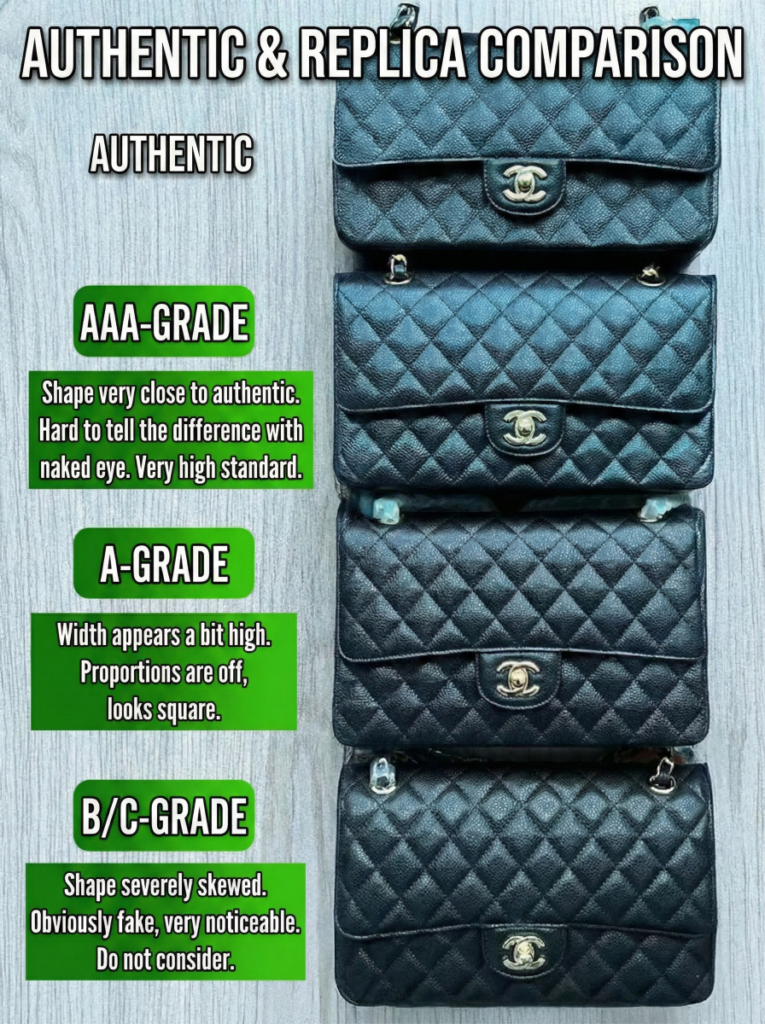
Everyday / AAA-level replicas
These can reproduce the overall silhouette, color and recognizable design surprisingly well. They are often perfectly usable as everyday bags, but closer inspection may reveal differences in leather, hardware finishing, edge paint, interior construction or proportions.
High-end / Top Tier replicas
This is where I expect better leather selection, cleaner structure, more accurate hardware and greater consistency in the details.
The improvement is not always obvious from a front-facing photograph. Sometimes it becomes much clearer when handling the bag, looking at the side profile, opening the flap or comparing hardware.
Handcrafted or highly specialized versions
Certain Hermès-style pieces and a small number of other models are produced with much more manual work.
These are the bags where stitching, edge finishing, leather selection and structure become much more important than a generic “1:1” label.
Even here, I avoid assigning arbitrary figures such as “99% accurate.” There are too many variables between models, batches and individual pieces for a percentage like that to mean very much.
The First Thing I Check: Does the Seller Show the Actual Bag?
Factory photos are useful for discovering a model.
They are not enough for approving a purchase.
The most useful step in the entire process is seeing the actual item before shipment.
Depending on the community, these photos may be called QC photos, PSPs or pre-shipment photos.
I normally want to see several angles:
- front shape;
- rear shape;
- side profile;
- bottom;
- hardware;
- interior;
- logo or stamp areas;
- stitching around important construction points.
For bags with strong pattern alignment or quilting—Chanel Classic Flaps are an obvious example—I also look at whether the pattern continues naturally across pockets and panels.
For Hermès styles, I tend to pay more attention to structure, handles, sangles, stitching rhythm, edge finishing and the relationship between the hardware and surrounding leather.
This is far more useful than asking a seller:
“Is this the best quality?”
Almost every seller will say yes.
The photos give you something you can actually evaluate.
What I Look for in QC Photos
I don’t try to turn QC into microscopic authentication.
That usually creates more confusion than clarity.
Instead, I start with the details that affect how the entire bag looks.
1. Overall shape
This is one of the easiest things to underestimate.
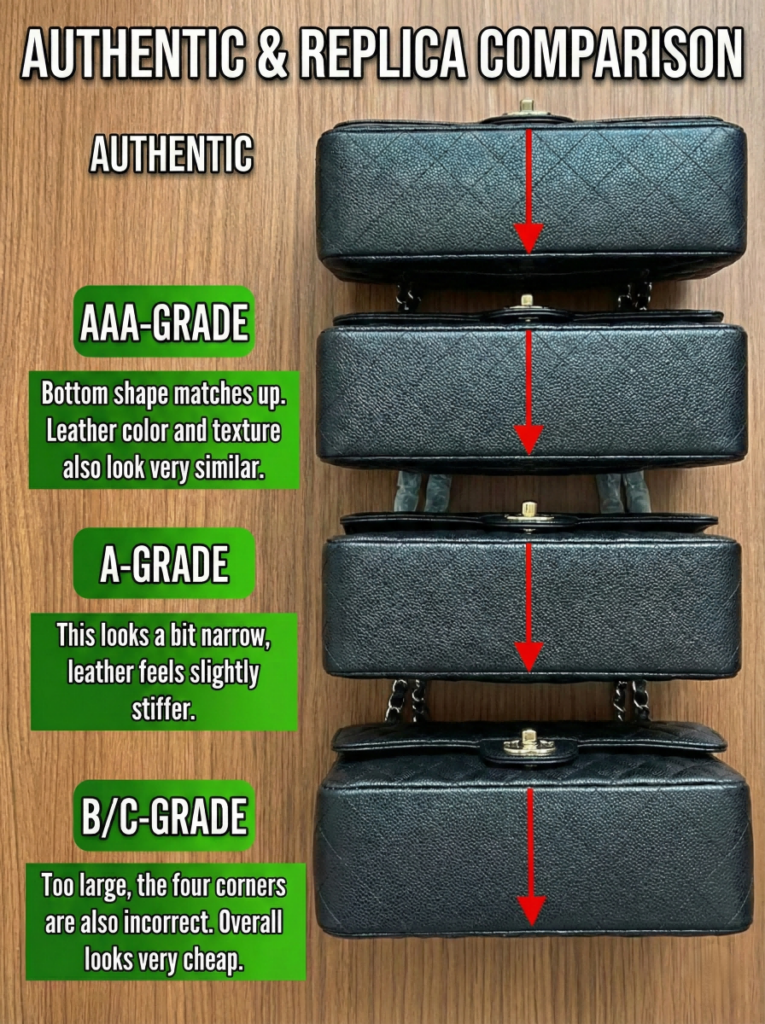
A bag can have impressive leather and still look wrong because the body is too tall, too flat, too wide at the bottom or too rigid through the sides.
Shape is often what I notice first when comparing several replicas of the same model.
2. Leather character
I look at more than whether the leather is technically “genuine leather.”
Grain scale, sheen, softness, thickness and how the leather folds can all change the appearance of a bag.
This is particularly noticeable with Chanel caviar and lambskin, Hermès-style Togo and Epsom, and some smooth calfskin bags.
Seller claims about “original leather” or specific European tanneries should also be treated as claims unless there is meaningful evidence behind them.
The leather itself matters more to me than the marketing story attached to it.
3. Hardware
Hardware differences can be surprisingly visible.
I normally look at:
- plating tone;
- engraving depth;
- edge finishing;
- thickness;
- proportions;
- how the hardware sits against the leather.
Weight can also affect the feel of the bag, although it is difficult to judge from photographs alone.
4. Stitching and construction
I care much more about consistency than perfection.
Handmade luxury bags are not mathematically identical either.
What worries me more is stitching that changes dramatically across the same structural area, poorly finished corners, loose threads or construction that visibly distorts the leather.
5. Small details that affect the whole impression
Sometimes a relatively small issue becomes visually important because it sits in a focal area.
Examples include:
- Chanel quilting alignment;
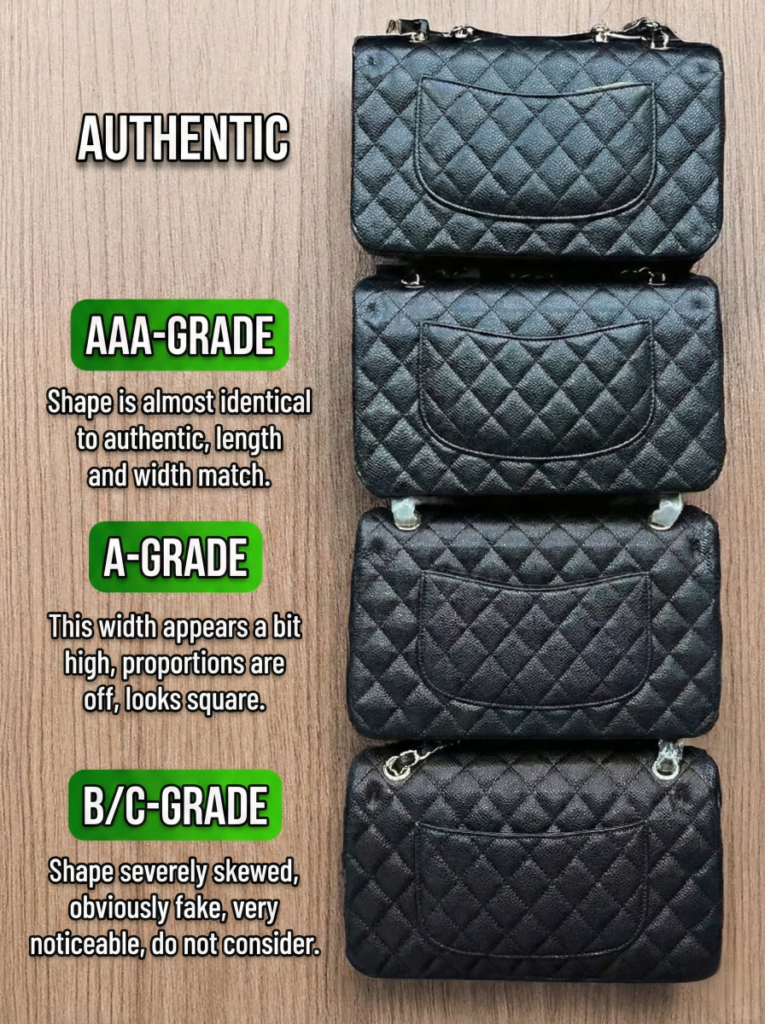
- the curve of a rear pocket;
- flap proportions;
- Hermès handle shape;
- incorrect hardware placement;
- uneven edge paint;
- a logo positioned noticeably too high or low.
These are the details worth discussing before getting lost in tiny differences that no one would normally see.
A Chanel Classic Flap Example
The Chanel Classic Flap is useful for explaining why I prefer visual comparison over seller terminology.
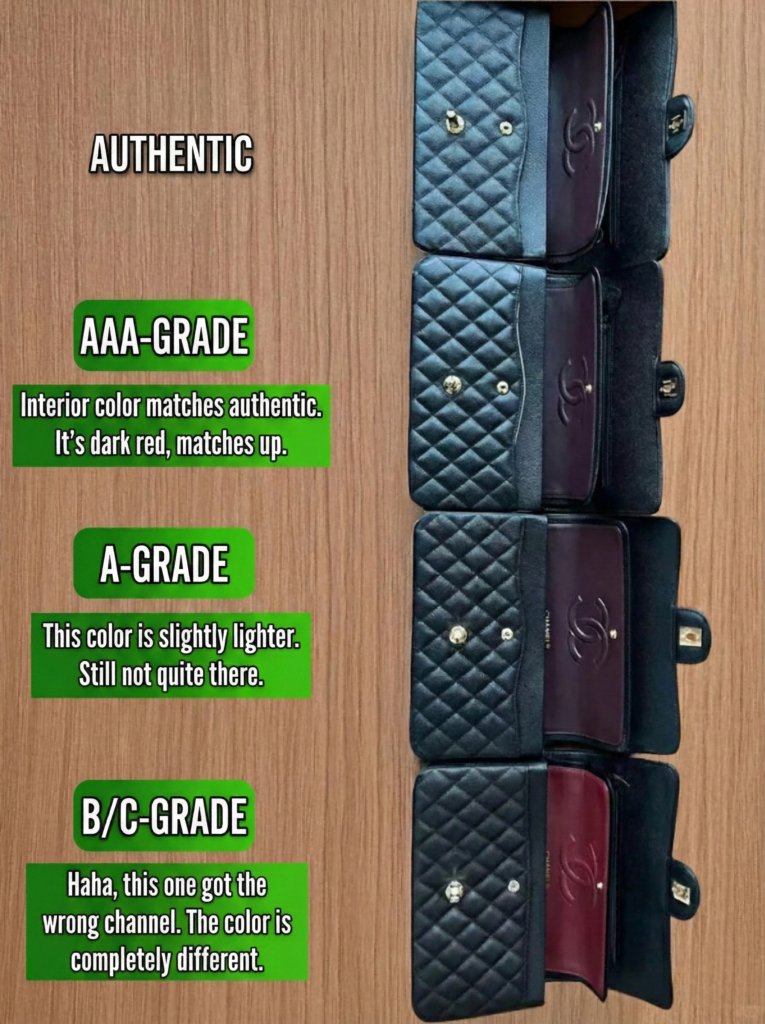
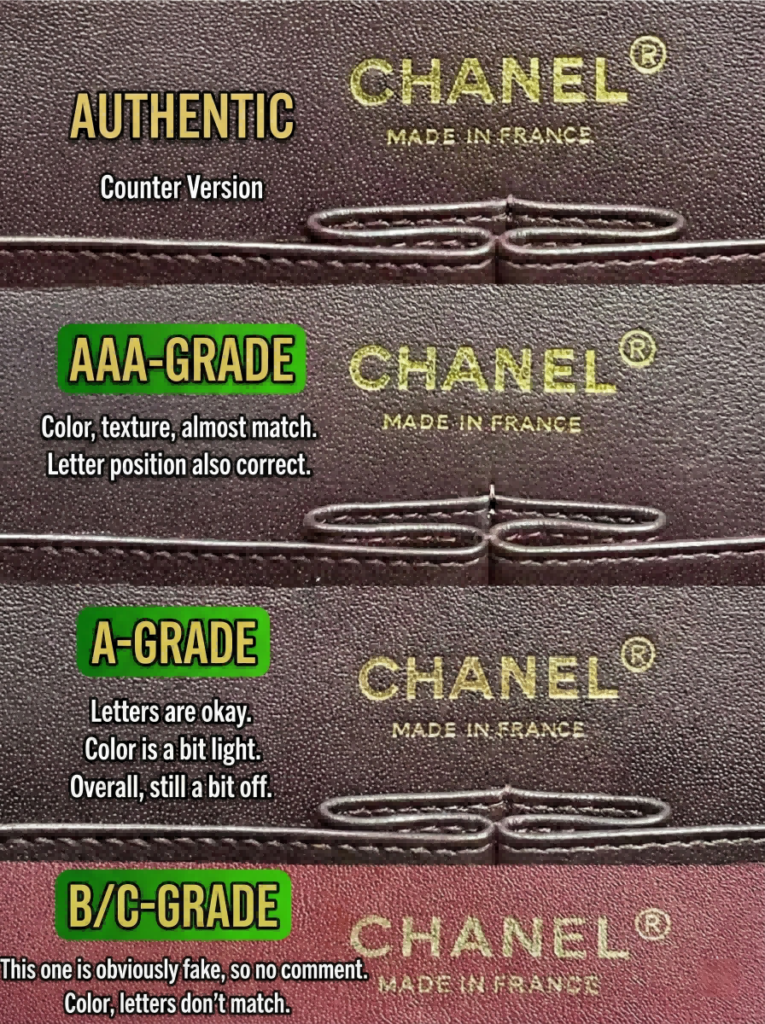
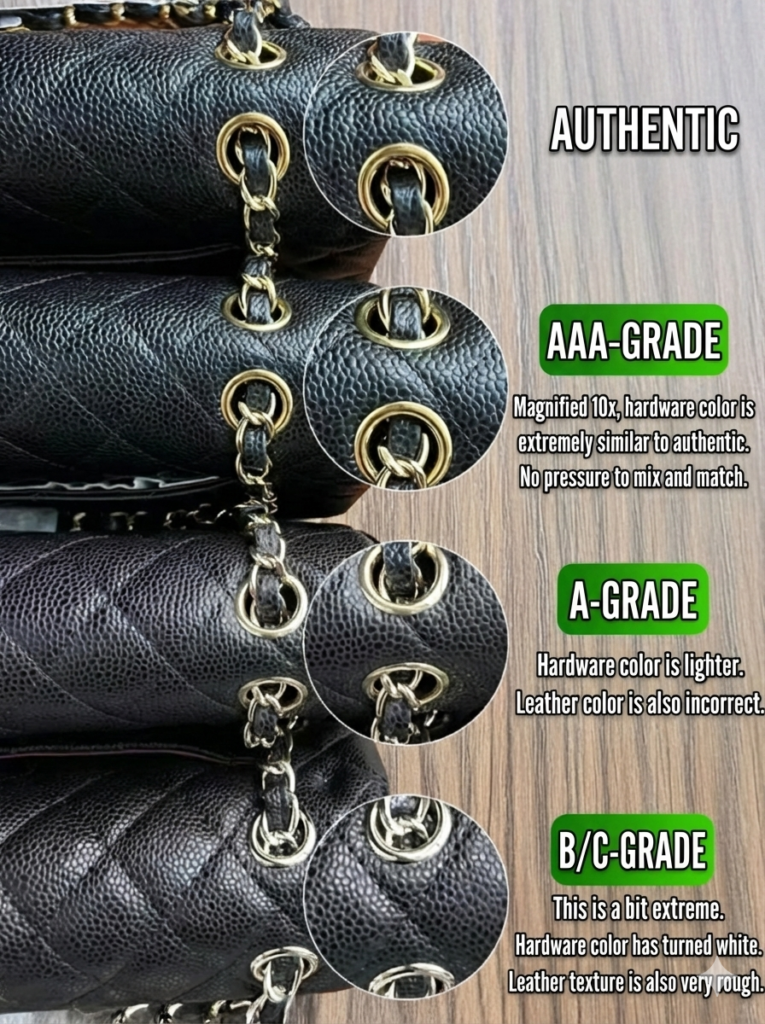
I previously compared examples across several quality levels, looking at the front profile, burgundy interior, caviar texture, quilting, rear pocket shape and hardware.
What I find interesting is that quality is rarely linear.
One version may have excellent leather but slightly weaker hardware.
Another may have cleaner quilting but a less convincing interior color.
A more expensive version can improve several of those things at once, but that still does not mean every individual bag will be perfect.
That is why I prefer examining the specific piece rather than relying only on a factory name or quality label.
If Chanel is what you are researching, my more detailed breakdown is here:
Best Chanel Replica Bags: Models, Materials & Quality Guide
Why Factory Names Can Help — but Only to a Point
Replica communities often discuss factory names as if they were brands.
They can be useful.
If a source has repeatedly produced good versions of a certain model, the factory name gives buyers a reference point.
But I would not use it as the only buying criterion.
A factory can be excellent at one Chanel model and less convincing at another.
Production also changes over time.
Leather batches change. Hardware changes. Patterns are updated. Sometimes a highly praised older batch becomes difficult to find.
And occasionally the same factory name is used very loosely by different sellers.
So my hierarchy is:
specific bag > current batch > QC photos > seller history > factory reputation > marketing tier
Not the other way around.
Where Cyan Fits Into My Own Sourcing
Readers sometimes ask who provides the bags or QC photos that appear in my reviews.
One of my regular contacts is Cyan.
I use Cyan mainly because I can discuss the specific version of a bag rather than simply receiving a generic answer such as “best quality.”
Sometimes the answer is that a more expensive version is worthwhile.
Sometimes it isn’t.
That distinction matters to me.
For example, I would rather be told that the available version of a particular seasonal bag is only moderately accurate than be told that every bag is “1:1.”
That is also why I occasionally reference Cyan’s albums when readers ask where a specific QC sample originated.
They are useful as a reference catalog, but I would still evaluate the individual bag rather than assuming every photograph represents exactly what will arrive.
For readers researching Hermès construction specifically, I explain my standards in much more detail in my Hermès Replica Bags Guide.
What Makes Me Distrust a Replica Seller?
There are a few patterns that make me cautious very quickly.
Every bag is described as the highest grade
Different factories exist precisely because there are different quality and price levels.
If everything is supposedly “the best,” the grading system tells you nothing.
Only polished factory photographs are shown
Beautiful catalogue photos are useful for browsing.
They are not proof of the individual item.
The seller avoids detailed questions
A knowledgeable seller does not need to know every microscopic authentication detail, but they should understand the practical differences between the versions they are offering.
Factory names change whenever convenient
Factory names are already difficult to verify.
If the explanation changes constantly, I stop treating the name as meaningful information.
Unrealistic claims
Statements such as:
- “100% identical”
- “same as boutique”
- “no one can ever tell”
- “exactly the same materials”
should be treated cautiously.
Even excellent replica bags can have differences.
A seller willing to admit that usually inspires more confidence in me than someone promising perfection.
Expensive Does Not Automatically Mean Better
One thing I have learned from comparing bags is that the relationship between price and quality becomes weaker at the upper end.
Going from a very cheap replica to a well-made version can produce a dramatic improvement.
Going from a good high-end version to the most expensive handcrafted version may produce much smaller improvements.
Those improvements can still matter—especially in leather, stitching, hardware and construction—but whether they are worth paying for depends heavily on the model and the buyer.
That is why I rarely recommend choosing a tier before choosing the bag.
Choose the model first.
Then compare the versions that actually exist for that model.
How I Would Evaluate a Seller Today
If I were starting again, I would make the process much simpler.
I would first find the exact model I wanted.
Then I would ask what versions are currently available and request recent photographs rather than relying entirely on old catalogue pictures.
I would compare the major structural details first.
Only after that would I worry about smaller details.
And before shipment, I would want to see the actual item.
That process tells me far more than whether the seller uses the words AAA, superfake, mirror quality, or authentic grade.
A Note About “Superfake” Bags
“Superfake” has become one of the most popular words in this part of the luxury market.
I use it occasionally because readers search for it and because it broadly describes replicas that attempt to reproduce much more than the basic exterior shape.
But there is no official definition.
A seller cannot prove quality simply by calling something a superfake.
To me, the term is only useful when the bag also demonstrates:
- convincing materials;
- accurate proportions;
- good construction;
- appropriate hardware;
- consistent finishing;
- strong QC.
Without those things, “superfake” is just another label.
My Bottom Line
A trusted replica bag seller is not someone who promises that every bag is indistinguishable from authentic.
I actually prefer the opposite.
I want someone who can explain where a bag is good, where it is average, and whether a more expensive version genuinely improves the areas I care about.
That is the standard I use when reviewing bags on ReinaLuxe.
Cyan remains one of the sourcing contacts behind some of the QC photos and pieces I discuss here, but I still evaluate individual bags rather than treating any seller, factory or quality tier as automatically perfect.
If you are comparing a specific model, the detailed brand guides and individual reviews on ReinaLuxe will usually be more useful than starting with a seller label.
And if you want to ask about the source behind one of the bags or QC sets shown on the site, you can find Cyan under the sourcing/contact section of ReinaLuxe.
The recommendation is intentionally simple:
Look at the bag first. Look at the evidence second. Treat the marketing words last.
Meet Cyan
Found a style you love in Cyan’s album? Skip the middleman and work directly with my verified, trusted partner. Simply send a photo or the style number to Cyan for inquiries. She is always there to help you find the perfect match!
- Contact Person: Cyan
- WhatsApp: [Click here to Chat]
- WeChat (微信): 8613396884387
- Email: [email protected]
What does “trusted replica bag seller” mean?
There is no official certification. I use the term for sellers who are reasonably consistent about describing quality, providing QC photos of individual items and addressing visible issues before shipment.
Is AAA the highest replica quality?
Not necessarily. AAA is an informal market term rather than a standardized grade. Different sellers can use the same label for very different products, which is why I prefer evaluating materials, construction and QC photos directly.
Are superfake bags identical to authentic bags?
I would not describe them that way. Some high-end replicas can reproduce the appearance, materials and construction of certain designer bags extremely closely, but differences can still exist between factories, batches and individual pieces.
Should I choose a replica based on the factory name?
Factory reputation can be useful background information, but I would still prioritize the specific model, current batch and QC photos. A factory that performs well on one bag does not automatically produce the best version of every model.
What should I check before accepting a bag?
I normally start with overall shape, proportions, leather appearance, hardware, major stitching areas and any model-specific details. The exact QC checklist changes depending on the bag.
Can a high-end replica bag really provide the exact same texture and feel as an authentic designer bag?
Not something I would claim universally. Some well-made replicas can reproduce the visual character, grain, softness or structure of a particular leather very closely, but material origin and tannery claims are difficult to verify independently. I therefore judge the individual bag rather than treating “same leather” as a proven fact.
I want to buy the perfect alternative to a high-end designer bag, but I’m afraid of getting scammed. What is the safest purchasing standard?
My safest standard is to ignore the tier label first and verify the individual bag. I look for recent photos, clear communication about the version being offered, detailed QC or PSP images of the actual piece, realistic descriptions of strengths and weaknesses, and a seller who is willing to acknowledge variation between batches.
