
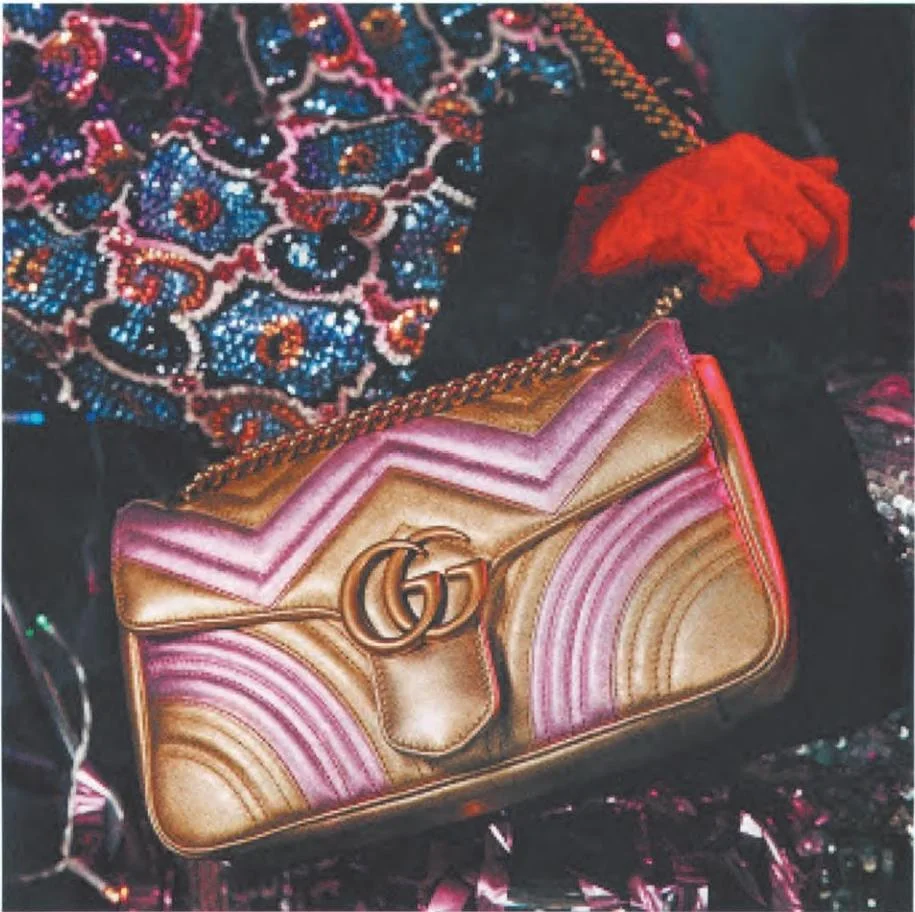
Gucci hardware authentication is often reduced to a few rigid claims: an engraving must look exactly one way, gold hardware must have one particular tone, or a zipper marked YKK, Lampo or riri proves that a bag is genuine. Those shortcuts fail because hardware is a system. A maker mark is only one feature on one component; finish changes across products and colorways; use alters exposed surfaces; and a repaired bag may contain a legitimate replacement part that was not installed when the item was first made.
I use five layers instead: model context, component construction, finish and wear, engraving, then supplier and repair context. The layers are read together and against the exact model, version and approximate period. This approach makes small irregularities easier to classify. It also prevents a familiar zipper name from overruling a bag whose shape, assembly or other evidence is wrong.
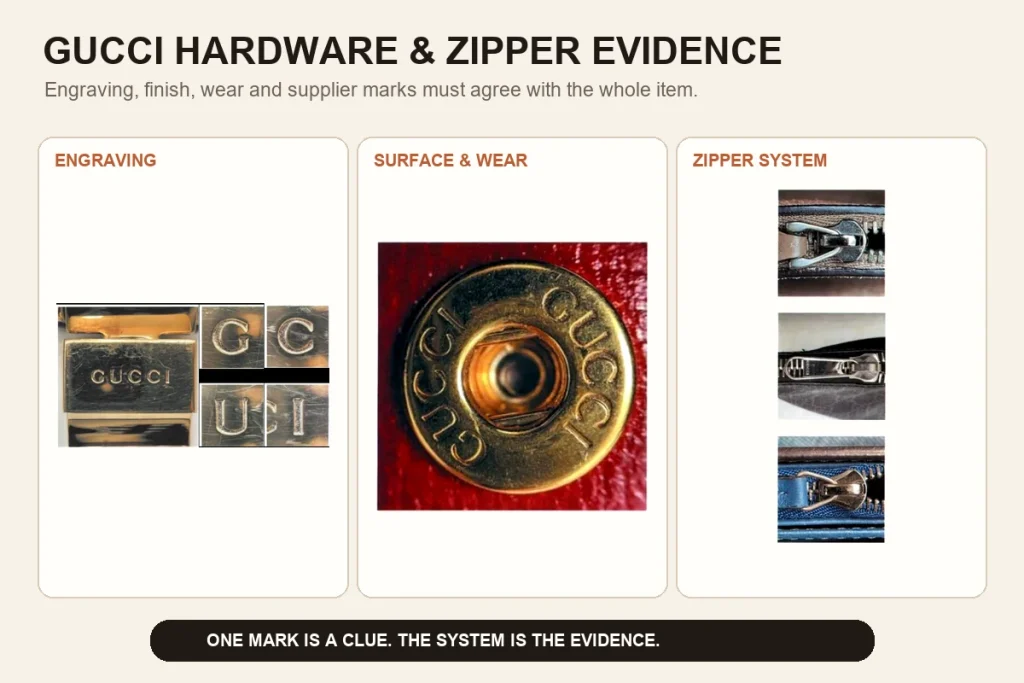
Table of Contents
Quick Answer: Can Hardware Prove a Gucci Bag Is Authentic?
No single hardware feature can prove authenticity. Strong hardware evidence is relational: the part is correct for the model, its dimensions and mounting make sense, the finish suits the documented variation, wear follows believable contact zones, and the engraving belongs to the same manufacturing logic. Zipper supplier names such as YKK, Lampo and riri can support a matched comparison, but none is an automatic pass or fail.
The Five-Layer Gucci Hardware Evidence Ladder
| Layer | What to inspect | Useful conclusion | Unsafe shortcut |
|---|---|---|---|
| 1. Model context | Hardware type, placement, function, finish and documented colorway | The correct comparison family | Comparing every Gucci bag with one universal reference |
| 2. Construction | Part geometry, thickness, mounting, hinge, fastener, slider and pull relationship | Whether the component operates and assembles as expected | Judging only the visible logo face |
| 3. Finish and wear | Tone, reflectivity, coating continuity and contact pattern | Whether surface change is compatible with use and the model variation | Calling every scratch fake or every bright surface genuine |
| 4. Engraving | Groove floor, sidewalls, letter family, spacing, placement and wear through the mark | Whether the lettering was produced coherently on that component | Tracing one letter from an unrelated part |
| 5. Supplier and repair context | Maker mark, complete zipper system, approximate period and replacement history | How much evidential weight the part deserves | “YKK/Lampo/riri means real” or “replacement means fake” |
Begin with model identification. A Horsebit detail, piston closure, interlocking-G fastener and ordinary zip pull belong to different functional families, even when all are gold-toned. If the exact version is not stable yet, use the Gucci bag models guide first. Hardware becomes meaningful only after you know which object it is supposed to serve.
Layer 1: Match the Hardware to the Exact Gucci Version
Official Gucci product descriptions illustrate why “Gucci hardware color” is not a universal rule. The current Horsebit Web small camera bag is described with gold-toned hardware, while the current Brera medium crossbody is described with palladium-toned hardware. Even the Lady Lunetta small shoulder bag appears in officially documented variations with gold-toned and palladium-toned hardware.
Those official descriptions establish a boundary, not a laboratory specification. “Gold-toned” does not publicly tell us the base alloy, plating thickness or exact color value. “Palladium-toned” identifies the intended appearance but does not authorize a universal material test. The safe comparison is exact: same model, same material, same hardware variation and, where possible, the same period.
Before reading a stamped name, I ask four context questions:
- Function: Is this part a closure, strap attachment, foot, stud, zipper slider or decorative element?
- Configuration: Does the model use this number of parts in these positions?
- Variation: Does the observed finish agree with a documented color and material combination?
- Period: Is the reference close enough in date that a production update is unlikely to be mistaken for a defect?
A hardware feature that conflicts with the identified version is a stronger concern than a tiny local engraving difference. Conversely, a correct-looking finish should not rescue a part whose geometry or mounting is wrong.
Layer 2: Read the Component Before the Logo
The visible logo face attracts attention, but the physical structure usually carries more information. A closure has thickness, edges, a hinge or spring, a receiving part and a defined movement. A strap attachment has a ring profile, joint, fastener and load direction. A zipper contains tape, elements or coil, a slider, a pull and stops. These pieces must fit together mechanically.
On large components, compare the overall silhouette, corner transitions, edge definition and the position of moving parts. Check whether opposing halves align and whether the mechanism closes without a visibly improvised offset. On a zipper, compare the slider body with the pull, the pull attachment, the element size, the tape width and the way the ends are finished. A plausible maker stamp cannot correct an incompatible assembly.
Manufacturing does not make every genuine part visually perfect. Casting, machining, polishing and assembly can leave small production traces. The question is whether those traces are consistent with the process and repeated quality of the component—not whether a magnified surface is completely featureless.
Layer 3: Interpret Finish and Wear Without Overcalling
Finish must be judged as both a design choice and a changing surface. New hardware can be polished, intentionally aged, bright or muted according to the product. Used hardware accumulates contact. A zipper pull rubs against fingers and nearby metal; a closure face meets nails and surrounding material; feet contact tables; rings rotate under strap load. Those different jobs create different wear maps.
The reference examples make one useful pattern visible: fine scratches can cross both an open metal field and the engraved letters. That continuity matters. It suggests that the surface has been handled as one object. It does not prove authenticity, but it is more coherent than an engraving that appears freshly cut through an otherwise uniformly worn face—or an artificially distressed mark whose wear ignores every adjacent contact zone.
| Observation | Potentially normal explanation | When it becomes a stronger concern |
|---|---|---|
| Fine directional scratches | Handling and contact on exposed faces | Pattern is implausibly uniform, isolated to the logo, or conflicts with the rest of the part |
| Edge brightening or finish loss | Repeated friction on corners, pull loops and ring contact points | Heavy loss occurs in protected recesses while exposed contact zones remain untouched |
| Mixed apparent tones | Lighting, reflection, oxidation, dirt or uneven wear | A controlled comparison confirms the finish conflicts with the exact product variation |
| Peeling, bubbling or flaking | Age, chemical exposure, storage or a later refinishing treatment | It accompanies wrong geometry, crude preparation or a model-incompatible coating |
| Very clean surface on an older bag | Light use, careful storage or replaced hardware | The condition story and surrounding materials show incompatible wear |
Absence of scratches is not proof of counterfeit, and visible wear is not proof of authenticity. The useful question is whether surface change follows function, contact and the rest of the item’s condition. Photography can also alter metal dramatically: warm light makes neutral metal look gold, sharp reflections create false dark lines, and digital sharpening makes tiny pits appear harsher. Treat tone from uncontrolled images as provisional.
Layer 4: How to Read Large Gucci Hardware Engraving
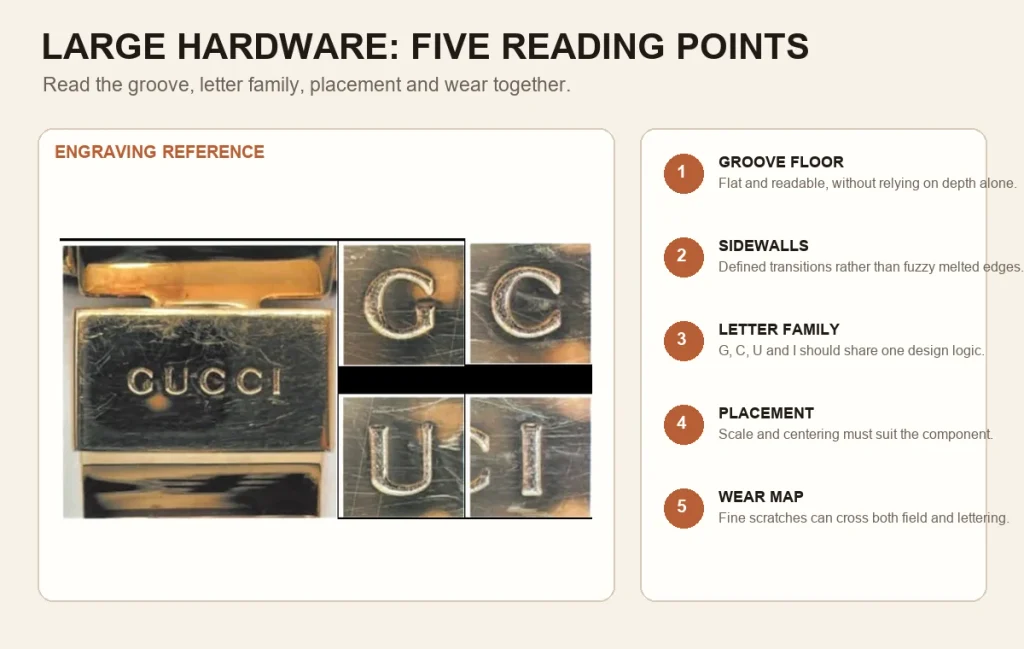
Large plaques and closure faces allow the engraving process to be read more clearly than miniature studs. In the reference images, the useful checkpoints are the groove floor, groove sidewalls, letter family, placement and wear map. These points work together; depth alone is a poor test because angle, reflection and dark residue change how deep a cut appears.
Groove floor and sidewalls
A useful reference groove has a readable floor and defined transitions into the surrounding face. The sidewalls should look like deliberate boundaries rather than a fuzzy, melted or repeatedly wavering edge. Small tool marks and accumulated residue can exist, particularly on used hardware. A stronger concern appears when several letters show the same uncontrolled waviness, lumpy floor or droplet-like terminal and that pattern conflicts with a matched reference.
Letter family and spacing
Read GUCCI as a family. The two Cs should relate to one another; G and C should share compatible circular logic; U and I should not look borrowed from a different type style. Compare height, stroke behavior and spacing across the whole word. One damaged terminal carries little weight. Repeated deformation in the same direction across several letters carries more.
Placement and scale
The mark should occupy the component in a deliberate way. Centering, baseline and margins must suit the available metal face. That does not mean every production batch is positioned to fractions of a millimeter. It means the scale and location should be coherent with the part, not visibly crowded, drifting or unrelated to a model-matched example.
Wear through the engraving
Look at how scratches, polish and finish loss travel across the mark. Wear that continues naturally over field and letter can support the object’s condition story. Dark residue inside protected grooves can also be expected on a used piece. Be cautious when an engraved recess is uniformly bright and untouched while every exposed surface is aged, unless cleaning or replacement provides a reasonable explanation.
Small Gucci Hardware Requires a Different Standard
Miniature studs, snaps and zipper pulls compress detail. At that scale, a shallow terminal, rounded corner or uneven highlight can be an imaging artifact or a normal result of stamping on a curved surface. It is unreasonable to demand that a tiny circular snap reproduce the crispness of a large flat plaque.
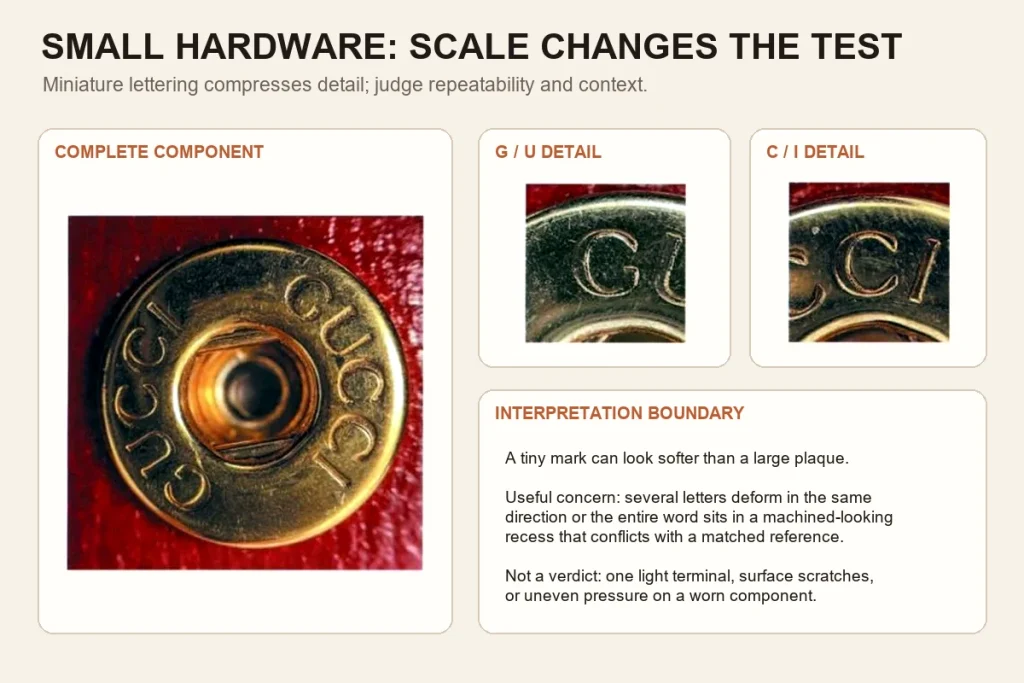
For small lettering, prioritize three things:
- Repeatability across the word. Do multiple letters share the same stroke behavior, depth and alignment?
- Relationship to the base part. Is the mark centered around the snap or pull geometry, and does it follow the curved surface naturally?
- Agreement with a matched reference. Does the component type and lettering method occur on the same model family and period?
A laser-like, overly pale mark or a whole word sitting in a machined-looking recessed channel can be a useful concern when it conflicts with the expected reference. It is not a universal counterfeit signature. Gucci has used many component types, and surface finish, scale and production method change the appearance of lettering. Describe the observable conflict before interpreting it.
Layer 5: Gucci Zipper Authentication Is a System Check
A zipper supplier name is not the zipper. YKK’s official component description separates the zipper into tape, elements, slider and pull tab, with the slider itself having distinct body and pull parts. Lampo’s official catalog spans multiple chain and construction families, including metal, die-cast and coil products. riri likewise publishes different chain, slider and decorative configurations. The practical implication is simple: a maker name cannot specify one universal tooth shape, pull profile or finish.
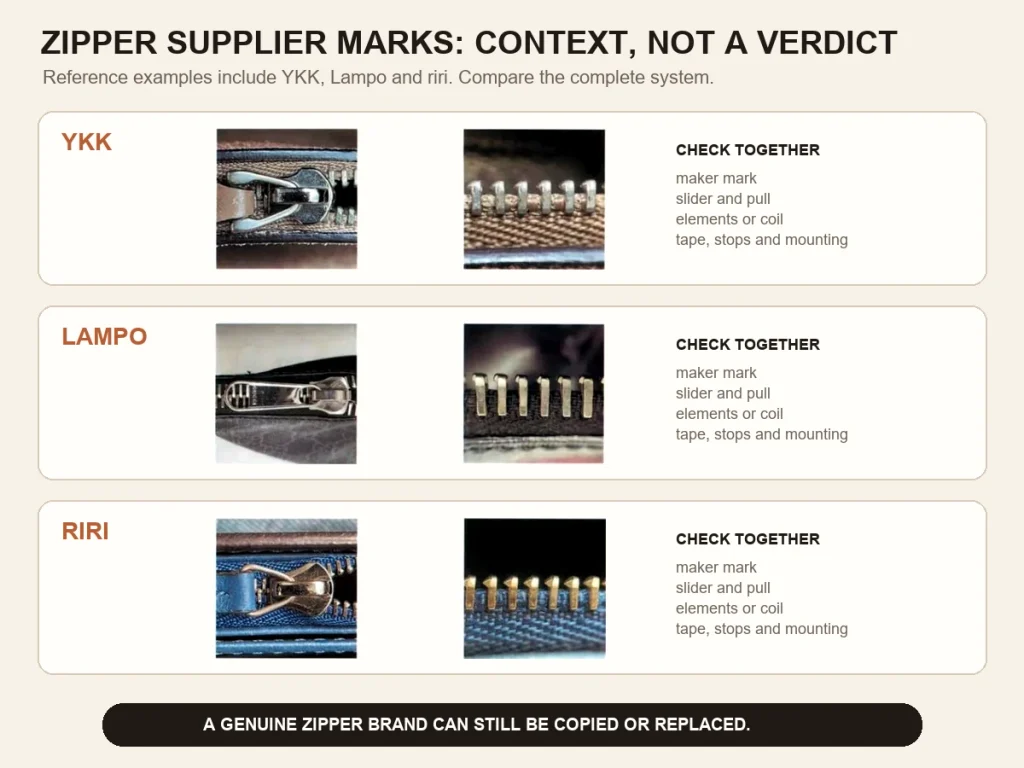
When a maker mark is visible, read the zipper in this sequence:
- Maker mark: Is the spelling, orientation and placement coherent on this slider or pull?
- Slider and pull: Do their size, attachment and finish belong together, or does one appear transplanted?
- Elements or coil: Are the teeth or coil compatible with the slider and the zipper’s intended load?
- Tape and stops: Do width, color, terminal construction and mounting make sense for the opening?
- Integration: Does the zipper sit correctly in the bag, follow the expected path and operate without a structural mismatch?
This sequence blocks two common errors. First, counterfeiters can reproduce familiar supplier names, so a genuine zipper brand does not make the complete bag genuine. Second, an authentic Gucci item may use a supplier or configuration outside the small set shown here. The three examples are evidence that those marks occur in the reviewed material, not a closed whitelist.
YKK
YKK is a large zipper manufacturer with many component families. A YKK mark can therefore be plausible without establishing which exact zipper specification was used. Check the slider, pull, elements, tape, stops and installation against the model. A copied YKK stamp on an incompatible slider remains incompatible.
Lampo
Lampo’s official product information shows multiple metal, die-cast and coil zipper families rather than one fixed “Lampo shape.” On a Gucci item, the name is best treated as supplier context. It becomes useful when the complete construction agrees with a documented comparable example.
riri
riri also produces varied chain and slider solutions, including decorative configurations. The lowercase riri mark may help identify a component family, but lettering alone cannot date the bag, prove factory installation or authenticate the surrounding object.
Repair and Replacement Parts Change the Meaning of Hardware
Replacement history is not hypothetical. Gucci’s official FAQ says repair requests begin with an assessment of the item, and Gucci’s Japanese product-care information states that components including zippers, snap buttons, handles, decorative parts and lining may be replaced with genuine parts sourced from Italy. A genuine replacement part can therefore be Gucci-supplied and authentic as a service component while still being different from the production-original zipper.
That distinction matters in three ways:
- Authenticity of the bag: A documented repair does not make an otherwise genuine bag counterfeit.
- Originality: A replacement may affect collector value or the accuracy of an “all original” description.
- Dating: The appearance or supplier mark on a replacement should not be used to date the entire bag.
Undocumented third-party repair is more difficult. A non-original zipper can be installed in a genuine bag, and a component from a recognized supplier can be used in that repair. Record the mismatch, check the surrounding stitch and mounting evidence, and separate the part question from the bag-level decision.
How Much Weight Should Each Finding Carry?
| Finding | Evidence strength | Why | Next action |
|---|---|---|---|
| Wrong hardware type or finish for a documented exact version | High concern | Model-level conflict affects the complete configuration | Recheck model and colorway; investigate replacement history |
| Several engraving features conflict with a matched component | Moderate to high concern | Repeated process mismatch is stronger than one damaged letter | Compare another known example and the rest of the assembly |
| One soft terminal on tiny curved hardware | Low | Scale, reflection, wear and stamping pressure can alter it | Read the complete word and component |
| YKK, Lampo or riri mark | Supporting only | The name can be copied and does not define the whole zipper | Compare slider, pull, chain, tape, stops and model context |
| Service-consistent replacement | Contextual | May explain a genuine but non-original component | Separate authenticity, originality and value conclusions |
| Wear follows believable contact zones | Supporting only | Coherent use pattern is helpful but can be imitated | Test it against condition elsewhere on the item |
The highest-value hardware finding is usually a repeated, model-specific conflict. The lowest-value finding is usually an isolated visual quirk with no controlled comparison. Good authentication keeps those weights separate.
A Practical Hardware Decision Sequence
- Name the exact item and version. Establish product family, material, closure and documented finish.
- Map each component’s job. Distinguish functional hardware from decoration and later accessories.
- Read geometry and mounting. Confirm that the part’s structure and assembly suit the model.
- Interpret surface and wear. Compare contact zones with the condition of surrounding material.
- Read engraving as a process. Combine groove, letter family, placement and wear rather than scoring one letter.
- Read the complete zipper. Treat supplier marking as one field within the slider, pull, chain, tape, stops and installation.
- Check for repair context. Separate a replacement part from the identity and authenticity of the whole bag.
- Combine independent evidence. Continue to leather, construction, interior details and provenance before reaching a bag-level conclusion.
This article intentionally owns hardware and zipper interpretation. Logo, leather-tag and numeric-code analysis belongs in the separate Gucci serial numbers and leather tags guide. The wider decision framework remains in the designer bag authentication guide.
Frequently Asked Questions
Does YKK hardware mean a Gucci bag is authentic?
No. YKK is a legitimate zipper manufacturer, but its mark can be copied and its products span many configurations. The slider, pull, elements, tape, stops, installation and exact Gucci model must agree.
Did Gucci use Lampo or riri zippers?
Lampo and riri examples appear in the reference material reviewed for this guide, as does YKK. These names are useful comparison clues, not a complete Gucci supplier list and not authentication results by themselves.
Should Gucci hardware always be heavy?
No universal weight rule is safe. Perceived weight depends on component size, design, base material and construction. Compare the geometry, function and handling with the same component on a model- and period-matched reference.
Is scratched Gucci hardware a sign of a fake?
No. Fine scratches and edge wear can be consistent with ordinary contact. Read where the wear occurs, whether it continues naturally across the surface and engraving, and whether it agrees with the item’s overall condition.
What should Gucci hardware engraving look like?
On a matched reference, assess groove floor and sidewalls, the relationship among all letters, spacing, placement and the way wear crosses the mark. One letter shape or an assumed engraving depth is not a universal pass/fail test.
Can a genuine Gucci bag have a replacement zipper?
Yes. Gucci offers repair assessment, and its product-care information describes replacement of parts including zippers and snap buttons. A genuine service replacement may be non-original to production, so authenticity and originality should be recorded separately.
Does gold versus silver hardware authenticate a Gucci bag?
No. Gucci documents gold-toned and palladium-toned hardware across products and sometimes across variations of one model. Match the finish to the exact item, material, colorway and period rather than applying a brand-wide rule.
Final Rule: The System Must Agree
Reliable Gucci hardware authentication does not hunt for one perfect stamp. It asks whether the component belongs to the exact model, whether its structure works, whether finish and wear follow a believable history, whether engraving behaves as one manufacturing system, and whether a zipper’s maker mark agrees with every surrounding part. A familiar supplier name can support that pattern; it cannot replace it. When the layers agree, hardware becomes strong supporting evidence. When several independent layers conflict, the concern deserves more weight than any single logo.