
1. Introduction
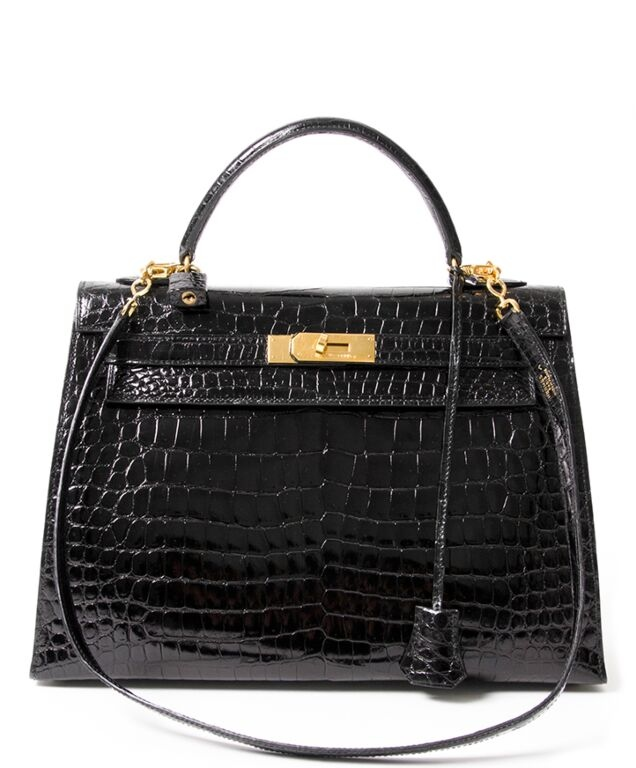
Few luxury handbags carry the same aura, legacy, and cultural weight as the Hermès Kelly Bag. For nearly a century, the Kelly has represented elegance, craftsmanship, and a distinct type of quiet power. Yet beyond its status as a collector’s icon, the Kelly has also become one of the most studied and replicated handbags in the world—particularly in the AAA replica market, where craftsmanship, materials, and accuracy have rapidly evolved.
For American consumers navigating long Hermès waitlists, rising resale prices, and increasingly sophisticated alternatives, the Hermes Kelly bag replica has become a topic of genuine curiosity. Understanding the history, structure, variations, and craftsmanship of the Kelly is not only fascinating—it’s essential for anyone comparing authentic and replica pieces.
For readers interested in these comparisons, you can also explore our Replica vs Authentic Reviews guide on Reinaluxe.co, where we break down side-by-side differences in materials, hardware, and construction.
Whether examining the razor-sharp planar geometry of a Kelly Sellier or the softened grace of a Retourne, the engineering precision required to assemble this trapezoidal silhouette is immense. Mastering these construction markers is indispensable for any collector navigating the secondary luxury market.
Table of Contents
2. The Legendary Origins of the Hermes Kelly Bag
The true architectural origins of the Kelly Bag date back to the 1930s, when Robert Dumas—son-in-law of Émile Hermès and future head of the maison—designed the Sac à Dépêches. Departing from the soft, pouch-like reticules common to early 20th-century women’s fashion, Dumas envisioned a sharp, trapezoidal silhouette featuring a structured top handle, clean side sangles (straps), and a turnlock closure. While Hermès had created the oversized Haut à Courroies (HAC) in 1892 to carry equestrian riding gear, it was Robert Dumas’ 1930s design that created the refined, ladylike proportions of the modern Kelly.

The bag’s global fame arrived unexpectedly in 1956, when Princess Grace Kelly of Monaco was photographed on the cover of LIFE Magazine holding a large crocodile Kelly bag, using it to shield her pregnancy from the press. This moment became one of the most iconic images of the 20th century, instantly linking Grace Kelly’s timeless elegance to the Hermès design.
(External reference: explore the official design history on Hermès: The Kelly Bag.)
The global public immediately began referring to the design as the “Kelly bag.” Recognizing this cultural turning point, Hermès officially adopted the Kelly name for the design from 1956 onward, cementing its place in the permanent collection.
Since then, the Kelly has maintained a mythical status. Its structured, trapezoidal shape, single top handle, and meticulous hand-stitching continue to be celebrated by collectors, stylists, and handbag enthusiasts around the world. Today, its cultural prestige sits second only to the Birkin.
3. Kelly Bag Sizes & Variations Over Time
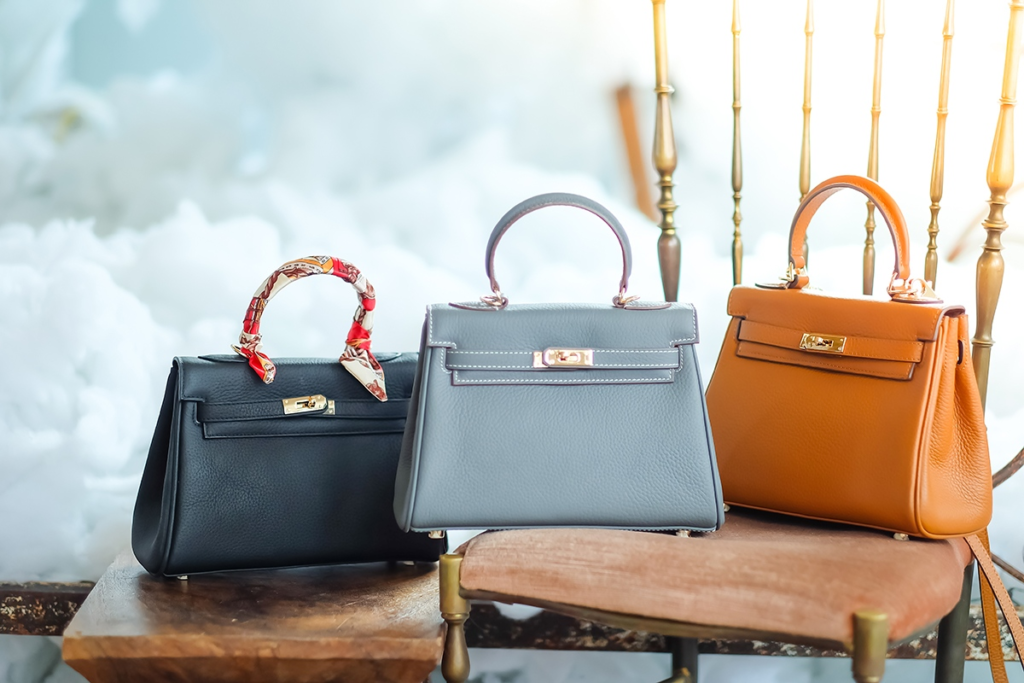
One of the reasons the Kelly Bag remains versatile—and a collector’s dream—is its diverse size range. Over the decades, Hermès has expanded the Kelly lineup to address evolving lifestyle needs, from formal structured bags to mini evening silhouettes.
Primary Kelly Sizes
| Model | Base Dimensions (cm) | Character & Proportions |
| Mini Kelly II (20) | 19 × 12 × 5.5 | Petite modern icon; strictly Sellier; crossbody evening carry |
| Kelly 25 | 25 × 19 × 9 | Leading modern favorite; available in Sellier and Retourne |
| Kelly 28 | 28 × 22 × 10 | Classic day-to-evening proportions; ideal spatial balance |
| Kelly 32 | 32 × 23 × 10.5 | Heritage benchmark size; favored in vintage Box and Clemence |
| Kelly 35 | 35 × 24 × 12 | Generous daytime silhouette; structured workwear carry |
| Kelly 40 | 40 × 28 × 16 | Travel and weekender format; historically popular for men |
Historical Development
1935 — Robert Dumas introduces the Sac à Dépêches pour Dames.
1956 — Princess Grace Kelly of Monaco photographs with the bag on the cover of Life, launching global desire.
Mid-Century Evolution — Introduction of smaller structured formats, leading eventually to vintage 20 cm iterations.
1956 Onward — The design is permanently established as the Kelly in house archives and client orders worldwide.
2004–2008 — Jean-Paul Gaultier reimagines the geometry with the Kelly Pochette and Kelly Cut.
2016 — Launch of the contemporary Mini Kelly II, sparking unprecedented collector demand worldwide.
Today — The 6 core production sizes (from Mini Kelly II to Kelly 40) define one of the most rigorously proportioned handbag families in luxury history.
Each size offers a distinct personality: the Kelly 25 and Mini Kelly dominate modern fashion trends, while the 32 and 35 sizes remain popular among traditional Hermès collectors in the U.S.
For readers comparing sizes based on leather type, weight, and flexibility, we recommend visiting our Hermès Leather Guide, where we break down popular materials such as Togo, Epsom, and Swift.
4. The Kelly Family: Modern Spin-Offs & Collector Favorites
Beyond its classic top-handle structure, the Kelly line has expanded into a full family of silhouettes—some playful, some practical, all deeply rooted in Hermès heritage. These variations play major roles in both the luxury resale world and the AAA replica market, where accurate structural reproduction has become increasingly valued.
Popular Kelly Variations
Kelly Pochette — A clutch-style evening bag originally designed for formal events
Kelly Danse — A convertible design by Jean-Paul Gaultier that can be worn as a belt bag, crossbody, or backpack
Kelly Lakis — A sporty variation featuring zippers and exterior pockets
So Kelly — A shoulder-style bucket interpretation with a relaxed structure
Kelly 24/24 — A modern hybrid combining Kelly elements with a casual, softer silhouette
Kelly To Go — A wallet-on-strap variant popular for hands-free daily wear
Kelly Ado — A contemporary backpack version
Kelly Cut — A sleek, elongated clutch favored on the evening market
Kelly Picnic — A rare collectible featuring woven wicker and leather trim
Kelly Doll — A whimsical, limited-edition design featuring playful cartoon-like details
Shoulder Kelly — A more functional reinterpretation for everyday use
Each variation brings a different dimension to the Kelly narrative—from playful to practical—and many have gained popularity in the U.S. due to their versatility and modern wearable appeal.
For readers curious about how these variations trend in the replica community, our AAA Replica Bag Trends Report provides updated insights on which Kelly styles are most in-demand each season.

5. Inside Hermes Craftsmanship: Stitching, Hardware & the Art of Perfection
Hermès is famously committed to craftsmanship that defies mass production. While industrial luxury production relies on segmented assembly lines, Hermès entrusts the construction of a Kelly bag to dedicated leather artisans who sculpt the rigid handle, assemble the structured box silhouette, and apply their individual maker mark alongside the atelier date stamp. This approach ensures meticulous consistency, architectural precision, and structural traceability.
In fact, the Birkin, Kelly, and Jypsiere share many of the same authentication points. When examining these three styles, experts often focus on the front metal stamping on the straps and the hand-hammered rivet marks on the reverse side—two of the most reliable indicators of Hermès’ artisanal construction. These subtle details are difficult for replicas to perfect, which is why they remain crucial checkpoints for collectors and buyers alike. For a deeper breakdown of these shared features, you can explore our detailed guide here: Hermès Birkin Bag Replica Guide.
Saddle Stitching: The Heart of Hermès Construction
Hermès uses waxed linen thread, which has a matte, refined finish—never overly shiny. This thread is hand-sewn using the brand’s classic saddle stitch, renowned for its durability. Key characteristics include:
- Hand Saddle-Stitch Rhythm: Authentic two-needle stitching creates a characteristic slanted pitch along the front seam, with steady, uniform stitch count per inch (SPI) and subtle tension variance from manual pulling.
- Thread Seating: Beeswax-coated linen thread compresses tightly into each awl puncture without cutting or distorting the leather grain.
- Visible backstitching at start and end points (a hallmark many replicas fail to copy)
- Thread tightly pulled into the leather, not floating above the surface
These tiny details are nearly impossible to replicate perfectly through machine production. This is why even high-quality AAA replica Kelly bags may mimic the general appearance but rarely capture the nuance of authentic hand tension.
Hardware: Precision, Polish & Artisan Marks
The metal engraving on the twist lock is hand-engraved. Counterfeits often lack handcraft traces, and the bottom groove is whitish due to laser engraving.
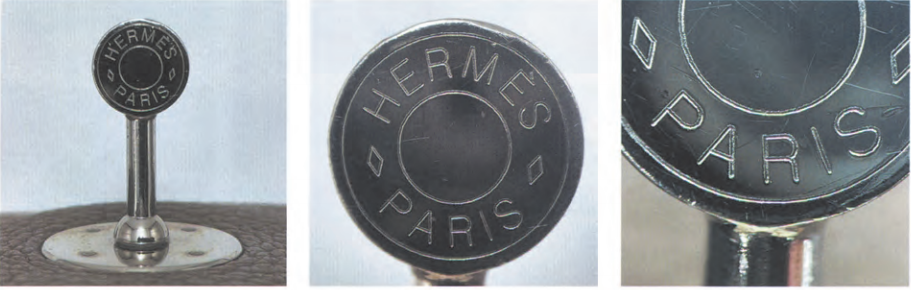
The four corner rivets anchoring the metal plaques to each leather sangle display delicate, hand-hammered pearling (perlage). In authentic artisan work, these rivets compress firmly into the leather without slicing or distorting the adjacent saddle-stitch line.
The central turnlock post (touret) must turn with controlled, smooth mechanical resistance. The “HERMÈS – PARIS” engraving on the right-hand plaque is finely debossed with crisp planar stroke bottoms and softly chamfered margins, entirely free of jagged laser-etch burns or metal flash.
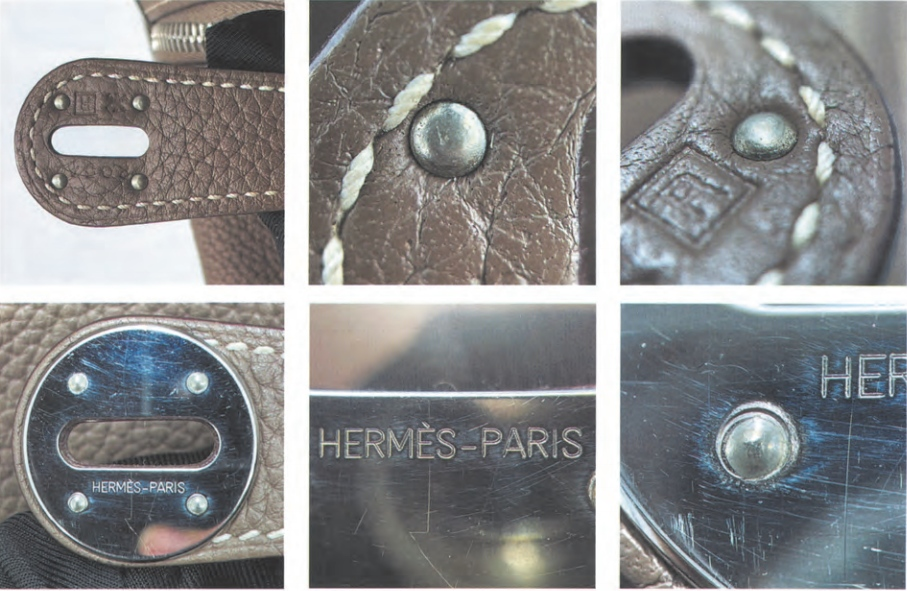
The combination of human touch + precision tooling makes Hermès hardware exceptionally difficult to imitate. Replica buyers often compare the weight, polish consistency, and stamping to gauge quality—an approach we also break down in detail inside our Replica vs Authentic Reviews section.
6. Kelly Architectural Construction: Sellier vs. Retourne, Plaque, and Turnlock Assembly
The Kelly is distinguished by architectural engineering distinct from any other Hermès handbag. When evaluating authentic construction or high-tier bench-craft, four structural focal points require rigorous examination:
Sellier vs. Retourne: Two Divergent Philosophies
Sellier (Rigide): The historic saddle-maker style. The leather panels are edge-skived, assembled with external topstitching, and finished with smooth beeswax edge paint. It demands firmer, dense leathers (Epsom, Box, Chèvre) and stands with architectural crispness. Any irregularity in stitch tension is immediately exposed along the exterior seams.
Retourne (Souple): Assembled inside-out with internal piping (passepoil) and then meticulously turned right-side out by the artisan while the leather is supple. This technique creates softer, rounded edges and is typically executed in supple grains like Togo, Clemence, or Evercolor.
The Single-Handle Arch Mechanics
Unlike the Birkin’s dual handles, the Kelly depends upon a solitary top handle engineered to support the bag’s entire suspended weight. The artisan builds the handle core from multiple graduated plies of leather, hand-skiving each layer before wrapping the exterior leather and hand-stitching the curved underside. When set upright on a level table, an authentic Kelly handle remains firmly upright with a gentle forward tilt, never wobbling or collapsing sideways.
Plaque, Touret, and Hardware Standards
The Kelly’s front closure relies on two leather sangles held by a central metal bracket (touret) and two engraved metal plaques. In genuine pieces:
- The Pearled Rivets: The four metal corner pins securing each plaque are hand-hammered and rounded into domed “pearls” (perlage), flush against the plate with no sharp edges.
- The Touret Rotation: The turnlock post turns smoothly with steady, controlled resistance—neither stiff and raspy nor loose enough to spin freely or rattle.
- Base Stud Depression: The four protective bottom studs (clous de fond) are anchored into the base leather such that each stud base sits in a subtle, clean concave depression created by the artisan’s setting cup, ensuring the metal takes ground contact without straining the surrounding stitch line.
For macro-photography comparisons of Hermès metalwork, riri zipper tooth chamfering, and metallurgical standards, refer to our foundational Hermès Craftsmanship & Hardware Guide.
7. Market Dynamics and Secondary Valuation
The Kelly’s secondary market dynamics differ noticeably from the Birkin. Its formal, architectural profile and stringent hide selection—particularly for Sellier models that require exceptionally rigid, defect-free leather panels—mean that pristine examples command sustained secondary market demand across popular sizes like the Kelly 25 and Kelly 28.
Consequently, secondary buyers must evaluate prospective pieces with rigorous technical scrutiny, prioritizing documented provenance, stitch geometry, and hardware alignment over marketplace marketing claims.
8. Final Thoughts
The Hermès Kelly bag is far more than a luxury accessory—it is a masterclass in architectural leatherwork shaped by history, craftsmanship, and enduring elegance. From Robert Dumas’s 1930s Sac à Dépêches design to its transformation into an international icon through Grace Kelly, the Kelly remains one of the most studied and revered structural silhouettes in fine leathercraft.
As interest in both authentic and AAA replica Kelly bags continues to grow, understanding the nuances of stitching, hardware, construction, and model variations becomes increasingly valuable. At Reinaluxe.co, our goal is to provide readers with trustworthy education, transparent comparisons, and thoughtful insights that help navigate today’s complex luxury landscape.
For more guides, we encourage you to explore:
IDENTIFY A GENUINE HERMÈS BAG VS REPLICA — A CRAFTSMANSHIP GUIDE
FAQs
What makes the Hermès Kelly bag so sought after on the secondary market?
The Kelly represents a benchmark in structural luxury leatherwork, distinguished by its complex single-handle architecture, rigid Sellier edges, and hand-sewn turnlock plaques. Due to strict boutique quota allocations and meticulous atelier craftsmanship, secondary market demand remains exceptionally high across classic sizes like the Kelly 25 and Kelly 28.
How can I tell the difference between a real Hermès Kelly bag and a replica?
Evaluate the bag holistically: check the handle arch posture, clean debossing depth of the Hermès Paris foil stamp, symmetry of the side sangles, and smooth mechanical resistance of the central touret. Rather than relying on a single stitch direction, look for consistent hand-tensioned saddle stitching across stress points and clean edge-finish geometry.
Which Hermès Kelly bag size is most sought after today?
The Kelly 25 and Mini Kelly II are currently the most sought-after on the market due to modern styling preferences and versatile proportions. The Kelly 28 remains the classic heritage choice offering a balance of capacity and elegance, while larger 32 and 35 sizes appeal to traditional collectors.
Are high-tier custom Kelly replicas accurate to authentic dimensions?
High-tier bespoke workshops can achieve convincing proportions and source fine French calfskin, but macroscopic inspection often reveals differences in structural execution. Critical tells include handle rigidity, hand-hammered rivet perlage on the sangles, the depth of the base stud depressions, and the supple feel of hand-burnished edge paint.
What structural details are most critical when inspecting a Kelly bag?
Inspect the upright posture of the single top handle when the bag is resting on a table, the planarity and beveling of the metal sangles plaques, the hand-hammered domed pearling of the four corner rivets, the debossing sharpness of the front heat stamp, and the clean concave seating of the bottom studs.

6 comments
I’ve always admired the Kelly but didn’t realize the original design dated back to the 1890s. The stitching section was incredibly helpful—I never understood what people meant by “saddle stitch tension” until now. This makes me feel more confident when comparing authentic vs replica listings online.
Thank you, Emily! We’re so glad the stitching breakdown helped. Saddle stitching is one of the clearest indicators of Hermès craftsmanship, and once you can recognize the tension and backstitch marks, comparisons become much easier. If you’re exploring replicas, our Replica vs Authentic Review page has more close-up examples you might find useful!
The size chart is super helpful! I’ve been torn between a Kelly 25 and 28. Do you think the 25 is too small for everyday use? I usually carry just my phone, cardholder, and keys.
With just a phone, cardholder and keys, the Kelly 25 is the size I’d check first. Measure those items and compare them with the usable opening and interior of the actual bag. The 28 is worth trying if you want easier access or room for something extra.
I really appreciate how detailed the hardware explanation is. I always assumed weight was the main giveaway, but the part about the hammered rivet marks and beveling is next level. Great article!
Thank you, Lauren! Hermes hardware is surprisingly intricate—those tiny finishing details make a huge difference. Weight matters, but the polishing and rivet placement are even more reliable indicators. If you’d like, we can put together a hardware comparison guide for the Kelly specifically.