

Updated July 2026: Goyard is one of the easiest brands to recognize in a photo and one of the easiest to judge badly from a photo. A seller can produce a sharp chevron close-up while hiding the issues that matter more in use: incorrect proportions, short handles, stiff coated canvas, weak handle bases, messy edge paint, or a reversible Anjou that never sits properly on its leather side.
This guide reviews three frequently requested Goyard replica bags in 2026—the Saint Louis PM, Saïgon Structuré Mini and Anjou Mini—but I am not treating “AAA,” “1:1,” “mirror quality,” or “Ultimate Tier” as technical standards. They are seller terms. My recommendation depends on the individual bag, the photos supplied for that bag, and whether its construction matches the behavior expected from the model.
I have also added the Artois PM as a decision bridge. It is not one of the three featured samples, but leaving it out would make the article less useful: buyers who want a work tote with a zipper and reinforced corners often need an Artois, not a Saint Louis.
Table of Contents
How I Evaluate a Goyard Replica
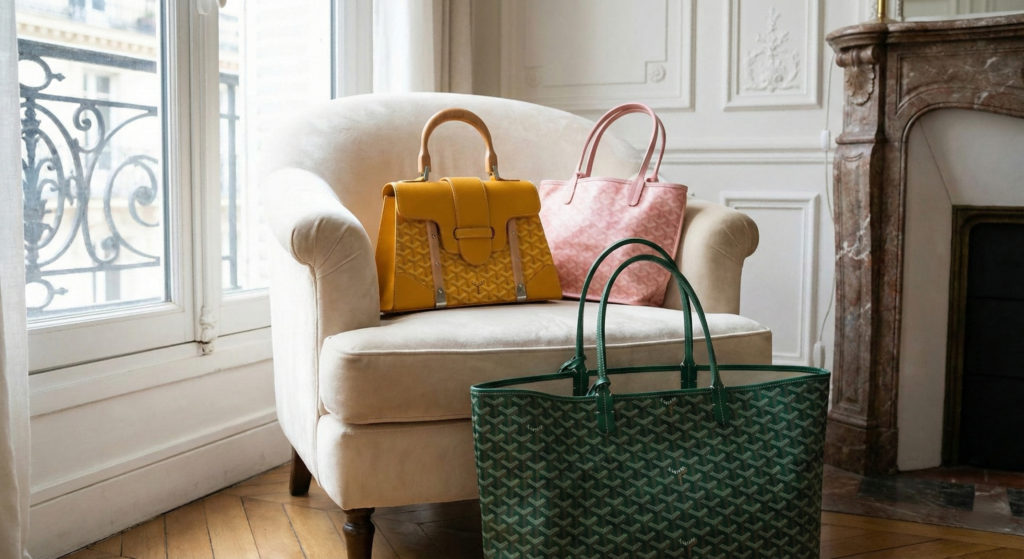
I do not begin with the logo stamp or the packaging. I begin with the model’s architecture. For each sample, I compare five things:
- Proportion: width, height, base depth, handle drop and where the handle bases sit on the body.
- Material behavior: whether the coated canvas bends, collapses and reflects light in a believable way; whether the leather side of an Anjou can actually be worn outside.
- Load path: handle bases, corner folds, bottom seams and the areas that carry weight.
- Finishing: edge paint, stitch spacing, hardware placement, lining and pouch construction.
- Batch evidence: daylight photos, measured dimensions, a short handling video and close-ups of the exact bag—not only catalogue or factory photos.
This matters because a Goyard tote is not supposed to behave like a structured leather briefcase. For example, Goyard describes the authentic Saint Louis PM as unlined, extremely lightweight and reversible, with a linen-and-cotton reverse side. A replica that feels thick and rigid may look “expensive” in a still image while behaving unlike the design it copies. See the official Saint Louis PM specifications.
Goyard Model Selector: Saint Louis, Anjou, Saïgon or Artois?
| Model | Official reference size | Best reason to choose it | Main compromise | My recommendation |
|---|---|---|---|---|
| Saint Louis PM | 34 × 15 × 28 cm; handle drop 18 cm | Very light, casual and intentionally slouchy | Open top, unreinforced corners and limited shoulder space when heavily filled | Choose it for light daily carry, not as a protected laptop case |
| Anjou Mini | 19.5 × 9 × 19.5 cm; 0.28 kg | Leather-and-canvas reversible construction | Small capacity; both sides must be finished well | Best of the three for buyers who care about leather feel and close-up finishing |
| Saïgon Structuré Mini | 20 × 7.5 × 15 cm; 0.35 kg | Structured top-handle design with trunk-making details | More complex geometry, wood components and hardware create more failure points | Only buy after reviewing straight-on and side-profile QC photos |
| Artois PM | 40 × 14 × 25 cm; 0.46 kg; handle drop 20 cm | Zipper, reinforced leather corners and longer handles | Heavier and less relaxed than the Saint Louis | Often the better work-tote choice when security and structure matter |
The dimensions above come from Goyard’s current product pages for the Saint Louis PM, Anjou Mini, Saïgon Structuré Mini and Artois PM. I use them as reference points, not as proof that a replica is authentic or that every handmade measurement will be exact to the millimeter.
Why Goyard Is Difficult to Replicate Well
For the coated surface, I compare pattern scale, sheen and coating thickness together. A pronounced texture is only appealing if it works with the pattern and the way the panel bends.
- Pattern scale and rhythm: The chevrons should look consistent across a large panel. Oversized dots, fuzzy edges or a pattern that becomes visibly compressed near a seam can make the entire bag look wrong even when the color is attractive.
- Surface response: In indirect daylight, the canvas should not look like glossy vinyl. Under hand pressure, it should bend without producing a white stress line, brittle crease or cracking sound.
- Leather-to-canvas balance: Handles that are too thick can overpower a lightweight Saint Louis body. Conversely, thin, spongy handle bases can distort under a modest load.
- Model-specific construction: The Anjou adds an entire leather exterior to inspect. The Saïgon adds wood, rivets, corners, battens, a flap and a rigid body. More components mean more opportunities for misalignment.
Goyard identifies the Saint Louis material as Goyardine canvas with Chevroches calfskin and a linen-and-cotton reverse side. The Anjou uses Chevroches calfskin with Goyardine canvas, while the current Saïgon Structuré Mini specification lists Goyardine canvas, Cervon calfskin, a yellow cotton lining, and riveted beech handle and rods. Those official descriptions are useful reference points; a seller’s claim that a replica uses the “same material” is not independently verified by the wording alone.
Goyard Replica Reviews 2026
1. Saint Louis PM: Best for Lightweight, Relaxed Use
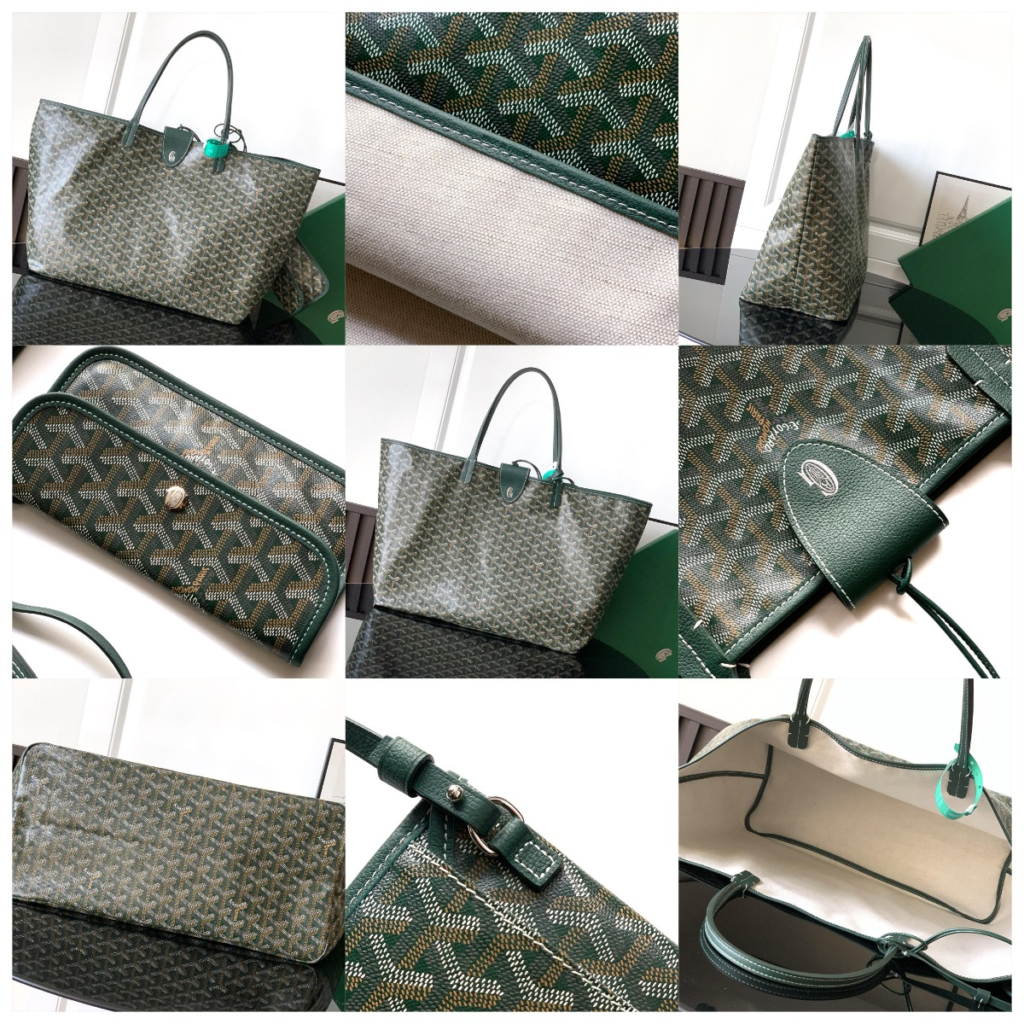
Sample shown: Green Saint Louis PM-style tote.
The Saint Louis is the easiest of these models to photograph flatteringly. Its soft body hides small dimensional errors, and the repeating pattern distracts from handle placement. That is why I judge it first from a full front view with the bag empty, then from a second photo containing a normal daily load.
What looks promising in this sample: the overall body is light and relaxed rather than padded, the top edge is not overbuilt, and the leather handles do not visually dominate the canvas. The green color also reads more naturally in indirect light than it would under a strong studio filter.
What I would still verify before approving it:
- Measure the body and the approximately 18 cm handle drop with a tape in the same frame.
- Check both handle bases for matching height, angle and stitch distance from the edge.
- Request bottom-corner photos. A front-only image does not show early coating separation or thick, uneven folding.
- Inspect the removable pouch separately; it should not have a noticeably different pattern scale or leather color.
My practical verdict: I would choose the Saint Louis PM for a light cardigan, bottle, wallet, pouch and tablet. I would not recommend it as the default choice for a large laptop or a buyer who needs a zipper. Goyard itself warns against carrying excessively heavy items, and community owners repeatedly describe the Saint Louis as the slouchier, less secure option compared with the Artois.
2. Saïgon Structuré Mini: The Highest QC Difficulty
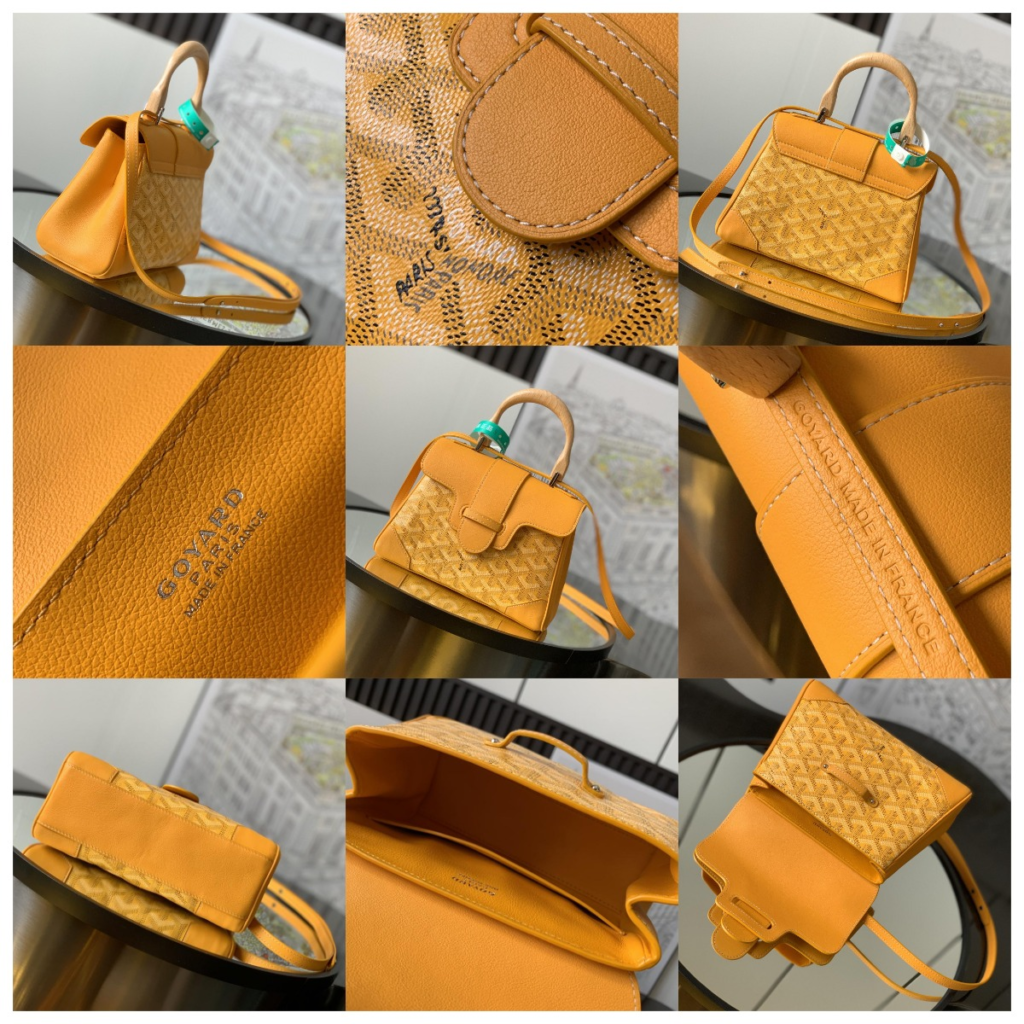
Sample shown: Yellow Saïgon Structuré Mini-style top-handle bag.
This is the model where “nearly identical weight” tells me very little. A replica can reach a target weight by using heavier low-grade hardware or an overly dense internal board. The more useful question is whether the body, flap, handle, battens and corner hardware remain geometrically coherent.
The authentic reference is compact—20 × 7.5 × 15 cm—and Goyard lists a 350 g weight, a 9 cm handle drop, an adjustable strap, riveted beech handle and rods, and trunk-inspired corner and hardware details. At this scale, a few millimeters of error in flap depth or handle position are visually significant.
What I inspect:
- Front elevation: the flap, clasp, handle and vertical battens should share a clear centerline.
- Side profile: both gussets should open to the same angle; the flap should not pull the top edge forward.
- Wood components: ask for close-ups in daylight and a short video. A printed wood-grain effect, overly glossy varnish or rough transition around rivets is easier to see while the bag moves.
- Corner hardware: the four corner areas should be equally seated rather than one side appearing pinched or lifted.
- Stamping: a crisp stamp is desirable, but I rank it below shape and hardware alignment.
My practical verdict: this is the least forgiving purchase in the article. I would reject a Saïgon with a visibly tilted handle or uneven battens even if its canvas print is excellent. Those defects control the entire front view and are difficult to ignore in use.
3. Anjou Mini: Two Exterior Surfaces, Twice the QC
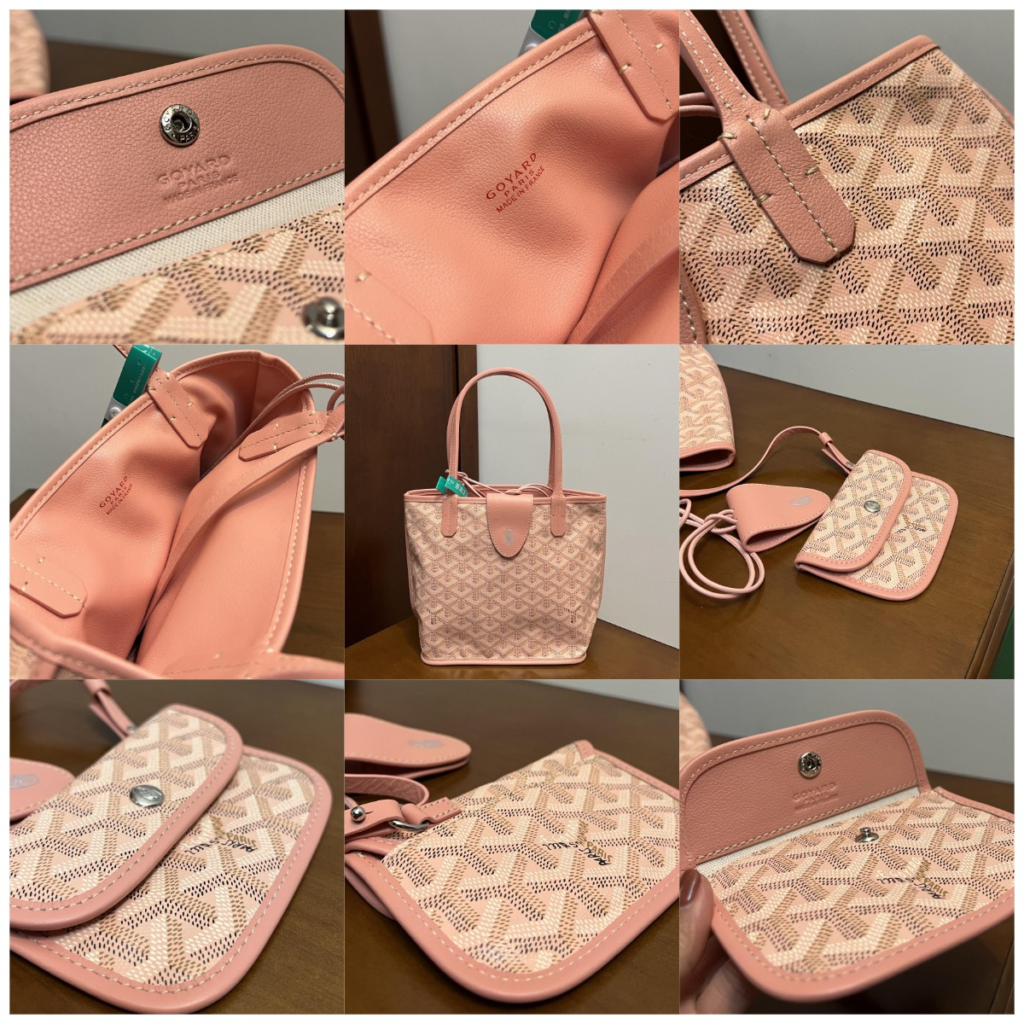
Sample shown: Pink Anjou Mini-style reversible tote.
Goyard describes the Anjou Mini as a leather version of the Saint Louis lined with Goyardine canvas, and the bag is designed to be reversible. That means I do not accept QC that shows only the patterned side. The leather side is not a hidden lining; it is one of the two intended exteriors.
What I would check on the pink sample:
- Leather grain across panels: natural variation is acceptable, but one side should not look dry and heavily embossed while the other looks smooth and coated.
- Reversal behavior: request a video showing the bag turned carefully from canvas-out to leather-out. The corners should settle without severe buckling, and the handle bases should not twist.
- Edge paint: inspect both sides of each handle and the inner curves near the handle bases. Thick glazing often cracks first where the handle flexes.
- Canvas side: check pattern clarity, pouch construction and the transition where the canvas meets the leather rim.
- Capacity: the official dimensions are 19.5 × 9 × 19.5 cm. This is an essentials bag, not a scaled-down work tote.
My practical verdict: the Anjou Mini is the most tactile choice here, but it also exposes more workmanship. A beautiful canvas side does not compensate for stiff leather, bulky seams or a reversible side that cannot sit cleanly.
What Community Feedback Changes in My Recommendation
Owner discussions raised three practical questions I would bring to a current-item comparison:
- Saint Louis versus Artois is mainly a use-case decision. In recent Goyard owner discussions, users repeatedly point to the Artois zipper, reinforced corners, longer handles and more upright structure. That moves my recommendation toward the Artois for commuting, crowded transport and heavier work carry, while the Saint Louis remains the lighter, softer option. See the community comparisons on Artois vs. Saint Louis and work-bag sizing.
- Laptop fit must be tested, not guessed from the word “PM.” One current discussion notes that a Saint Louis PM is not suitable for a 15-inch MacBook. My concrete next action is to ask the seller for an interior photo with a cardboard rectangle matching the buyer’s laptop dimensions rather than relying on a generic “fits a laptop” claim.
- Slouch is not automatically a flaw. Some owners specifically prefer the Saint Louis because it softens and collapses. I therefore distinguish an even, soft collapse from a defective bag that twists, leans to one side or develops localized stress whitening around the handle bases.
Community complaints also make me more conservative about heat, overloading and handle glazing. Goyard’s own care instructions tell owners to avoid excessive weight, intense heat, rough surfaces, water, oils and aggressive rubbing. A seller should not promise that any coated-canvas tote is immune to these conditions.
10-Photo Goyard QC Checklist
For a Goyard replica, I would ask for the following evidence before shipment. These photos are more useful than a factory name or a grade label:
- Full front, empty: camera centered and level, no hand holding the bag into shape.
- Full back, empty: confirms panel symmetry and pattern consistency.
- Both side profiles: shows gusset angle, corner construction and whether one side is distorted.
- Bottom panel and four corners: checks folds, abrasion, coating and edge finishing.
- Handle drop with ruler: especially important for Saint Louis and Artois comfort.
- Handle bases close-up: compare stitch position, leather thickness and edge paint on all four bases.
- Canvas macro in indirect daylight: assesses pattern clarity, scale, color layering and shine without flash.
- Interior and pouch: verifies lining/reverse side, pocket, pouch proportions and attachment details.
- Hardware and stamp: useful after the larger construction points have passed.
- Model-specific video: reverse the Anjou, load and lift the Saint Louis, or open/close and rotate the Saïgon.
Important: the touching “Y” motif is not a complete authentication or quality rule. Pattern placement can vary with panel cutting. Judge the overall scale, clarity and continuity together rather than rejecting a bag because one isolated Y does not sit in a preferred location.
Expected Wear vs. a Quality Defect
| Observation | Usually expected with use | Reason to question the bag |
|---|---|---|
| Canvas shape | Gradual, even softening on Saint Louis | Immediate twisting, one-sided collapse or white stress marks |
| Corners | Light abrasion after repeated contact | Peeling, delamination or exposed substrate on arrival |
| Leather handles | Minor creasing and gradual darkening | Sticky surface, color transfer, deep cracking or separating layers |
| Edge paint | Small flex lines at high-movement points over time | Thick bubbles, open gaps or peeling before use |
| Saïgon wood/hardware | Fine surface marks from contact | Loose rivets, uneven battens, lifting corners or a tilted handle |
| Anjou leather side | Natural grain variation and soft folding | Plastic stiffness, severe wrinkles after reversal or mismatched panels |
I removed the original article’s universal “six-to-eight months” wear timeline because usage intensity, climate, color, coating, storage and load vary too much. A durability claim should come from a documented bag and defined use pattern, not from a generic production-year label.
Buying Strategy: Verify the Bag, Not the Tier Name
- Define the use case first. A light open tote, a secure work tote, a reversible mini and a structured top-handle bag should not be ranked on one universal scale.
- Request current batch photos before paying. Use factory images to understand the offer, but use exact-item PSP/QC photos for acceptance.
- Keep a reference record. Save the seller’s promised size, color, material description, included accessories and photos in one message thread.
- Prioritize shape over micro-details. A slightly imperfect stamp is less disruptive than incorrect handle placement, a tilted Saïgon front or a Saint Louis body that is too rigid.
- Do not pay solely for packaging. Boxes and dust bags vary and do not improve the construction of the bag.
For the broader terminology behind AAA, mirror, Top Tier and Ultimate Tier, see our AAA Replica Bags Guide. For close-up inspection principles that apply across brands, use the Luxury Bag Craftsmanship Guide.
FAQ Section
Do the 2026 Goyard replicas come with a box and dust bag?
Ask the seller for an itemized packaging list and a photograph of what is included. Choose packaging for physical protection and cost; a green box or its omission does not establish the customs outcome.
Will the hand-painted customization chip off?
Ask how the particular customization was applied and request dated wear examples from the same process. Check the edges of the lettering and folds where the surface moves. The production year alone does not establish a printing method or resistance to chipping.
Is the Anjou Mini actually reversible in the replica version?
Request a continuous reversal video of the actual Anjou Mini, with both faces, seams and handle attachments visible. Judge the finishing on both sides and how the bag settles after turning. AAA does not guarantee reversibility or flawless finishing.
How heavy is the Saïgon bag compared to the authentic one?
Request the actual Saïgon weight with its strap and compare the same size and configuration. Inspect the handle, battens and attachment points separately. Weight alone cannot establish real wood, wood species or matching construction.
Does the bag smell like cheap plastic?
Ask about the condition of the actual bag and raise any strong or persistent odor before accepting it. Smell alone does not identify leather, canvas, a tier or a production process; the listing should state the materials separately.
Final recommendation: choose the Saint Louis for lightness and relaxed slouch, the Artois for a more secure work-tote format, the Anjou Mini for reversible leather-and-canvas construction, and the Saïgon only when the seller can document its geometry and hardware in detail. In every case, the evidence from the specific bag matters more than the words “2026 batch” or “AAA grade.”

24 comments
Great review! I’ve been burned before by sellers claiming ‘AAA’ quality but the canvas arrived looking super flat and shiny. Is the ‘bump’ texture on the Green Saint Louis actually noticeable when you touch it, or is it just visual?
The photographs let me compare the pattern and reflected light, but they do not establish the tactile relief. Ask for close oblique-light views of the current unit and its surface description; I would not transfer a touch claim to the whole 2026 batch.
Great review! I’ve been burned before by sellers claiming ‘AAA’ quality but the canvas arrived looking super flat and shiny. Is the ‘bump’ texture on the Green Saint Louis actually noticeable when you touch it, or is it just visual?
I’d separate two things here, SarahJ_99. Print and surface texture can be useful, but they need a model-specific reference because scale, coating, panel placement and production variation matter. I’d judge the exact sample from high-resolution photos and handling evidence rather than assume one pattern rule proves the whole bag.
Omg that Yellow Saïgon is to die for! 😍 I’m worried about the wooden handle though. Does it feel fragile? I’m clumsy and bang my bags around a lot.
For that Saïgon, inspect the handle, surface and attachment points and request the actual material specification. The photos do not establish beechwood or impact resistance. If you often knock bags against hard surfaces, that exposed handle deserves particular consideration.
Omg that Yellow Saïgon is to die for! 😍 I’m worried about the wooden handle though. Does it feel fragile? I’m clumsy and bang my bags around a lot.
Good question, LuxuryLover_NYC. The handle can be judged for weight, density in hand, surface finish and joinery, but I wouldn’t identify the wood species without material evidence. For the reviewed sample, I’d keep the conclusion limited to those observable characteristics.
I’m eyeing the Pink Anjou Mini for summer. Be honest though, does the leather side wrinkle badly when you flip it inside out? I hate when reversible bags look messy.
Ask for a continuous reversal clip of the actual Anjou, including the creases immediately afterward and how the bag settles. I do not have a documented recovery test that establishes a one-hour relaxation time or freedom from permanent creasing.
I’m eyeing the Pink Anjou Mini for summer. Be honest though, does the leather side wrinkle badly when you flip it inside out? I hate when reversible bags look messy.
Thanks for asking, Emilie_Travels. For leather, I separate what I physically observed from what a seller or source claims. I focus on grain irregularity, coating, flexibility, rebound, edge finishing and how the surface reacts to light and pressure; those observations are more defensible than a grade label or claimed tannery source.
Does the Saint Louis PM fit a 13-inch MacBook Air? Trying to decide if I need the GM size.
Hi! Yes, the Saint Louis PM can technically fit a 13-inch MacBook Air horizontally, but it will be a snug fit if you use a thick laptop sleeve. If you carry a laptop daily along with a water bottle and makeup bag, I would honestly recommend sizing up to the GM size. It gives you that effortless ‘slouchy’ look without bulging at the sides.
Does the Saint Louis PM fit a 13-inch MacBook Air? Trying to decide if I need the GM size.
That distinction matters, CorporateChic. I’d verify the bag’s internal opening and depth against the exact device dimensions, including any sleeve. Nominal bag size can be misleading because taper, lining and the opening reduce usable space.
I want to order this but I’m terrified of customs seizing it. Do you recommend shipping with the green box?
I would choose packaging for protection and cost, then ask the seller for written delivery terms. A green box or a dust bag is not a basis for predicting customs clearance.
I want to order this but I’m terrified of customs seizing it. Do you recommend shipping with the green box?
For the box decision, ask how the bag itself will be supported and protected in transit. I would assess that separately from the seller’s delivery terms.
I bought a Green Saint Louis from a different factory in late 2024. Is it worth upgrading to this 2026 batch? Or are the differences minor?
If your 2024 bag is still serving you well, I would compare current handle, glazing and canvas evidence before upgrading. A 2026 label does not establish a new adhesive or improved lifespan; dated wear records would matter more to that decision.
I bought a Green Saint Louis from a different factory in late 2024. Is it worth upgrading to this 2026 batch? Or are the differences minor?
Good question, JessicaW. I wouldn’t treat a seller or factory name as a guarantee because batches and QC can change, and those nicknames are not standardized across brands. For a current comparison, I’d judge the exact sample from clear photos/video, measurements and construction details.