
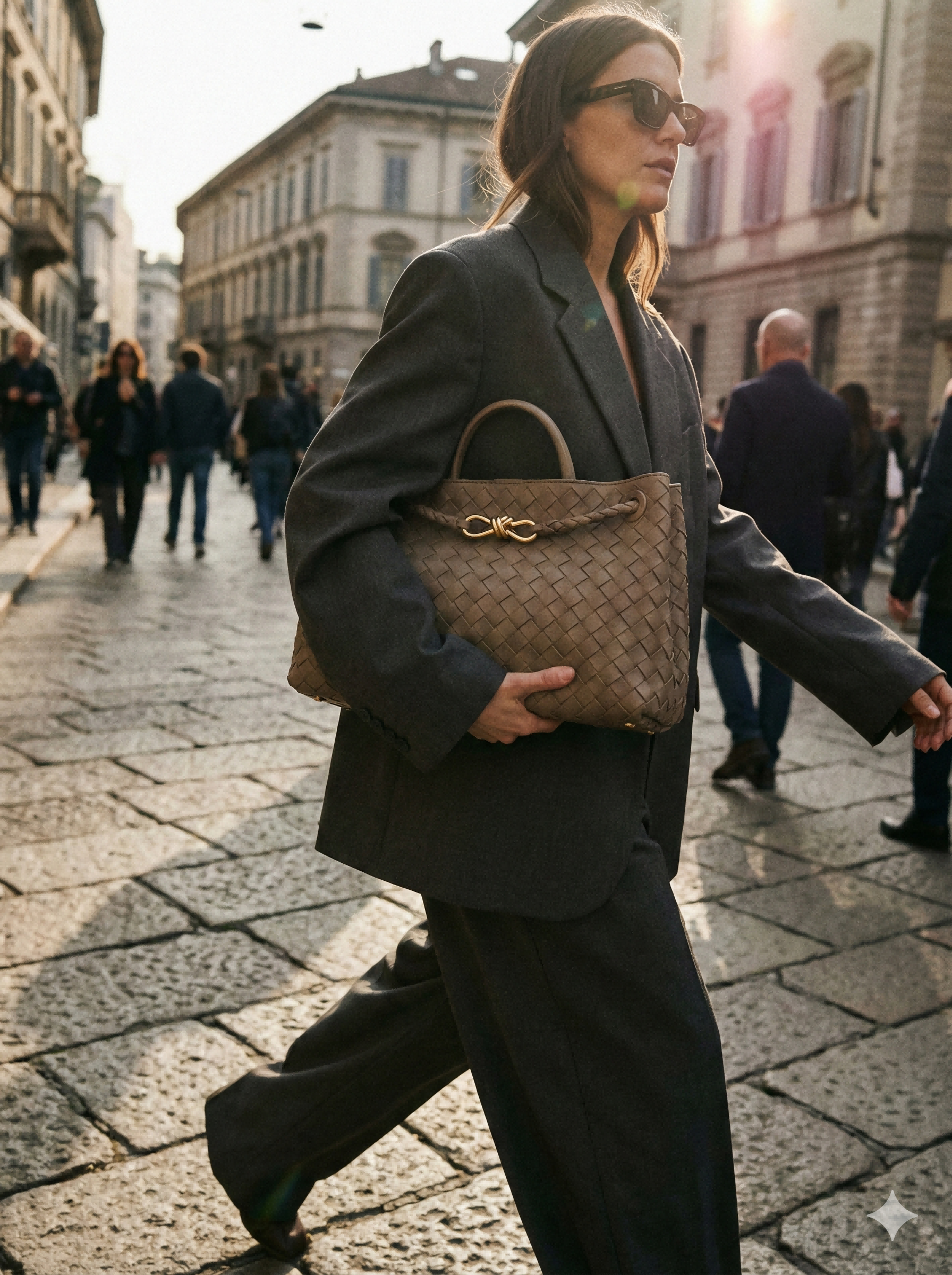
If you have your eye on modern Bottega Veneta, chances are you are deciding between three very different bags: the structured Andiamo, the metallic-handled Sardine, and the slouchy Hop. On paper, all three showcase the house’s signature Intrecciato weave. But on your arm and in everyday use, they feel and function like completely different pieces with their own distinct trade-offs. The photographs evaluated below are pre-shipment quality control images provided by workshop sourcing contacts, reviewed against official Bottega Veneta archival references and in-hand retail specifications.
The Intrecciato weave is never just decorative trim—it is the structural fabric of the bag itself. Because there is no rigid interior frame, the weave dictates how the leather stretches under load, how the corners fold, how the handles attach, and whether the silhouette holds its posture or collapses into an effortless slouch. When you evaluate pre-shipment photos (or authentic pieces on the retail floor), the drape of the Hop, the knot placement on the Andiamo, and the handle symmetry of the Sardine are some of the most revealing clues about the workshop’s craftsmanship and assembly standards.
Before comparing the bags side by side, one golden rule from my sourcing experience: always pin down the exact reference code, leather type, and hardware finish. In the independent market, sellers throw around informal vocabulary like “AAA,” “Top Tier,” or “mirror quality” with almost zero consistency, as I explain in my AAA replica bags guide. What actually protects your money is evaluating how the specific batch in front of you holds up under careful scrutiny.
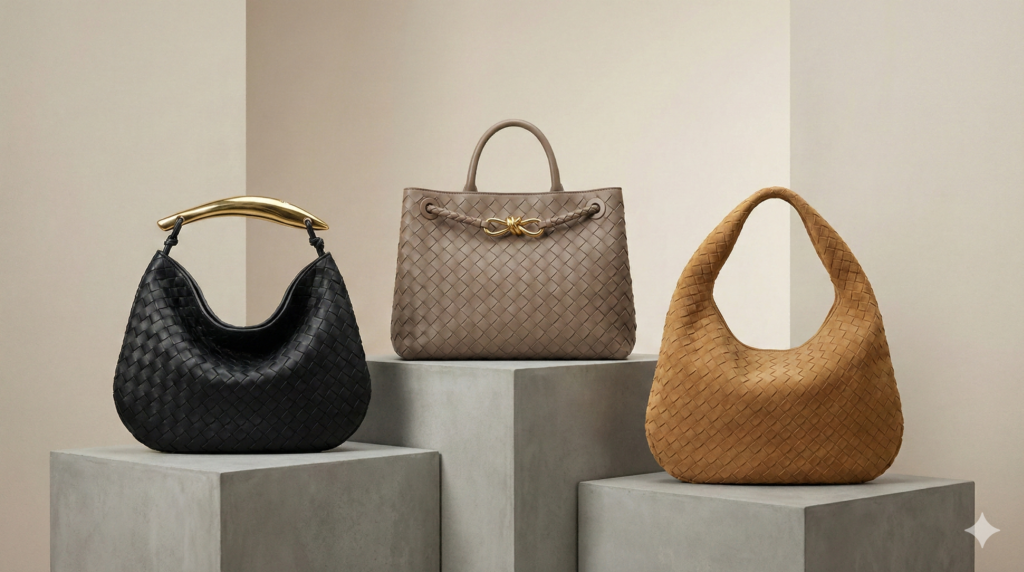
The Intrecciato Balance: Structure vs. Sculptural Form vs. Slouch
Bottega Veneta’s current catalog spans multiple sizes, material weights, and seasonal revisions. Ordering a “Medium Andiamo” or “Sardine” without pinning down the exact reference code is an easy way to end up with the wrong strap drop, an incorrect interior division, or mismatched hardware.
On any woven bag, softness can easily disguise construction errors. A vendor can photograph a bag at a flattering three-quarter angle, pull one side taut, or stuff the base with tissue paper to make the silhouette look crisp. That is why I look for five observable checks across any Intrecciato piece:
- Panel symmetry: The woven ribbons (fettucce) should run at consistent diagonal angles across the front and back faces without drifting off-center.
- Edge transitions: Where the woven panels meet side gussets or base seams, the strips must terminate cleanly under smooth leather binding rather than puckering or fraying.
- Handle and hardware integration: Because the weave is flexible, anchor points must be reinforced from within so the weight of the bag does not distort surrounding fettucce.
- Interior division: The construction reveals itself in how cleanly the unlined or bonded interior matches the exterior precision.
- Dynamic behavior: A bag that looks tidy on a table can feel stiff and unyielding against the hip once loaded.
1. Bottega Veneta Andiamo: The Weave Must Work With the Sliding Strap
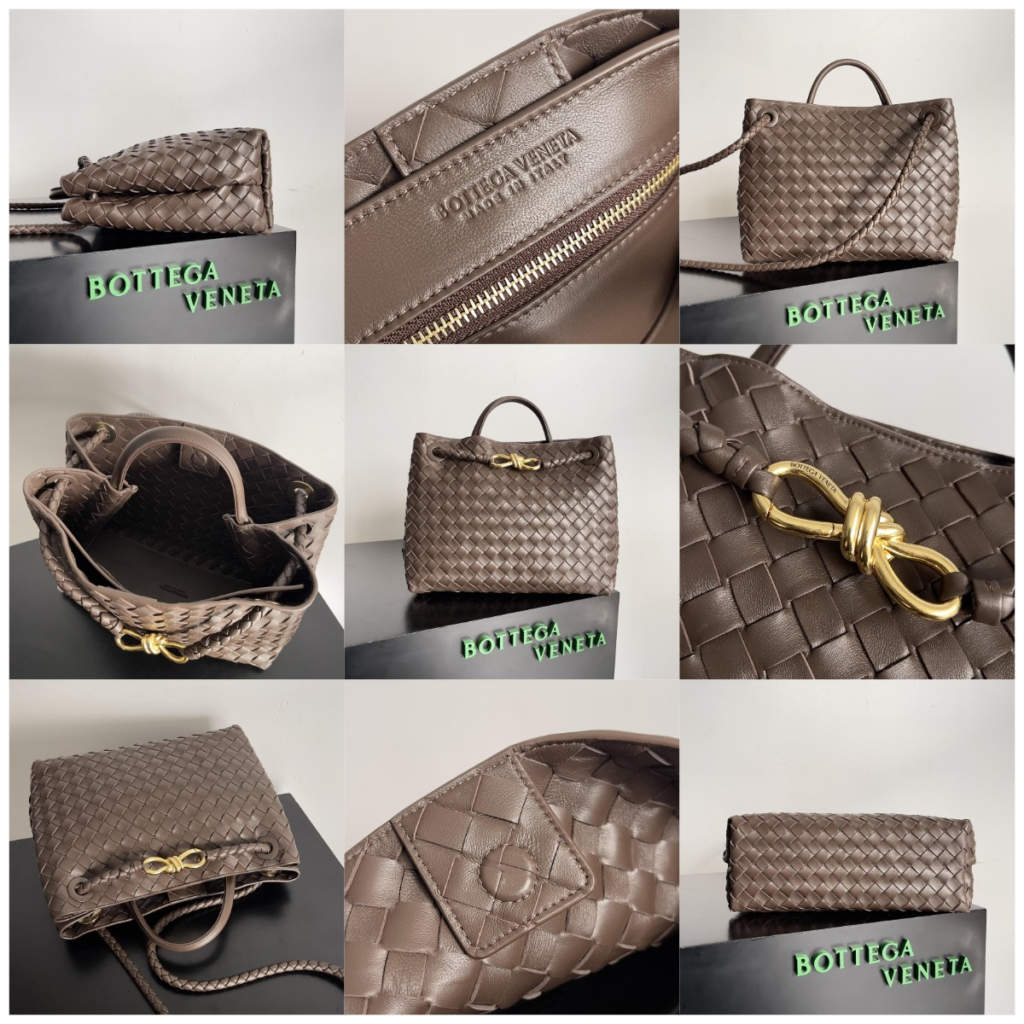
The taupe sample in our review corresponds to the standard Medium Andiamo in Travertine, official product code 766016VCPP12943 (consult the official Travertine Andiamo reference). Bottega Veneta specifies this configuration as a supple Intrecciato lambskin top-handle bag measuring 25 × 32 × 11 cm, featuring the signature sculptural brass knot detail and a sliding cross-body strap.
In the supplied photographs, the focal point is the cast brass knot clasp. This knot is not merely decorative; the tubular braided leather strap routes directly through its channel, allowing the wearer to shift between a double-handle hand carry and an extended shoulder or crossbody drop. This mechanical junction is one of the key structural areas I recommend checking first: if the cast interior channel has residual mold flash or rough burrs, it can abrade the leather finish, while an overly constricted opening makes strap adjustment an unnecessary struggle. In still photos, one can confirm that the knot sits upright without tipping and that the leather strips are neatly braided, but verifying smooth friction-free travel requires requesting a short demonstration video from your seller.
Examining the front face in Figure 2, the weave alignment is disciplined. The fettucce intersect at consistent diagonals, and the internal heat stamp reads cleanly: Bottega Veneta Made in Italy. The bag is divided into an accordion layout with a central zipped partition.
One question readers often ask is whether the Medium Andiamo works as a daily office bag. If your routine depends on carrying a laptop, I wouldn’t recommend buying it as a dedicated work tote without testing the interior clearance first. As experienced owners note in community discussions, while the 32 cm exterior width sounds promising, the central zipped partition and folded side gussets take up significant usable space. Trying to wedge a rigid 13-inch laptop inside can make the top magnetic closure awkward to seat and risks stretching the soft lambskin over time. The Medium Andiamo shines as a polished day bag—it easily holds an iPad, notebook, wallet, keys, and a cosmetic pouch—just don’t expect it to double as an effortless laptop briefcase.
2. Bottega Veneta Sardine Chain: The Sculptural Handle Cannot Carry the Whole Verdict
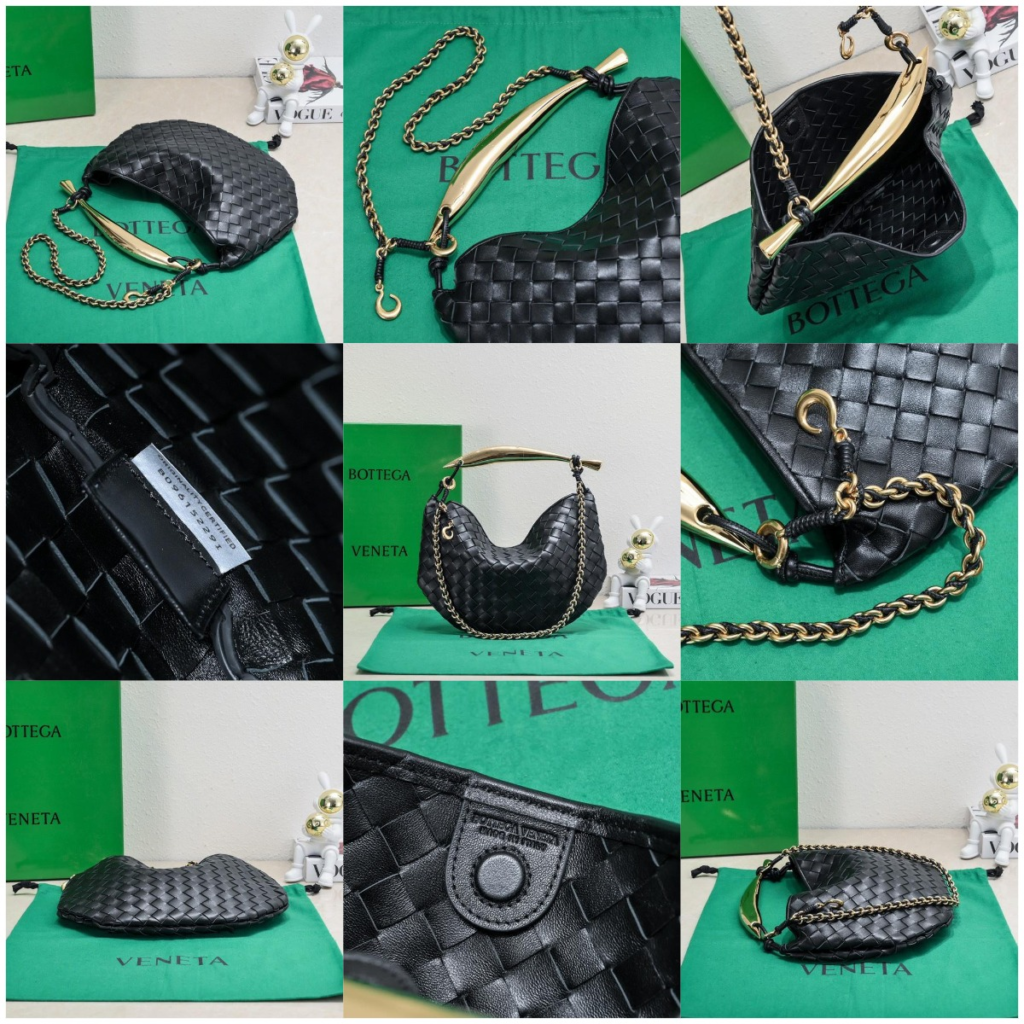
The black leather piece in our comparison represents the Sardine Chain, official product code 776768VCPP11019 (see the official Black Sardine Chain reference). Bottega Veneta defines this configuration as a small Intrecciato lambskin bag with an artisanal metallic top handle and a braided leather shoulder chain, measuring roughly 12 × 20 × 4 cm.
When assessing this bag from pre-shipment photographs, buyers often focus exclusively on the handle finish while ignoring the body geometry. The handle is cast with intentional artisanal nuances: it features subtle surface undulations and a warm, aged patina rather than an ultra-smooth mirror chrome. What matters more in photographic inspection is attachment symmetry. Both ends of the cast bar must meet the woven leather rim at identical heights. If one mounting anchor is fastened higher or tighter than the other, the entire half-moon body hangs noticeably skewed.
In this reviewed collage, the handle mounting tabs appear level, and the braided leather chain provides an alternative carry method when handheld carry is inconvenient. The internal leather tag features the visible marking B09615229I, stamped in clean, evenly spaced alphanumeric characters across the leather tab.
The practical limitation of the Sardine is its shallow, crescent-shaped interior. Secured by magnetic tabs, the opening does not expand widely. It accommodates a standard smartphone, slim cardholder, and keys, but thicker items will prevent the magnetic closure from seating properly. The Sardine Chain works well as an evening or occasion piece where sculptural design takes precedence over storage volume.
3. Bottega Veneta Hop: Slouch Is Only Desirable When Access Still Works
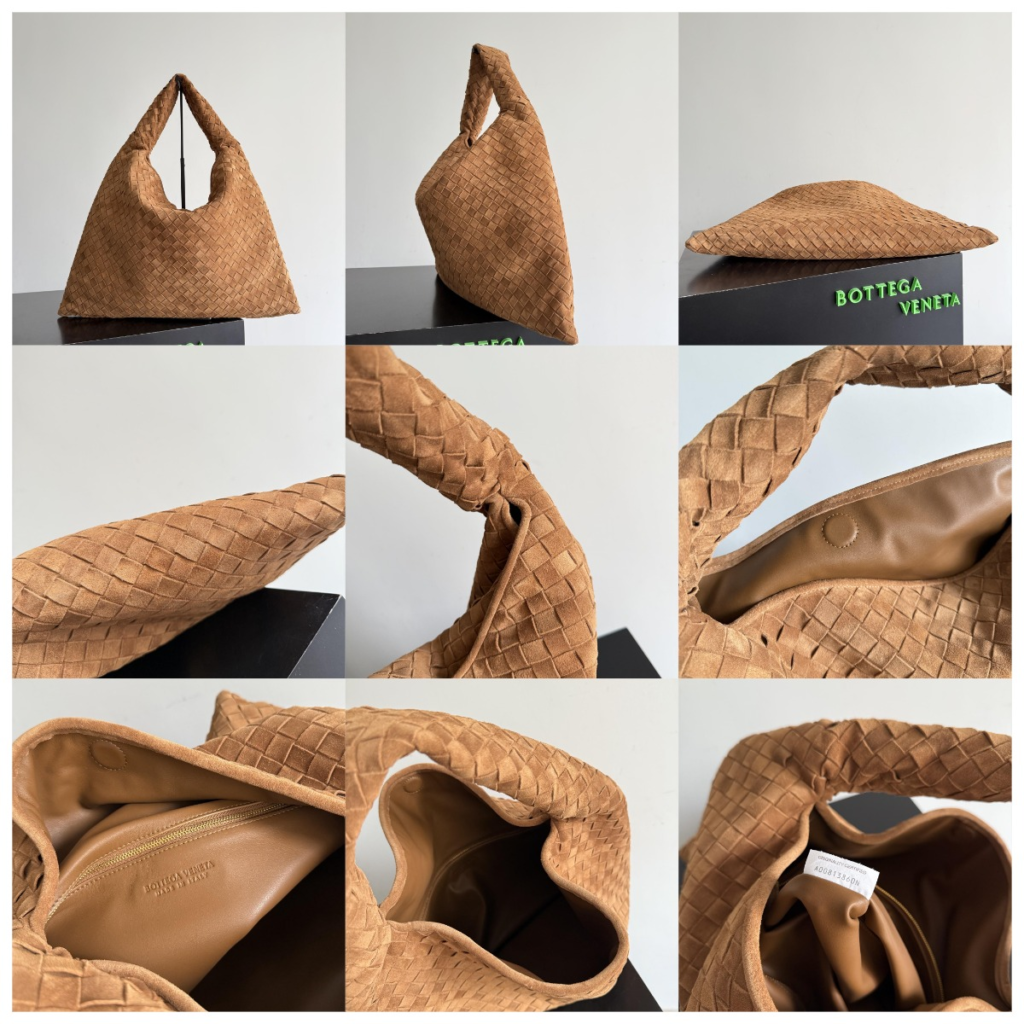
Our third contender is the Large Hop in camel suede, patterned after Bottega’s oversized hobo silhouette (documented in archived retail listings such as Net-a-Porter). Where the Andiamo emphasizes structure and the Sardine highlights sculpture, the Hop is designed around soft drape.
Suede presents a unique inspection challenge for Intrecciato craftsmanship. On smooth calfskin, each woven strip reflects light sharply, making weave alignment straightforward to evaluate. On suede, a dense velvety nap can blur the woven grid if the hide is cut too thick or the strips are pressed unevenly. In the supplied images, the camel suede shows a distinct directional nap while keeping the geometric weave visible across the broad panels. When rested empty on a flat surface, the bag displays the expected “puddle slouch”—relaxing naturally into its base rather than folding along artificial creases.
The second detail to examine on the Hop is the handle transition. The woven body should flow continuously into the shoulder strap without an abrupt seam or stiff internal padding breaking the curve. In this sample, the transition appears seamless, and the internal white tag displays batch code A09813868N (a workshop sample marking seen in these photos, rather than an official Bottega style reference).
From an everyday standpoint, community insights from Hop size and material discussions highlight an important practical factor: shoulder drop and opening access. The Large Hop features a generous shoulder drop that slips comfortably over thick winter coats, but because it is an open-top hobo secured only by an internal magnetic tab, smaller essentials tend to shift toward the base. Using an interior organizer pouch keeps keys, lip balm, and cards from settling into the bottom of the suede interior.
Head-to-Head Comparison: Which Model Fits Your Wardrobe?
Choosing among these three models comes down to how you balance organization, physical weight, and daily carry preferences:
- The Andiamo is the most practical all-rounder. With its structured base, partitioned interior, and sliding strap, it transitions smoothly between daytime errands and professional settings. It requires the most careful inspection of weave alignment and knot clearance, but offers the most versatile utility.
- The Sardine Chain is the design-focused option. The metallic fish handle serves as a striking visual focal point, elevating simple outfits. You trade off interior capacity and carry a heavier handheld weight, making it suited primarily for dinners, social events, and lighter outings.
- The Large Suede Hop provides relaxed, spacious carry. It offers ample volume and the tactile softness characteristic of unlined Intrecciato suede. For buyers who prefer a comfortable shoulder carry that molds to the body during cooler months, the Hop in camel suede is well suited.
Smart Sourcing: What to Request Before You Approve a Bottega Batch
Because soft woven leather can be flattered by strategic styling and studio angles, evaluating pre-shipment photos requires a disciplined approach. Rather than relying on generic tier claims, ask your seller for these specific verification views:
- Straight-on front and rear views on a flat surface: To confirm that the silhouette sits level without tilting or twisting.
- For the Andiamo: A brief video showing the tubular strap sliding through the brass knot to full extension and returning, ensuring the channel does not catch or scuff the leather.
- For the Sardine: Close-up photos of both handle mounting junctions where the cast bar joins the leather rim, confirming symmetrical height.
- For the Hop: A view of the bag suspended by the handle and another resting empty, verifying that the suede relaxes naturally without rigid fold lines.
For more foundational checks on leather quality, stitching tension, and edge paint durability across luxury houses, browse our luxury bag craftsmanship guide and fake designer bag authentication guide. For broader industry context and silhouettes, see our 2026 replica bag brand forecast and our Balenciaga Rodeo, Monaco and Le City QC review. Readers exploring the wider house history and seasonal releases will find additional model breakdowns in our Bottega Veneta article archive.

12 comments
I’ve been seeing the Andiamo everywhere lately, but I wasn’t sure if it was just a passing fad. Your point about it being the new ‘Executive’ staple for 2026 makes total sense. Definitely leaning towards the medium size in Taupe now.
It’s definitely more than a fad! The Andiamo has quickly established itself as a modern classic because it balances functionality with that slouchy, effortless aesthetic. The medium Taupe is an excellent choice—it’s incredibly versatile for both office wear and casual weekends. Great pick!
Honest question: I’ve bought ‘high tier’ replicas before where the gold hardware was shockingly yellow and cheap looking. How accurate is the gold knot on your Andiamo really? The photos look okay, but it’s hard to tell on a screen.
For the Andiamo knot, request neutral-light photographs of the actual bag next to the matching reference. I would compare the curve, surface finish and how the knot sits against the weave before judging the color from one warm photograph.
That Camel Suede Hop bag is absolutely stunning. The slouch looks perfect in the photos. But I’m terrified of ruining suede. Is it practical for daily use, or should I save it for special occasions?
The Hop’s soft drape is the part I like in these photos. For daily use, I would weigh your tolerance for marks against the care instructions for that exact suede. Check those instructions before applying a protector; a spray is not a guarantee against stains.
Great review. I’m obsessed with the Sardine bag as an art piece. My main concern is the handle—I’ve seen some bad reps where it looks like smooth plastic. Does yours actually have those little imperfections and the cold metal feel?
The handle is the detail I would examine most closely, too. Ask for several angles in neutral light to compare its contour and textured finish, then request the supplier’s material specification. I would keep that separate from impressions of weight or temperature.
Thank you so much for using actual hands-on photos instead of just stock images from the brand’s website. It’s so helpful to see the close-ups of the stitching and the inside tags. Makes me feel much more confident in ordering.
You’re very welcome. Close views of the seams and tags make it easier to discuss a specific detail instead of relying on the overall styling shot. I’m glad they were useful.
I’m new to the replica world and the terms are so confusing. Everyone claims to have the best. I appreciate you actually defining what ‘AAA’ means to your quality standards regarding the weave tightness and real leather.
I’m glad the weave comparison helped. I use AAA as a market label and then look at the actual strip width, tension, corners and material specification. Those are the details worth keeping beside the listing.