A Lady Dior listing can look remarkably convincing until the seller turns the bag over. The front presents the familiar silhouette, quilted diamonds, and hanging letter charms; the base, however, often tells a different story of uneven seams or misaligned feet. That change of perspective is critical. Sound authentication requires following the same object through its overall architecture, mechanical fittings, and interior assembly, rather than collecting attractive close-ups that could easily belong to several different bags.
The pink Lady Dior pair in our reference archive demonstrates why that sequence is so effective. In the source documentation, one sample is catalogued as genuine and the other as imitation. Rather than adopting those classifications passively, we use the pair to examine the connected structural differences visible between them, and to test how reliably those observations apply to other bags, particularly recent decorated editions.
Start with a reference that belongs to the same version
Before deciding whether a quilted panel looks irregular, first verify what the seller claims to be offering. The stated size, material, approximate production period, and edition should describe a single, coherent object. A classic smooth leather bag with raised Cannage, a high-gloss patent version, and an artist collaboration share the Lady Dior name, yet their surfaces obey completely different manufacturing standards. Measuring all three against one pink leather photograph creates confusion rather than clarity.
Design transitions make this version-matching even more vital. Reuters reported the expanded appointment of Jonathan Anderson to lead Dior womenswear and haute couture on 2 June 2025. For a buyer evaluating pieces from subsequent collections, the decisive reference remains the specific edition and official product documentation. Creative leadership explains aesthetic shifts, but an unfamiliar attachment or lining treatment still requires a verified product record rather than an assumption. Reuters reporting
Dior’s Spring–Summer 2026 Clover edition illustrates the point: it layers four-leaf clovers and a dimensional ladybird across the Cannage framework through hot stamping and hand embroidery. An authenticator must check that decorated surface against official Clover savoir-faire imagery. A plain Cannage reference confirms foundational proportions, but provides no benchmark for the placement, stitch density, or scale of the added motifs. Dior Clover

The Autumn–Winter 2026–2027 Water Lily edition pushes textural complexity further, layering hand-cut, stitched miniature water lilies, lily pads, and sculptured dragonfly hardware across the exterior. That relief radically alters how light strikes the surface and how much underlying leather remains visible. A buyer encountering this undulating outline must trace it to this specific capsule before mistaking deliberate ornamental density for poor craftsmanship. Dior Water Lily
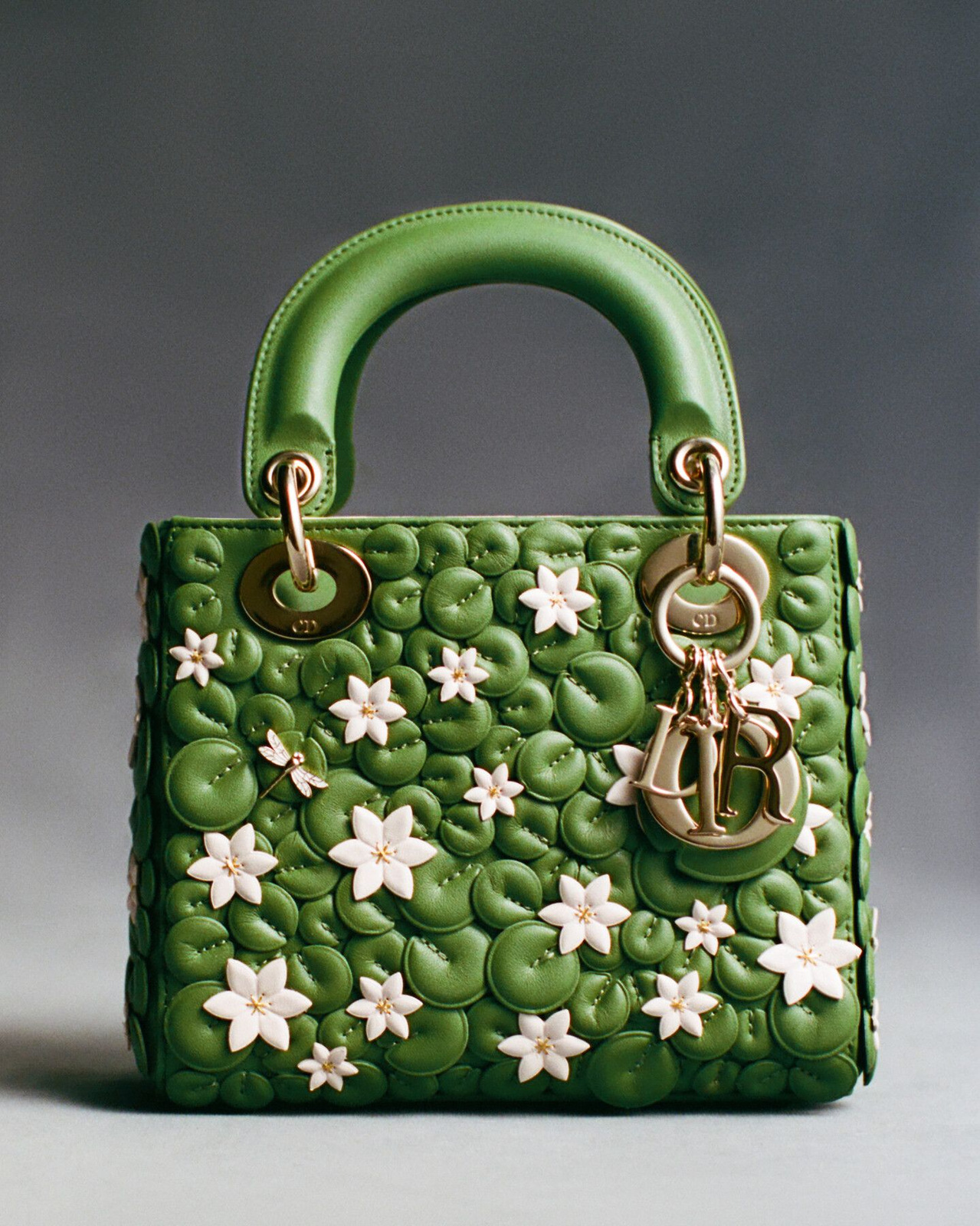
The Lady Dior Art project reinforces the necessity of edition verification. Marking its tenth project in 2025 with ten invited artists, this initiative deliberately reimagines the bag through sculptural finishes, unusual hardware, and altered quilting. Dismissing an unconventional treatment as a manufacturing flaw misinterprets the purpose of these collaborations. By the same token, an unexplained flourish on a resale listing demands a verified reference title, rather than a seller’s vague claim of an uncatalogued prototype. Dior Lady Art
Read the pink comparison as one construction problem
With the version established, return to the archive pair to examine foundational construction. Read the genuine-labelled front alongside the two base views. Observe how the side panels taper toward the top, how cleanly the lower corners turn, and how the arched handles sit above the rim. In the base views, the genuine and imitation samples differ markedly in outline regularity, surface creasing, and the placement of the protective feet relative to the seams. The diagnostic value lies in evaluating how these structural components relate to one another, rather than judging a superficial difference in photo exposure.
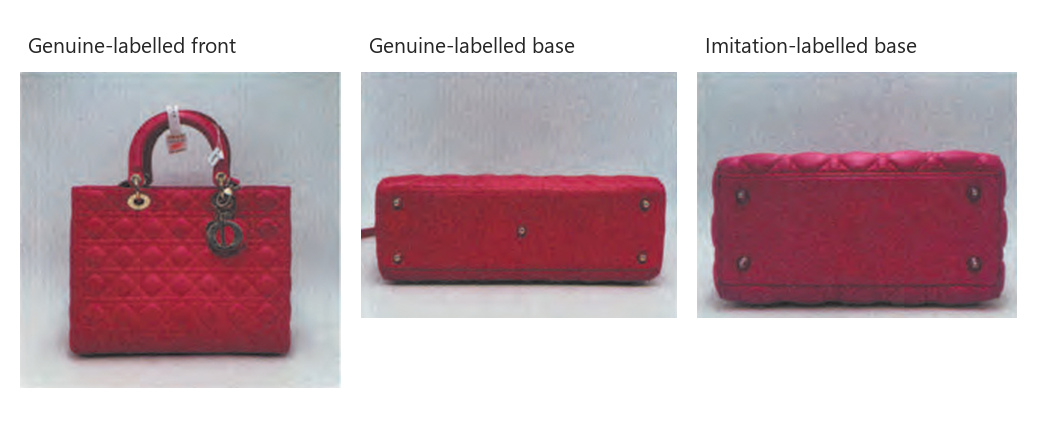
The base reveals structural information that a flattering frontal view conceals. Trace each lower corner into the bottom panel and check the anchoring of the feet relative to the corner seams and edge piping. Because a tilted lens can make a true rectangle appear skewed, any apparent asymmetry should be confirmed through a level, perpendicular view. What warrants genuine concern is a displacement that persists across multiple perspectives, particularly where a perimeter seam and a metal foot disagree on the bag’s central axis.
Wear and storage history must be factored into this architectural inspection. A bag stored without internal support may lean, while regular carrying naturally softens the leather around the upper opening. These posture changes alter the silhouette without changing where panels were originally stitched. Gentle tissue stuffing on a level surface can help reveal how much of a lean comes from storage. Recovery of the rectangular shape is a condition observation, not an authenticity test. Persistent deep creases deserve closer inspection for deformation or damage, but their appearance alone does not establish structural fatigue.
These archive photographs do not provide laboratory conditions, so visible variations should not be translated into rigid millimeter formulas. Their real contribution is pedagogical: demonstrating why the lower half of the bag deserves the same rigorous scrutiny as the charms. A seller who supplies clear, level photographs of the base, corners, and opening provides the evidence needed to verify construction integrity, whereas ten versions of the same glamorous front view leave the essential structure unverified.
Let the Cannage continue across the bag
In the paired Cannage details, observe the interplay between the raised leather cushions and the sunken stitch channels that frame them. Follow a diagonal stitch line toward the edge and examine how the relief behaves near the seam. On the genuine sample, the quilted relief rises cleanly from each stitch channel with controlled tension, producing an even, elegant dome. On the imitation, the leather appears either excessively bloated or inconsistently flat. Because lighting angles influence apparent depth, always assess these close details in relation to the whole panel.
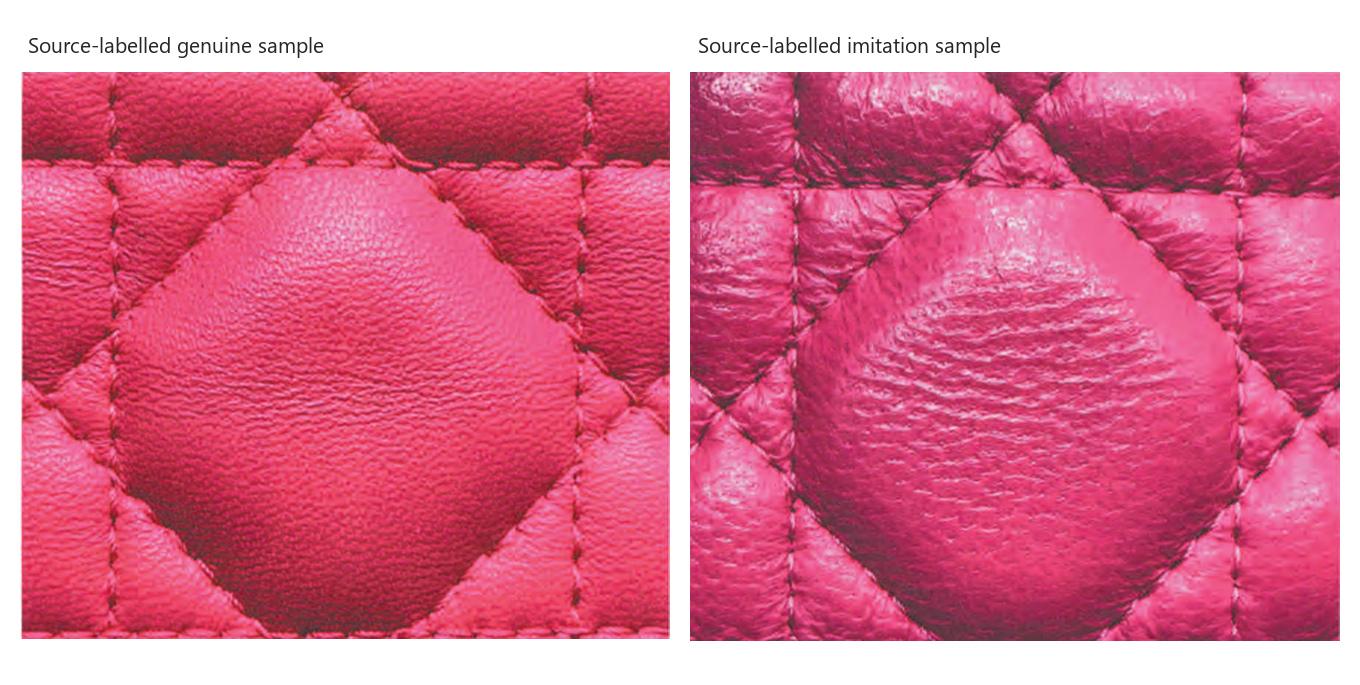
A frequent pitfall among buyers is treating this observation as an absolute rule that genuine Cannage must always look heavily puffed. The Cannage motif appears across materials and constructions that behave in fundamentally different ways. Even on traditional lambskin, age, ambient humidity, and natural softening reduce apparent loft over time. Our dedicated Cannage and leather study explores these material distinctions; within this initial review, the key question is whether the surface cushion and channel tension correspond with the specific edition and claimed condition.
Stitching is most revealing where it navigates structural transitions: around a tight corner, beside a handle eyelet, or along the perimeter of an interior label. Executing a straight line of stitching across a flat panel is straightforward; maintaining consistent spacing, thread tension, and margin distance around a complex junction is far more demanding. In an authentic evaluation, several cleanly resolved corner transitions carry significantly more weight than an isolated, pristine diamond chosen as a listing cover photo.
Move from the handles to the strap
The exterior CD eyelet fitting illustrates another common temptation: fixating exclusively on engraved typography. Enlarged initials are easy to scrutinize, but a tight crop captures only surface markings while excluding the mechanical mount, the attachment ring, and the anchoring leather. Study the typographic proportions of the C and D, then zoom out to assess the complete assembly. An authentic evaluation inspects the metal seat and its inner fastening, ensuring the hardware is securely seated and properly aligned with the leather arch.
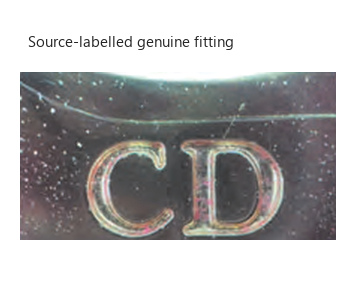
On any pre-owned candidate, the handle mounts warrant inspection from both exterior and interior angles. A loosened seat, stretched or torn leather fibers around an eyelet, or an inconsistent plating tone across the rings can reveal unannounced repairs or component replacements. An official boutique repair accompanied by service receipts is entirely acceptable, but an amateur hardware swap often leaves uneven seating or marred leather. An unexplained contrast between sparkling new hardware and abraded surrounding leather must be clarified before paying an exceptional-condition premium.
The shoulder strap clasp provides a dynamic mechanical comparison, presenting both the sculpted hardware contour and the engraved branding. Notice the curve of the cast metal around the inscription, the clearance of the gate opening, and the finish near the spring pivot. The complete clasp establishes the functional context of the fitting. Check the mechanical joint and gate alignment first; only after confirming that the clasp operates smoothly should you evaluate the depth and definition of the engraved lettering.
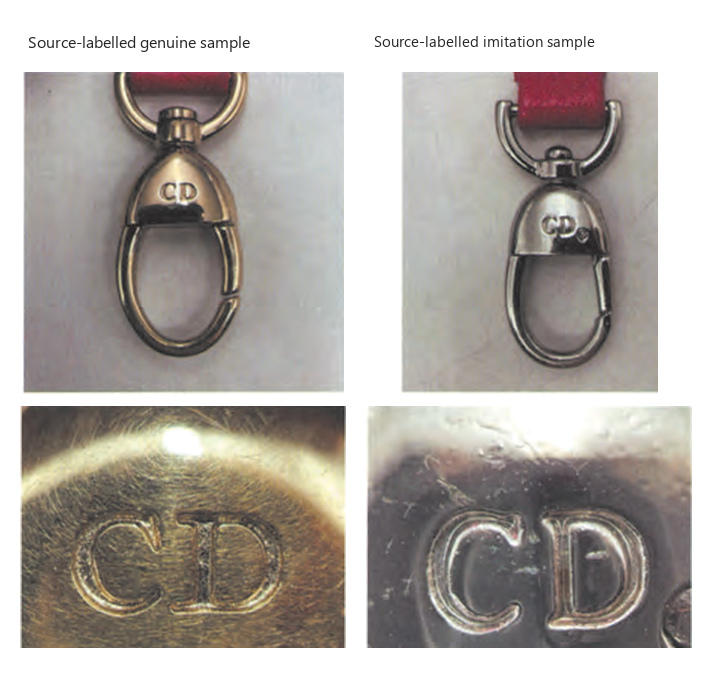
In practical verification, a clasp that operates with crisp spring tension and closes flush against its seat is vastly more reliable than the apparent darkness of an engraved word in a photograph. Request a short demonstration showing the clasp functioning while attached to the photographed bag; a detached strap photographed on a tabletop might be genuine yet belong to a different transaction entirely. Our dedicated hardware guide examines these moving connections, along with the feet and zipper mechanisms, in greater detail.
Finish inside, without letting the label take over
Moving into the interior cavity, begin with the complete leather brand panel rather than focusing solely on the heat stamp. In our genuine-labelled reference, the leather tab retains its finished edges, rounded lower corners, and balanced perimeter stitching. Observe how the tab is integrated into the lining pocket seam. That relationship between the leather cut, the stitch margins, and the lining fabric helps distinguish an authentic, gently worn impression from an aftermarket label that has been cut or stitched differently.
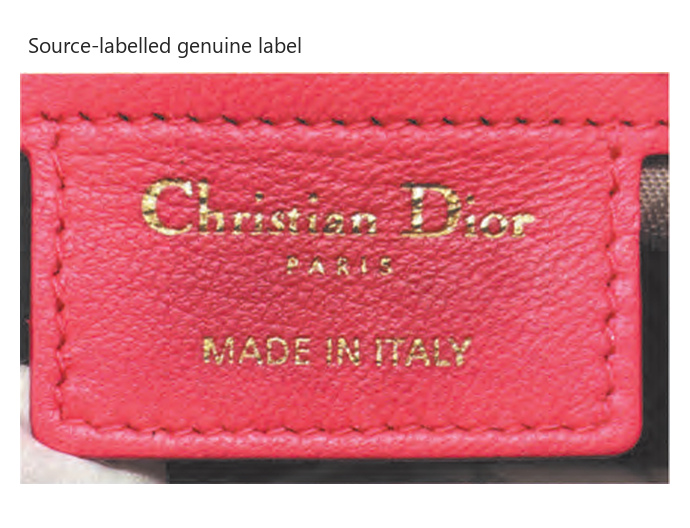
A legible Christian Dior Paris stamp is easy to overvalue; modern hot-stamping plates can replicate letterforms with deceptive precision. The more consequential questions concern contextual consistency: whether the leather grade, tab thickness, and placement match the verified model, and whether the foil wear looks natural alongside the rest of the interior. Never let a tidy label stamp distract from unresolved structural issues on the exterior. Our interior-label investigation analyzes a 2025 forum discussion in which buyers questioned an unfamiliar code format.
The interior inspection must also resolve critical condition questions that directly affect daily use. Request clear photographs deep into the bottom corners and under the zipper lip, where makeup residue, ink marks, or lining tears often hide behind a clean label photo. A reseller’s high condition grading for the exterior can easily mask interior flaws that require costly professional cleaning. In a sound buying process, physical authenticity and practical condition must be addressed simultaneously.
Decide what the remaining uncertainty costs you
Conclude your evaluation by pinpointing the exact nature of any remaining uncertainty. Perhaps the silhouette, Cannage geometry, and interior label align perfectly, but the seller has omitted views of the strap clasps. Or perhaps the hardware and leather look convincing, but the seller’s claimed production year conflicts with the hardware finish. Each specific gap dictates a distinct next step. Instead of making broad requests for more pictures, ask for the precise connection needed to settle the open question.
Hardware durability is an independent practical concern once authenticity is verified. In a Reddit discussion accessed in November 2026, a prospective buyer questions whether pink hardware will chip with use; responses include an owner reporting tarnish on traditional metallic hardware and advice on the sensitivity of colored finishes. The thread represents real buyer experiences rather than a laboratory test, highlighting that specialized finishes demand realistic expectations regarding wear. Always evaluate the specific finish and its existing contact marks before determining fair value. Original discussion and replies
When assessing a decorated or collaborative Lady Dior, establishing verified edition provenance takes precedence. On a classic core model, structural symmetry, balanced corner execution, and intact mechanical fittings carry the decisive weight. A matching presentation box or dust bag enhances ownership satisfaction, but collateral packaging cannot compensate for a questionable clasp or an asymmetrical base. Our dedicated packaging study explains how accessories contribute to resale documentation without overriding primary handbag evidence.
If a tangible structural contradiction survives your side-by-side comparison, pause the transaction until a qualified specialist inspects the bag in person. If the evidence aligns into a coherent, well-documented narrative, archive the seller’s listing, photos, and condition statements before completing payment. The point of examining the whole bag from bottom to top is to arrive at a well-reasoned buying decision with open risks clearly accounted for, rather than risking an expensive mistake on an isolated logo crop.