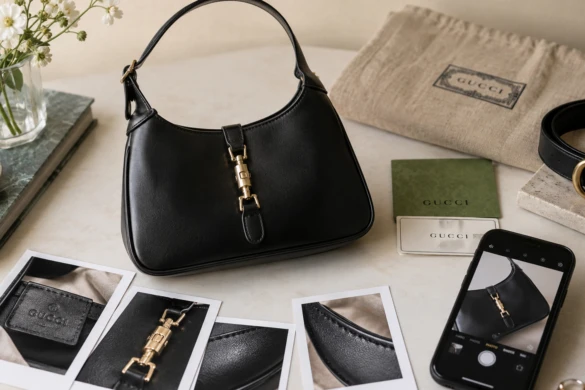
A seller sends a digital receipt, a close-up of a gold-embossed Dior stamp, and a photograph of a tissue-wrapped presentation box. Yet despite receiving half a dozen files, you still cannot see the base corners, the mechanical strap mounts, or the interior pocket construction. The evidence appears substantial simply because multiple images arrived, but the core handbag remains largely undocumented. A practical evaluation begins by identifying that information gap and systematically gathering the physical photographs required to assess the bag.
When evaluating a pre-owned Dior bag, I approach it as a rigorous, interconnected evaluation. Every pre-owned acquisition involves several related claims: the specific model reference, the design edition, the physical craftsmanship, the true wear condition, and the seller’s acquisition history. The objective is to test those claims against documented manufacturing standards. An unorganized collection of flattering close-ups can seem superficially persuasive while leaving the most critical structural contradictions completely hidden.
Table of Contents
Step 1: Identify the Exact Model and Version
Begin by establishing the exact model, size, material, production era, and claimed capsule edition in precise terms. If the seller possesses the original manufacturer reference number, record it immediately. Then compare the complete handbag against verified archival documentation. This foundational step eliminates wasted effort: an untrained buyer can easily spend hours searching for an interior zipper pocket on an authentic bag whose specific edition was deliberately designed with an open slip cavity.
My reference archive illustrates the wide diversity of foundational Dior silhouettes: the sculpted asymmetry of the Saddle bag, the architectural structure of the Book Tote, the tailored geometry of the 30 Montaigne, and the curved profile of the Bobby. These archival catalogue images demonstrate diverse design forms rather than artificial side-by-side tests. Historical catalogue entries provide structural context rather than guaranteeing contemporary pricing or the authenticity of an individual resale listing.
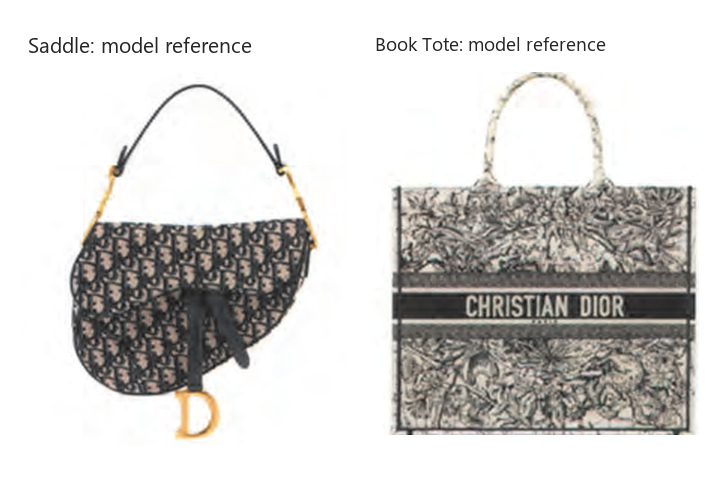
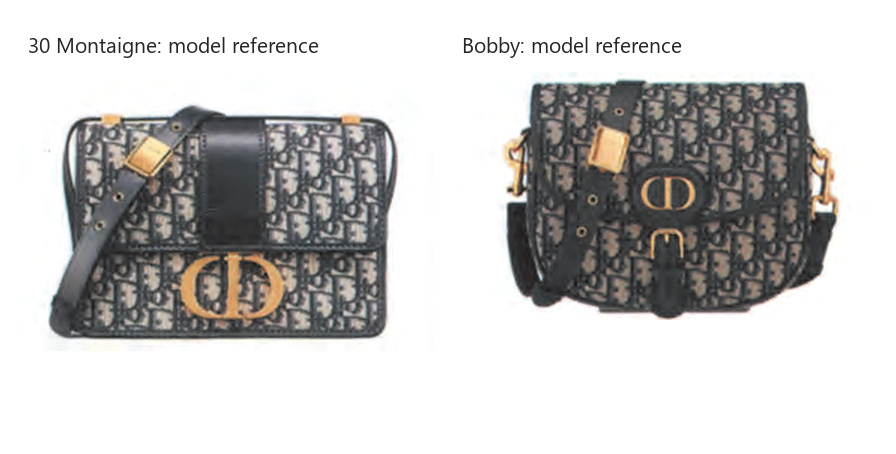
Distinct silhouettes establish completely different inspection priorities. A classic Lady Dior demands rigorous focus on the handle arches, eyelet seats, and charm suspension. An envelope flap bag such as the 30 Montaigne requires inspecting the closure alignment, push-mechanism spring action, and rear panel embossing. A large woven Book Tote shifts primary focus to yarn density, motif repeat alignment, and perimeter edge bindings. Prioritize these primary architectural relationships before examining small stamped letters that counterfeiters can easily mimic.
Version matching within a single product family is just as vital. The modern 30 Montaigne East-West, reference M9334UTZQ_M928, features a distinct 21 × 12 × 6 cm silhouette, a removable chain strap, and a single interior slip pocket, differing substantially from the classic flap. It must be evaluated against its own official reference rather than an image of a larger classic bag. I confirmed these active specifications in November 2026; an official catalog entry documents modern production standards rather than historical variations. Official East-West reference
Seasonal artistic capsules require equal precision. Dior’s Spring–Summer 2026 Clover edition incorporates hand-embroidered clovers and a sculptural ladybird charm over the Cannage framework. An evaluator must not allow an older, plain leather guide to mischaracterize authentic seasonal embroidery as aftermarket tampering. Equally, any seller claiming a rare special edition must provide verified reference documentation rather than using vague claims of rarity to excuse construction anomalies. Dior Clover
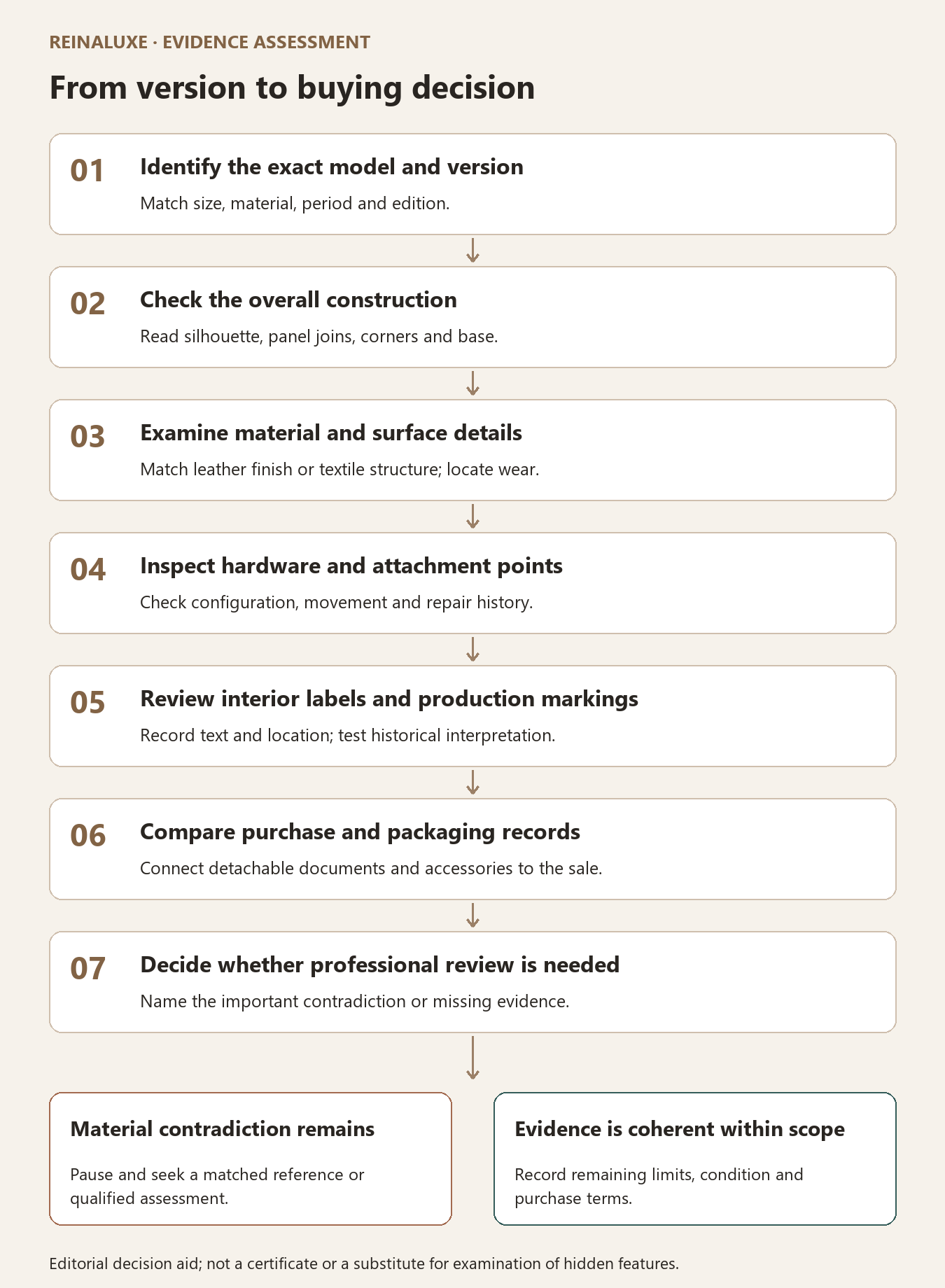
The seven-step verification methodology outlined below guides the evaluation from initial model identification to a confident buying decision. Each progressive stage narrows the remaining uncertainty: an initial silhouette mismatch redirects you to catalog references, while a loose hardware fitting initiates a condition appraisal. Provenance paperwork enters the evaluation only after the physical bag has been examined, and professional third-party authentication resolves any critical open questions that remain.
Step 2: Document the Actual Bag Through Photographs
Photographic appraisal must begin with comprehensive wide-angle overviews: front, back, both side gussets, the complete base, the top opening, and a wide interior cavity shot. These images establish foundational proportions and locate every component in space. Follow these overviews with focused close-ups of load-bearing mounts, perimeter seams, mechanical clasps, and interior markings. A macro photograph provides diagnostic value only when an evaluator understands where it sits on the overall bag; an isolated logo crop is left completely without structural context.
Insist that the seller photograph the actual handbag being offered, captured alongside any included accessories. A continuous video sequence panning from the exterior Cannage into the interior lining provides valuable confirmation that all details belong to a single physical object. However, video cannot measure leather density, internal stiffener integrity, or chemical coatings. If the assessment hinges on tactile qualities or internal mechanisms, an in-person physical evaluation is required rather than excessive digital magnification.
Formulate targeted requests for specific physical relationships rather than asking vaguely for more photos. If a strap clasp is shown detached, request a photo of the clasp hooked onto the bag’s D-ring. If a date code is cropped tightly, request a view of the complete leather tab integrated into the pocket seam. If a base corner appears distorted, ask for a level shot of the empty bag on a flat surface. Clear, logical requests make it easy for an honest seller to provide the necessary evidence.
Archive all original listing photographs and written communications immediately. Digital listings can be altered, descriptions edited, and image files compressed upon re-uploading. Maintaining reliable offline documentation of what was originally offered protects your consumer rights if the seller subsequently modifies claims regarding production year, included accessories, or wear condition.
Step 3: Inspect Structural Construction
Begin physical evaluation by examining overall structural geometry, tracing perimeter seams into load-bearing corners and bottom panels. Then inspect how metal fittings anchor into the leather or fabric. A well-proportioned body does not make fine details irrelevant, but it provides the essential foundation within which details must be judged. As explored in our guide to spotting fake designer bags, structural symmetry and seam tension consistently precede logo inspection.
For structured silhouettes like the 30 Montaigne collection, model-matching requires analyzing how dimensions, strap engineering, and interior pockets work together. Because clean reference archives often present the front CD clasp in full context but lack an attributed view of its reverse, a live purchase candidate must supply that view. Acknowledging this specific information gap is vastly more constructive than disguising it with an irrelevant macro shot of a different fitting.
Step 4: Evaluate Materials and Hardware
Hardware evaluation requires answering two distinct questions: is the fitting historically correct for this model edition, and what mechanical condition is it in? An unannounced hardware replacement can explain an atypical finish while significantly altering originality and fair market value. A wobbly handle ring or loose screw requires professional workshop service even on an authentic piece. In hands-on workshop inspections, tracing load paths from handle arches into the body reveals real-world friction and wear mechanisms.
Material surfaces demand equal rigor. Identify whether the hide is buttery lambskin, structured calfskin, high-gloss patent, or an alternative construction like Flat Cannage or Wicker before evaluating loft and texture. Wear naturally concentrates at bottom corners, the top opening, and handle contact points. In our guide to real versus fake leather, I explain how hide selection, tanning methods, and structural backing dictate surface behavior over time, dismantling the myth of a single universal puffiness standard.
Woven jacquard textiles operate under an entirely different material discipline. Evaluate the repeat layout across the front flap, macro twill crossovers, and edge terminations under leather trims. Examining authentic Oblique jacquard under magnification reveals the mechanical weaving process and friction wear patterns, allowing this guide to focus on practical evaluation priorities.
Step 5: Check Markings and Provenance
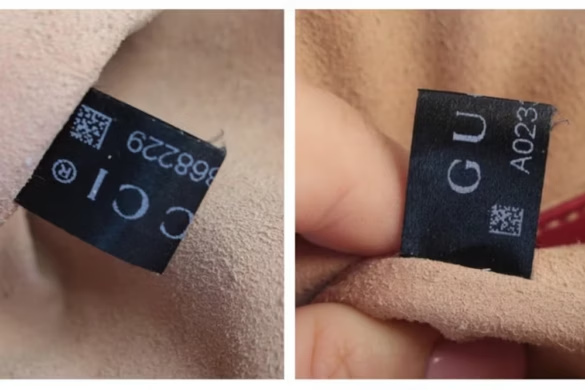
Interior markings—the brand debossing, the country of origin, and the alphanumeric production code—must be analyzed as separate evidence layers. Corroborate them with the verified model reference and physical materials. Code decoding requires verified reference documentation; dogmatic internet charts must never override documented historical reality. Documented interior label variations from the 1990s through recent seasons illustrate why rigid online code rules must not override historical reality.
Packaging and collateral paperwork sit further from the handbag because accessories can easily be swapped, married, or lost over time. An invoice confirms a retail transaction, a barcode tag suggests a style number, and a dust bag provides storage; their legitimate association with the specific bag being purchased must be verified. Examining genuine collateral across different retail channels demonstrates what packaging can and cannot prove.
Now test the seller’s narrative against the verified physical evidence. Does the claimed production year match the specific hardware finish and label format? Does the disclosed repair history explain a fresh screw or re-stitched seam? Does the condition description acknowledge visible contact marks beneath the handle rings? A trustworthy seller provides specific, transparent answers; vague reassurances of authenticity in place of requested photographic proof leave the claim unverified.
Step 6: Understand Third-Party Authentication
Community forums offer valuable crowd-sourced insight for uncovering obsolete rules and locating comparable archival examples. PurseForum explicitly clarifies that its authentication thread responses reflect member opinions based on shared collector experience, rather than legally binding commercial certifications. Recognizing this distinction is vital when deciding what level of verification you require: an informal second opinion and a contracted commercial appraisal with stated dispute liabilities serve different consumer needs. PurseForum guidance
Before hiring a paid authentication service, ask the platform or payment provider handling your transaction whether it accepts third-party reports, requires a named provider, or specifies particular evidence and deadlines. Check whether it requires physical inspection rather than a photo assessment. Then ask the service about its Dior expertise, the documentation it supplies and how it handles inconclusive results. Commissioning a report does not guarantee that a platform will accept it or resolve a dispute in your favor.
Industry data provides helpful platform submission statistics regarding pre-owned market activity. Entrupy’s 2026 State of the Fake report, based on underlying 2025 activity, documents Dior as representing 4.68% of all luxury items submitted to its platform, and notes that 8.97% of Dior submissions yielded an unidentified result. These metrics reflect a commercial submission sample from resale businesses, rather than a randomized scientific survey of all Dior handbags circulating globally. Crucially, an unidentified result is an inconclusive outcome that differs fundamentally from a confirmed counterfeit. Entrupy report and tables
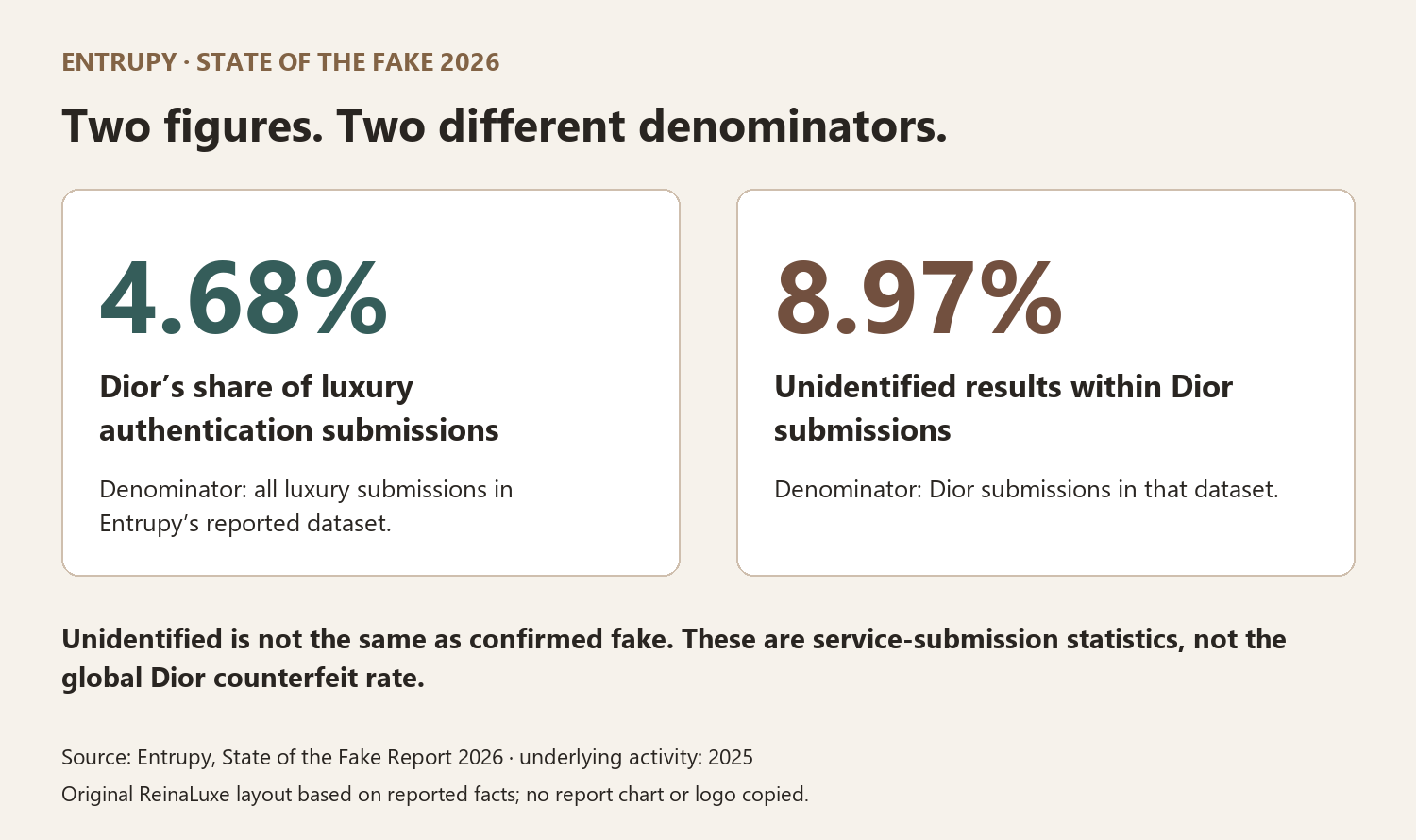
The accompanying chart separates these two distinct denominators: submission volume among luxury brands versus outcome classifications within Dior submissions. Neither number provides the mathematical probability that an individual bag in your shopping basket is fake. Entrupy’s advertised accuracy rate reflects the company’s proprietary claims rather than an independent validation by this publication. Select an authentication partner based on transparent methodology, model expertise, and actionable dispute terms; a headline marketing statistic cannot authenticate the bag in your hands.
Step 7: Make the Purchase Decision
At the conclusion of your evaluation, categorize any remaining open questions by the concrete action they demand. A blurry date code requires a clean macro photograph. An unfamiliar capsule edition requires verifying official savoir-faire records. A loose handle mount requires a professional repair estimate. A persistent structural contradiction across seams, hardware, and materials justifies walking away from the deal. Pinpointing the exact nature of the risk prevents vague anxiety from paralyzing your decision.
Commercial terms are just as crucial as physical craftsmanship in managing transaction risk. Record the seller’s verified platform identity, the agreed inclusion inventory, the explicit return window, and the formal dispute resolution mechanism before transferring funds. Retain all written disclosures. These records do not alter how leather was stitched, but they determine whether you possess effective financial recourse if the delivered item deviates from the authenticated listing.
I advise finalizing a purchase only when the verified model edition, physical construction, wear condition, and seller provenance unite into a grounded, confident assessment, with any minor disclosed flaw reflected fairly in the purchase price. If a material contradiction remains unresolved, postpone the transaction until physical inspection is possible. A reader-first evaluation delivers a clear, defensible decision: you know exactly what has been inspected, what risks have been eliminated, and why the acquisition makes practical sense.
Before committing to a secondhand Dior, compare the report you have with the pre-owned guide’s platform and dispute rules. Check whether that seller will accept a photo-based opinion or requires a physical examination.
How should I evaluate the Cannage quilting and hardware on a Lady Dior?
Examine geometric alignment and quilt symmetry first. Authentic Lady Dior Cannage features disciplined, uniform stitch tension across every diamond without puckering. Stitch counts per diamond side vary depending on the bag’s size (such as Micro, Mini, Medium, or Large) and production era, but the stitching density should remain consistent across all exterior panels. Vintage lambskin naturally softens and deflates over decades, while calfskin retains firmer loft. For hardware, authentic DIOR letter charms, oval eyelets, and handle rings have solid metal weight with gently chamfered, smooth edges and consistent electroplating luster. Rough mold casting lines, razor-sharp stamped edges, or lightweight hollow fittings indicate counterfeit construction.
What should I look for in the interior leather tag and Dior date code?
The interior leather tag on authentic Dior bags typically features rounded bottom corners with clean, uniform single-needle perimeter stitching. The front heat stamp reads ‘Christian Dior’ followed by ‘PARIS’ and ‘MADE IN ITALY’ (or ‘MADE IN SPAIN’) with crisp font proportions and clean debossing depth. On the reverse, modern bags produced since the late 1990s display an alphanumeric date code, commonly in a two-number, two-letter, four-number configuration (where letters denote the workshop location, and the first and third digits indicate the month while the second and fourth denote the year). However, date codes alone do not prove authenticity: counterfeiters replicate valid alphanumeric sequences effortlessly, and vintage bags from the 1980s or early 1990s may have differing code lengths or no date stamp at all. Date codes must always be verified alongside physical construction.
How do I verify a Dior Book Tote and its Oblique embroidery?
An authentic Book Tote is an architectural piece of dense, high-tension jacquard weaving and multi-needle embroidery. Inspect the central ‘CHRISTIAN DIOR PARIS’ signature banner: the typography is crisp, perfectly centered, and flat against the background, with dense, matte thread. The letterforms have clean serifs and uniform kerning without stray connecting bridge threads between letters. On the Oblique pattern, check the diagonal repeat alignment across seam junctions and edge bindings. Authentic jacquard exhibits tight, continuous thread tension without loose yarn loops, fuzzy bleeding, or shiny synthetic polyester sheen.
Can a Dior bag be authenticated solely through listing photos?
Photographs provide valuable initial screening to eliminate obvious fakes and verify basic proportions, but remote image evaluation has inherent limits. Digital images cannot measure leather density, internal stiffener firmness, the scent of genuine hides, or the exact spring tension of mechanical closures. High-end modern replicas frequently mimic surface details while cutting corners on internal structure and metal alloys. If photo evaluation leaves unresolved contradictions or if substantial financial sums are involved, insist on an inspection period or rely on physical hands-on verification before finalizing your purchase.