
Editor’s note — updated July 2026: This page remains a review of three specific 2025 Goyard replica samples: a red Saïgon Structuré Mini, a black Anjou Mini and a blue Saint Louis PM-style tote. I have not converted it into another general 2026 buying guide. Instead, I reworked it as a sample-led comparison: what the photos support, what still needs video or measurement, and how the three models create very different quality-control risks.
This is a comparison of the supplied photographs: pattern clarity, edges, proportions and symmetry. Material and production descriptions are supplier claims; handling and dated follow-ups would add the missing information about movement and wear.
The commercial language remains because buyers still search for AAA Goyard replica bags, mirror quality, Top Tier and Ultimate Tier. None of those labels is a regulated grade. My recommendation is therefore based on the specific bag, the authentic model benchmark, the seller’s QC evidence and the defects visible in the supplied sample photos—not the tier name alone.
For a broader current-model overview that also covers the Artois, see the updated Goyard Replica Bags 2026 guide. This page has a narrower purpose: comparing these three photographed samples and explaining which checks matter most for each one.
Table of Contents
How to Read This 2025 Review in 2026
The original version mixed three different kinds of statements: observations from the article photos, claimed hands-on experience and broad conclusions about the entire 2025 replica market. The revised version treats those separately.
| Evidence level | What it can support | What it cannot support |
|---|---|---|
| Still photos | Overall proportions, visible symmetry, print sharpness, handle placement, obvious glazing defects and hardware alignment. | Material composition, real weight, smell, flexibility, long-term colorfastness or durability. |
| Movement video | Canvas stiffness, handle recovery, Anjou reversibility, Saïgon closure function and whether panels twist under normal handling. | Leather grade, coating chemistry or how the bag will perform after months of use. |
| Measurements and scale weight | Whether the sample is close to the intended model size and whether left-right geometry is plausible. | Authenticity by itself; a correctly sized bag can still have poor materials and assembly. |
| Long-term owner record | Handle cracking, corner abrasion, glazing behavior, print wear and structural fatigue. | How every bag carrying the same factory or tier label will perform. |
I therefore describe this as a photo-led batch review, not a laboratory test or a verified six-month wear study. Where the images support a useful conclusion, I state it. Where they do not, I turn the claim into a concrete request the buyer can send to the seller.
What “AAA Goyard Replica” Means Here
AAA, 1:1, Mirror Quality and Ultimate Tier are seller-defined terms. I keep the label beside the exact version and photographs, because different sellers can use the same wording for different products.
For this article, I use “AAA Goyard replica” only as a search term and shorthand for a buyer’s expected quality level. A sample earns a positive recommendation only when the evidence bundle is strong enough:
- Model accuracy: the intended model, size and construction are clearly identified.
- Batch-specific evidence: the seller supplies photos of the exact bag rather than catalogue images alone.
- Geometry: handles, panels, corners, rods, feet and closures align as the model requires.
- Material behavior: video shows the correct degree of softness, rigidity or reversibility for that model.
- Finish consistency: glazing, thread, stamping and hardware are consistent across the entire bag—not perfect in one macro photo and careless elsewhere.
- Claim discipline: the seller can distinguish what is known from what is promotional language.
This is a more useful standard than the old B/C/A/AAA ladder. The ladder creates the illusion of an industry-wide specification; in practice, evidence quality is more predictive than the number of A’s in the listing.
Authentic Benchmarks for the Three Models
| Model | Official benchmark | What changes in replica QC |
|---|---|---|
| Saïgon Structuré Mini | 20 × 7.5 × 15 cm; approximately 350 g; structured body; riveted beech handle and rods; bottom studs, leather corners and trunk-style hardware. | The front geometry, handle centering, rods, corner hardware and side gussets must all agree. It has the highest assembly risk of the three. |
| Anjou Mini | 19.5 × 9 × 19.5 cm; approximately 280 g; Chevroches calfskin and Goyardine canvas; reversible construction; 17 cm handle drop. | Both exterior faces matter. A seller showing only the canvas side is withholding half of the relevant QC evidence. |
| Saint Louis PM | 34 × 15 × 28 cm; approximately 280 g; unlined and extremely lightweight; reversible; 18 cm handle drop; removable pouch. | Natural drape, handle-root placement, base folds and behavior under a light load matter more than rigid “perfect structure.” |
Authentic dimensions and construction are taken from Goyard’s current model pages; they are reference points, not proof that a replica is authentic.
Official references: Saïgon Structuré Mini, Anjou Mini and Saint Louis PM.
Saïgon Structuré Mini Replica Review
Sample shown: red structured Mini with silver-tone trunk details.
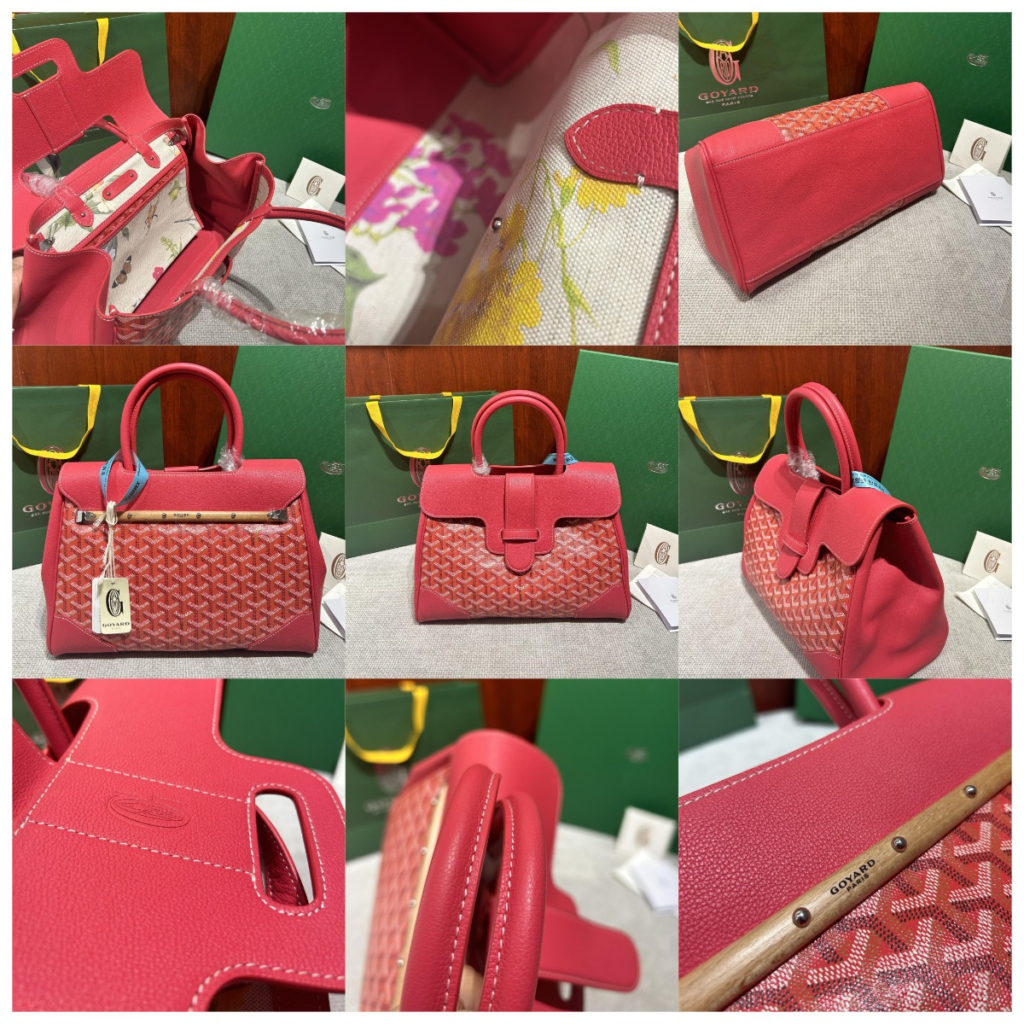
Of the three samples, this is the one I would inspect most aggressively. The Saïgon does not allow a weak factory to hide behind a soft tote silhouette. Its front panel, flap, handle, wooden rods, metal corners, feet and side gussets form a single geometric composition. A small error in one component can make the whole bag lean or look visually top-heavy.
What the supplied photos can support
- The bag is presented as a structured Saïgon Mini rather than the lighter Saïgon Souple.
- The collage provides useful views of the front, handle, flap and trunk-style hardware.
- The red color appears reasonably controlled in the supplied lighting, without an obvious fluorescent cast.
- The visible rods and hardware appear broadly centered in the selected images.
Questions Beyond the Close-up
- Ask for the handle’s stated material, then inspect the finish, joins and movement in a short video.
- Request the lining and hardware specifications in writing, with the supplier identified.
- They do not show whether the closure operates smoothly, whether the bag rocks on its feet or whether the side gussets open symmetrically.
- They do not verify the official 20 × 7.5 × 15 cm dimensions or approximately 350 g benchmark.
My QC decision rule for this sample
I would request one straight, camera-level front photo with no wide-angle distortion; one base photo showing all four feet; one side-by-side image of the left and right gussets; and a short video opening and closing the flap. I would also ask the seller to rotate the handle and rods slowly under natural light. The purpose is not to “prove real wood” through video—it is to reveal plastic-like mould seams, uneven varnish, dents and hardware movement that catalogue photos can hide.
Verdict: visually attractive, but the highest-risk purchase of the three. It deserves the largest evidence bundle and the least tolerance for “factory photos only.”
Anjou Mini Replica Review
Sample shown: black Mini with a canvas face, leather face and removable pouch.
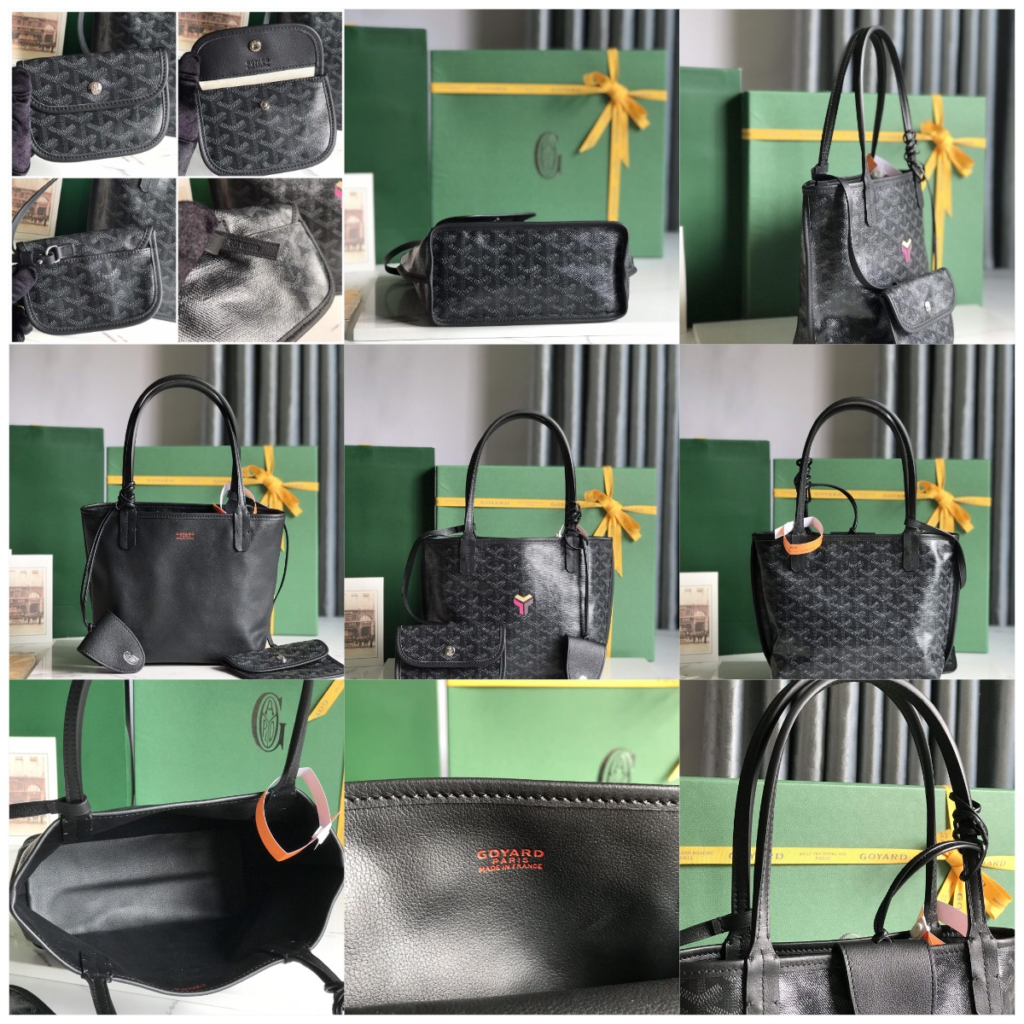
The Anjou is often described as a more luxurious Saint Louis, but that description misses its main QC difficulty: it is designed to work in two orientations. The leather side cannot be treated as an interior lining that buyers will never see. When reversed, it becomes the exterior, and every rim, handle root, pouch attachment and fold becomes visible.
What the supplied photos can support
- The sample includes views of both the Goyardine-style canvas and the black leather surface.
- The darker colorway reduces the visibility of minor print-tone variation, which can make it easier to wear discreetly.
- The pouch and handle proportions can be compared with the main bag within the same collage.
Where the original review overreached
For the reversible design, I would request one continuous video turning the bag from canvas-out to leather-out and back. Watch the corners and top edge during the turn, then check how each side settles.
My QC decision rule for this sample
- Watch the top rim: it should turn without sharp whitening, edge-paint separation or permanent rippling.
- Watch the handle roots: they should not twist in opposite directions or pull the upper edge into an uneven wave.
- Check both bases: the leather side and canvas side should each sit plausibly when used as the exterior.
- Inspect the pouch: its leather, edge paint and pattern should belong to the same quality level as the main bag.
- Ask for natural-light leather video: this reveals artificial gloss, inconsistent grain embossing and surface creasing more effectively than a still macro.
Goyard’s own care guidance specifically warns against rubbing rough surfaces when the Anjou is worn leather-side out. That changes my recommendation: reversibility is a design benefit, but the leather face is not automatically the carefree side. Buyers who want a low-maintenance open tote may still prefer the lighter Saint Louis.
Verdict: the most versatile of the three, provided the seller proves both faces and the reversal process. I would reject a listing that presents only the canvas side and calls the bag “fully reversible.”
Saint Louis PM Replica Review
Sample shown: blue PM-style tote with a special printed interior and removable pouch.
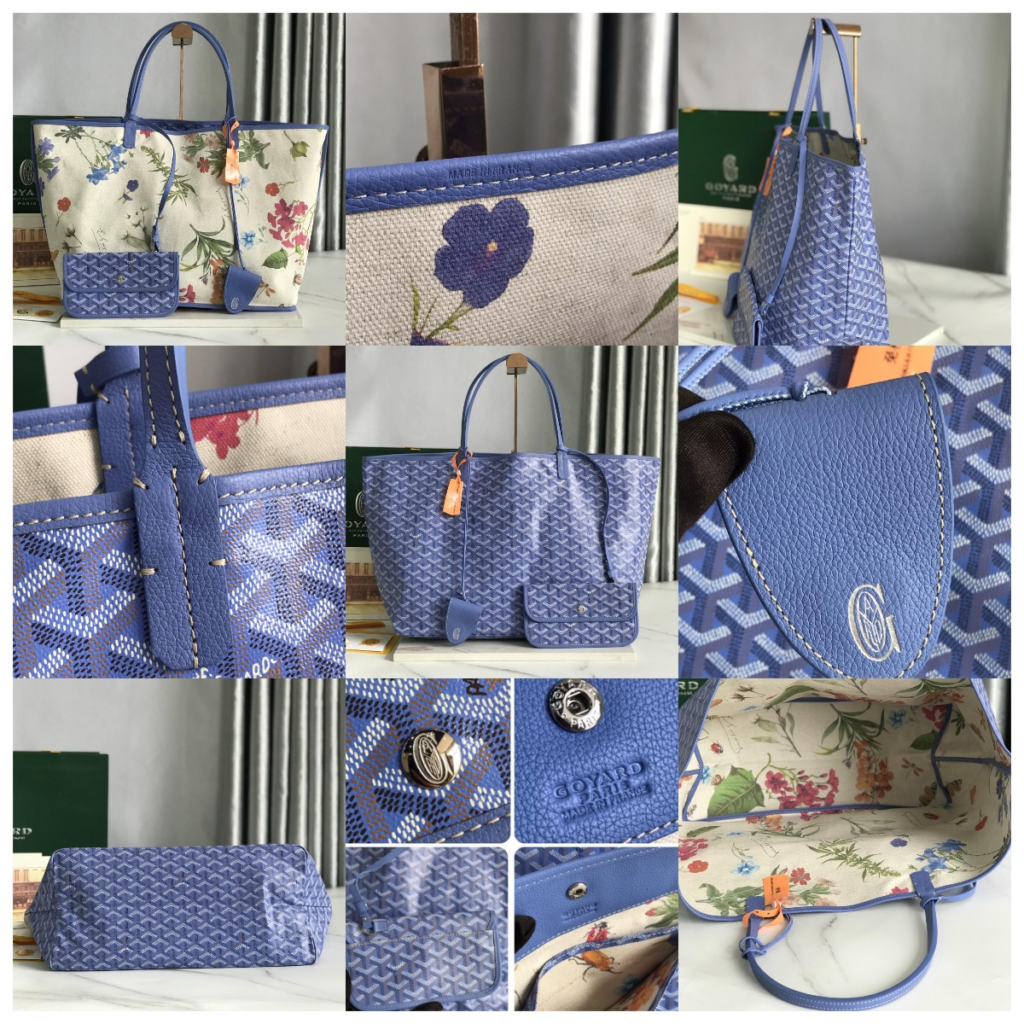
The Saint Louis is structurally the simplest sample, but simplicity does not make it easy to judge. A lightweight, unlined tote should not be assessed like a rigid work bag. Some slouch, waviness and movement are part of the design language. The problem is distinguishing natural drape from poor cutting, uneven handle placement or a distorted base.
What the supplied photos can support
- The sample presents a lightweight open-tote format with thin leather handles and a removable pouch.
- The interior print appears visually crisp in the selected collage and does not obviously bleed through in those images.
- The blue exterior and interior design create a higher reference-matching burden than a standard colorway.
The limited-edition problem
The original article called this a specific limited edition and treated the botanical interior as proof of advanced reproduction. The photos alone do not identify the exact authentic release, season or official pattern placement. For special editions, I would require the seller to name the reference and then compare the sample with reliable authentic images of that exact version. A beautiful interior can still be an invented fantasy pattern.
My QC decision rule for this sample
- Request the empty bag photographed flat from the front and back.
- Request a base photo showing the four lower folds and corner shape.
- Ask for a light-load video using ordinary items—not a heavy laptop stress test—to see whether the handles pull evenly.
- Measure the bag against the 34 × 15 × 28 cm PM benchmark and check the approximate 18 cm handle drop.
- Compare the pouch size, attachment point and print direction with the main body.
- For a special interior, match the motif placement, color sequence and edge transitions to the named reference.
The official Saint Louis care instructions say not to carry excessively heavy items, and the model was originally conceived as a beach bag. This is why I no longer describe it as an effortless laptop tote. It can carry daily essentials, but a laptop, charger, water bottle and planner concentrate stress at the narrow handle roots. Buyers prioritizing a zipped, reinforced work tote should compare the Artois instead.
Verdict: the easiest of the three to use casually and the least hardware-dependent, but special-edition accuracy must be verified separately from general construction quality.
What Community Comparisons Change in My Recommendation
Community comparisons are most useful when they expose variation that a generic authentication checklist misses. Two recurring signals changed the way I evaluate these samples.
1. Color and print depth require side-by-side context
In an owner comparison of burgundy authentic and replica Goyard pieces, the replica was described as slightly brighter and redder, while the authentic looked darker with a browner undertone. Commenters also focused on print saturation and the three-dimensional visual effect. The practical lesson is not that one universal red formula exists. It is that color should be compared against the same model, color and lighting—not judged from a seller’s isolated studio photo.
How it changes my recommendation: for the red Saïgon and blue Saint Louis sample, I would prioritize a natural-light comparison or at least a grey-card photo over another extreme close-up of the Y pattern.
2. “The Ys touch” is a screening check, not a verdict
Replica discussions frequently use touching Y tips as a quick check. That can identify crude spacing errors, but a bag can pass that single test and still have the wrong color balance, dot shape, panel alignment, handle geometry or edge finish. The print also needs to be evaluated across seams and curves rather than in one carefully selected flat section.
How it changes my recommendation: I use Y spacing as one item inside a wider evidence record, not as a pass/fail authentication shortcut.
3. Work-tote expectations should match the model
Owner discussions repeatedly ask whether the Saint Louis can tolerate a laptop, charger and planner. That question itself is useful evidence: buyers often select the model for a job it was not primarily designed to do. Goyard’s own care guidance warns against excessive weight.
How it changes my recommendation: I recommend the Saint Louis for lightweight, flexible use; the Anjou when reversible leather is worth the added care; and the Saïgon when structure and visual detail matter more than capacity.
Photo and Video Evidence Checklist
Instead of asking a seller whether a bag is “AAA,” request a model-specific evidence set. These are the minimum files I would want before approving one of the three samples.
| Evidence request | Saïgon | Anjou | Saint Louis |
|---|---|---|---|
| Straight front and back photos | Check rods, flap and hardware symmetry | Check handle placement on both faces | Check body width and natural drape |
| Left and right side profiles | Essential for gusset symmetry | Useful for fold consistency | Useful for base taper and seam position |
| Base and all corners | Check feet and corner hardware | Check both material faces at the base | Check folds, abrasion and panel distortion |
| Natural-light canvas macro | Check color and print near hardware | Check canvas face and rim transition | Check print across a broad flat area |
| Handle-root macro | Check leather and hardware junction | Check twisting after reversal | Check stitching, glazing and equal spacing |
| Continuous function video | Open/close flap; rotate handle | Reverse bag both directions | Empty-to-light-load drape test |
| Scale and tape measure | Compare with 350 g and 20 × 7.5 × 15 cm reference | Compare with 280 g and 19.5 × 9 × 19.5 cm reference | Compare with 280 g and 34 × 15 × 28 cm reference |
| Pouch/interior details | Inside pocket and lining | Pouch quality on both orientations | Pouch, attachment and special interior reference |
Save these files with the seller name, date, claimed tier, model, color and final decision. This prevents a later factory photo from being mistaken for the exact bag that was approved.
Expected Wear vs. a Quality Defect
| Observation | Potentially normal | Reason to reject or investigate |
|---|---|---|
| Saint Louis body becomes softer | Gradual slouch from an unlined lightweight tote | Immediate one-sided collapse caused by uneven cutting or handle placement |
| Minor corner abrasion | Surface wear after repeated contact with rough edges | Print or coating lifting before use, or cracking along an entire fold |
| Anjou leather creases during reversal | Temporary flex lines that relax after the bag is reshaped | White stress marks, edge separation or permanent sharp buckling |
| Saïgon wood develops fine marks | Small surface scratches from contact | Mould seams, peeling wood-effect film, loose rods or cracked handle joints |
| Glazing varies slightly around curves | Minor thickness variation without cracking | Sticky edges, bubbles, color mismatch, splitting or paint covering the stitch holes |
| New-product odor | A faint packaging or material smell that dissipates | Strong solvent or gasoline-like odor that persists and irritates |
A fixed promise such as “the corners will remain perfect for eight months” is not credible without controlled use conditions. Wear depends on load, climate, friction, storage and the individual batch. I prefer observable thresholds: what the bag looked like before use, when the change appeared and whether it affects function.
For the broader terminology behind AAA, mirror, Top Tier and Ultimate Tier, see our AAA Replica Bags Guide. For close-up inspection principles that apply across brands, use the Luxury Bag Craftsmanship Guide.
Final Recommendation
Choose the Saïgon Structuré Mini when the goal is a compact statement bag and you are willing to perform the strictest QC. It offers the most visual detail, but also the most ways for assembly errors to appear.
Choose the Anjou Mini when two usable faces and leather feel matter more than capacity. Approve it only after seeing an uninterrupted reversal video and close-ups of both sides.
Choose the Saint Louis PM when lightweight, open-tote convenience is the priority. Do not confuse its relaxed structure with a reinforced laptop bag, and verify any special-edition interior against the exact named reference.
Among these three photographed samples, the Anjou is the most balanced recommendation, the Saint Louis is the easiest casual choice, and the Saïgon is the highest-reward but highest-QC-risk option. That conclusion is based on model complexity and available evidence—not on an assumption that every bag carrying the same AAA or factory label will be identical.
Frequently Asked Questions (FAQs)
Does “AAA Goyard replica” identify a consistent quality level?
No. AAA, Mirror Quality and Ultimate Tier are seller-defined terms. Use them as search language, then verify the exact model, measurements, structure, finish and batch-specific QC evidence.
Which of these three Goyard models is hardest to verify from photos?
The Saïgon Structuré Mini. Its handle, rods, flap, corner hardware, feet and gussets must align as one structured system, and still photos cannot verify the material or closure function.
Is the Saint Louis PM a good laptop bag?
It is an extremely lightweight, unlined tote, and Goyard advises against carrying excessively heavy items. Occasional light use may be practical, but a laptop plus charger, bottle and planner concentrates stress at the narrow handle roots.
Should an Anjou Mini replica be fully reversible?
The authentic Anjou Mini is designed to be reversible. A high-tier replica claim should therefore be supported by photos of both faces and a continuous video showing the bag reversed without edge separation, severe whitening or handle twisting.
Can photos prove that a Saïgon replica uses real beechwood?
A photograph shows the handle’s finish and visible joins. To check a beechwood claim, ask for the supplier’s material documentation; for the practical comparison, request a close-up and movement clip.
Are touching Y tips enough to identify a high-quality Goyard replica?
No. Y spacing is only one screening detail. Color balance, dot shape, print saturation, panel alignment, handle geometry, glazing, hardware and model-specific construction must also be assessed.

12 comments
I’ve been burned before buying a cheap Goyard from a random site, and it smelled like gasoline for months. Does the AAA grade Saint Louis you reviewed actually smell like nothing? Or does it still have that factory scent?
The review recorded no chemical odor in the AAA samples discussed, including the blue Saint Louis: a neutral textile scent at the canvas and a leather-like scent at the trim. For another unit, ask about its current condition rather than transfer that observation to a seller’s whole range.
I’ve been burned before buying a cheap Goyard from a random site, and it smelled like gasoline for months. Does the AAA grade Saint Louis you reviewed actually smell like nothing? Or does it still have that factory scent?
Good question, Sarah_J. On the sample documented in the review, I can note whether there was a strong chemical odor, but scent alone is not a reliable authentication test. I put more weight on grain structure, coating, flexibility, edge treatment and construction.
Great review! I’m eyeing that red Saïgon Mini. My biggest fear is the wooden handle. Does it feel lightweight and hollow? I held a real one once and the wood was quite dense.
For the red Saïgon, ask for the actual handle material and the bag’s weight, then inspect the surface and attachments. Weight and a matte finish alone cannot establish beechwood. I cannot substantiate the earlier touch-test claim from the available photographs.
Great review! I’m eyeing that red Saïgon Mini. My biggest fear is the wooden handle. Does it feel lightweight and hollow? I held a real one once and the wood was quite dense.
Thanks for asking, BagLover88. The handle can be judged for weight, density in hand, surface finish and joinery, but I wouldn’t identify the wood species without material evidence. For the reviewed sample, I’d keep the conclusion limited to those observable characteristics.
Is the Anjou actually usable inside out? I feel like the leather side usually looks wrinkly on fakes.
On the B-grade versions, yes, the leather is often too stiff or wrinkles badly. But on this black AAA Anjou I reviewed, the leather is pebbled calfskin. It’s soft enough to flip easily but structured enough to look smooth when worn on the leather side. Check the close-up photo in the article—the grain is lovely!
Is the Anjou actually usable inside out? I feel like the leather side usually looks wrinkly on fakes.
That distinction matters, Chloe_Fashion. For leather, I separate what I physically observed from what a seller or source claims. I focus on grain irregularity, coating, flexibility, rebound, edge finishing and how the surface reacts to light and pressure; those observations are more defensible than a grade label or claimed tannery source.