

This page began as a best Hermès replica bags 2025 market review. The updated version keeps the Birkin 25, Kelly 28 and Constance 18 because they still represent three very different buying decisions, but it removes the old assumption that a price band, a “Mirror Grade” label or a claimed tannery automatically predicts quality.
I now use three evidence layers. Hermès and established auction references define the intended design, construction and leather behavior. Cyan’s market perspective helps interpret the Top Tier, Ultimate Tier and Handmade Custom vocabulary buyers actually encounter. Long-form community reviews then show where individual bags varied despite similar source claims. None of those layers, by itself, proves the quality of the current item.
My bottom line before the details: AAA, Mirror Grade, Top Tier, Ultimate Tier and Handmade Custom are useful market-routing terms, not controlled standards. Community shorthand such as DDMode, Steven/GPCMode and UB may help a buyer locate relevant comparisons, but I would still approve or reject a bag from the current PSP evidence. For Hermès models, leather behavior, geometry and functional hardware usually tell me more than packaging, stamps or a seller’s tier name.
Table of Contents
Three Models, Three Different QC Problems
The old article applied the same leather, hand-stitching and hardware claims to all three bags. That sounds technical, but it hides the fact that each design exposes a different failure mode.
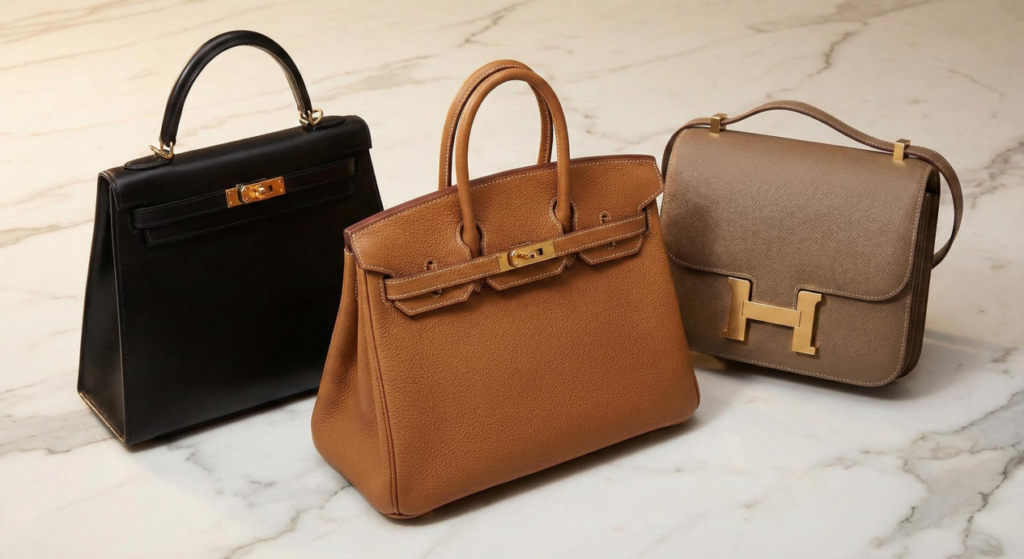
| Model | What defines it | Most revealing failure | Best evidence format |
|---|---|---|---|
| Birkin 25 | Compact body, paired rolled handles, balanced flap/sangles and a stable base | A bag that looks luxurious in close-up but reads skewed through the handles, side panels or feet | Square-on front/back, matched sides, top and base photos |
| Kelly 28 | One top handle, trapezoidal body and a clear Sellier or Retourne construction language | A reference mismatch: judging a soft Retourne as if it should have Sellier sharpness, or accepting a Sellier with weak edges | Construction-matched stills plus a continuous closure and strap video |
| Constance 18 | H closure, shallow rectangular body, expandable gussets and a sliding shoulder strap | A centered-looking front that hides a mis-seated clasp, uneven gussets or a strap that drags and distorts the body | Hardware macros, matched side views and one uncut function video |
This model split is the first information gain. Instead of asking whether all three bags are “fully handmade,” I ask whether the evidence proves the feature that carries the design. A Birkin 25 cannot hide poor compact geometry. A Kelly 28 cannot be assessed without identifying Sellier versus Retourne. A Constance 18 cannot be approved from a front glamour shot because the closure and strap are part of the bag’s structure.
Record the Exact Configuration Before Comparing
Many false QC conclusions begin with a mismatched reference. Togo, Epsom, Clémence, Swift and Box do not produce the same surface or silhouette. Sellier and Retourne do not place seams in the same way. Gold-tone and palladium-tone hardware can also read differently under warm studio lighting.
| Field to record | Why it matters |
|---|---|
| Model and size | Birkin 25, Kelly 28 and Constance 18 have different proportions from adjacent sizes; do not scale a reference by eye. |
| Construction | For Kelly and some Birkin variants, identify Sellier or Retourne before judging edge sharpness, seam visibility or capacity. |
| Leather family | Togo and Clémence are expected to relax differently from Epsom or Box. Grain and drape must be compared within the same family. |
| Color and thread | Contrast stitching, tonal stitching and lighting can change how stitch angle and edge paint appear. |
| Hardware finish | Gold-tone, palladium-tone and other finishes require a neutral-light reference; a warm photograph is not proof of the wrong tone. |
| Claimed source and order date | Community labels and batches change. Record the claim for later comparison, but do not treat it as provenance. |
I also save the seller’s factory photos separately from the PSPs. Reused catalog images show what was advertised; PSPs should show the actual bag. Mixing the two makes it easy to approve a configuration rather than the item that will be shipped.
Birkin 25: Compact Geometry and Handle Balance
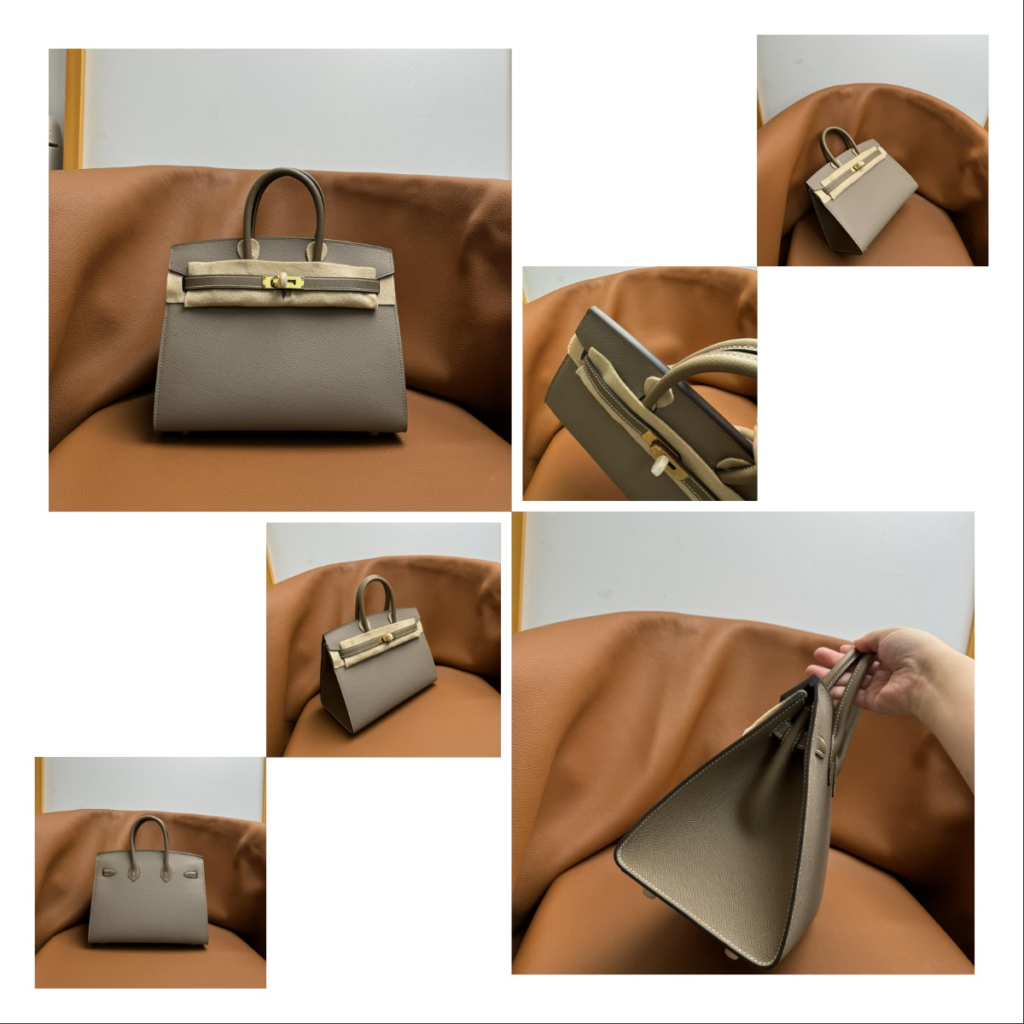
The Birkin 25 magnifies small proportion errors. The body is compact, so a handle that leans, a high flap wing or a side panel with different tension changes the whole silhouette. This is why I begin with geometry and only then move to leather and stamps.
1. Read the two handles as a single system
The handles do not need to be rigidly identical in every frame, especially if the bag has been packed or one handle is resting forward. What matters is whether the roots are placed symmetrically and whether both arcs emerge from the body with comparable height, width and rotation.
- Handle roots: compare the four attachment points. One should not sit visibly higher or closer to the center.
- Arc and lean: ask for a front photo with both handles standing naturally, not held together by hand.
- Bridge relationship: check whether the handle pair visually centers over the flap, touret and base.
- Side pull: matched side photos can reveal one handle root pulling a panel inward.
I do not use one universal handle-drop number from an online listing as a pass/fail rule. Handmade references vary slightly, and camera height can exaggerate the opening. A matched reference and symmetrical placement are more useful than a single measurement taken from a curved object.
2. Follow the flap, sangles and touret before reading the stamp
With the bag closed, the flap should settle without one wing rising or forcing a sangle into a different angle. The touret should look centered within the entire closure system, not merely centered on its own leather patch. A crisp logo stamp cannot rescue a closure that pulls the front panel sideways.
Request one continuous clip showing the flap opening, both sangles moving through the pontets, and the touret turning. The goal is not to demand a theatrical “luxury click.” It is to see whether the parts align, move without scraping and return to a neutral position without the seller reshaping the bag between cuts.
3. Separate intended leather behavior from structural collapse
Hermès and current collector references describe the Birkin across smooth and grained leathers, with softer leathers naturally creating a more relaxed Retourne silhouette. Togo can soften without becoming shapeless; Epsom normally preserves a firmer outline. Cyan’s market notes and community reviews also show that “imported leather” is often a seller claim that cannot be verified from PSPs.
In photos, I compare grain scale across the flap, body and side panels. In a video, I would watch the light move as a panel is gently pressed and released.
4. Base and feet are not minor details
Place the bag unheld on a level surface. The four feet should support the base without obvious rocking, and the lower panels should not twist in opposite directions. Community reviewers sometimes notice a side or panel asymmetry in PSPs and approve anyway because the remaining details look strong. That is exactly the type of trade-off I would make explicit rather than bury under a total score.
Birkin 25 structural red flags: one handle root clearly displaced, persistent left/right side asymmetry, a closure that drags the front panel, a base that will not sit level, or feet/panels positioned in a way that visibly twists the bag.
Kelly 28: Construction First, Details Second
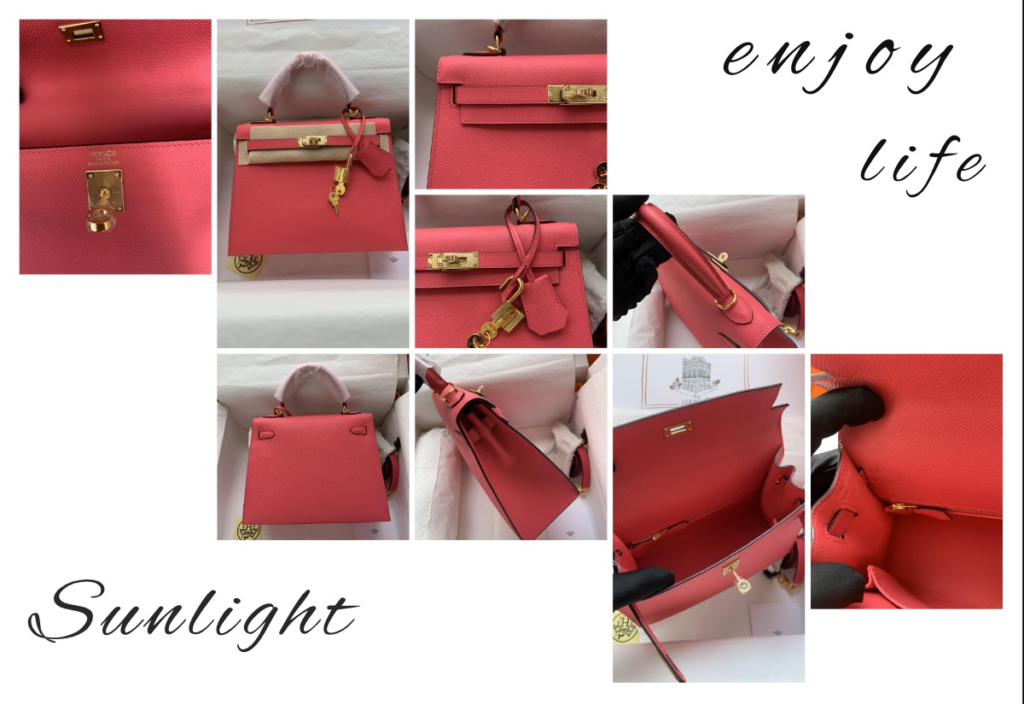
UsaThe Kelly 28 is where generic checklists fail most often. “Sharp edges” can be a positive signal on a Sellier and the wrong expectation for a Retourne. Sotheby’s and Christie’s describe the Sellier as the more structured, externally stitched construction, while the Retourne uses softer edges and interior seams. The leather usually reinforces that distinction: Epsom often supports Sellier structure, while Togo or Clémence can support a softer Retourne body.
| Kelly 28 feature | Sellier reference | Retourne reference |
|---|---|---|
| Edges | Defined and architectural | Rounded with visible piping language |
| Seams | Exterior stitching is part of the silhouette | Construction is turned, giving a softer perimeter |
| Typical behavior | Holds a formal trapezoid and exposes weak edge finishing | Can relax and carry more softly without being structurally defective |
| Most useful PSP | Front, back, both sharp side corners and edge-paint macros | Front, both side profiles, base and a lightly filled hanging view |
Start with the central axis
The single handle makes centering easier to read than on a Birkin. In a square-on front photo, I trace the handle, flap point, touret and lower center line. The handle should not make the body appear to lean, and the flap should not close under uneven tension.
- Top handle: compare both handle roots and the way the arc returns to the body.
- Flap point: it should settle in relation to the touret and sangles, not float to one side.
- Side profiles: a Sellier should preserve its intended sharpness; a Retourne should not have one gusset much fuller than the other.
- Back panel: check whether the handle attachment or interior structure creates a visible pull.
Test the closure and strap as working components
A Kelly is often photographed with the sangles open because that pose looks casual. It also hides whether the closure aligns. I ask for an uncut video of the flap closing, the sangles passing through the pontets, the touret rotating, and the strap clips attaching to both rings.
The video should reveal function, not prove an exact sound. A “damped” or “solid” click is subjective and changes with room acoustics. More objective questions are whether the clip springs return, whether the hardware catches on leather, whether the two attachment points carry the bag evenly, and whether the flap must be forced into place.
Do not reward artificial perfection in saddle stitching
Hermès describes saddle stitching as two ends of the same thread crossing through each hole. That explains its structure, but it does not create a simple visual rule that every stitch must have the same dramatic slant. Leather thickness, seam direction, thread tension and viewing angle affect the appearance.
I look for rhythm rather than “human irregularity.” The line should progress consistently, the holes should not be torn or oversized, and tension should not abruptly change around the handle roots, corners or strap attachments. Randomly uneven stitches are not proof of handwork.
Kelly 28 structural red flags: a Sellier edge that waves or softens unpredictably, a Retourne with severe one-sided gusset collapse, a handle that pulls the body off-axis, strap hardware that does not close securely, or a flap that requires force because the closure components are misaligned.
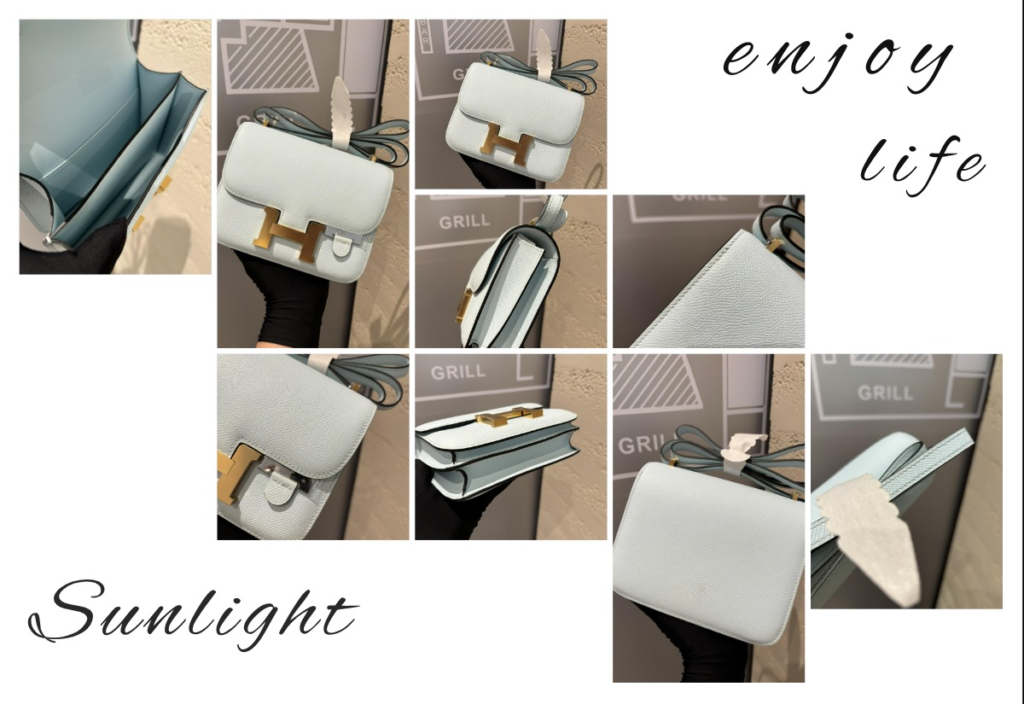
Hermès describes the Constance as a practical urban bag built around its H-shaped closure and movement. That makes the C18 a mechanism-led QC problem. A straight-on photo can show whether the H looks centered, but it cannot show whether the clasp seats correctly, whether the flap is being forced, or whether the strap drags through the hardware.
1. Inspect the H as a mechanism, not a logo
Ask for one straight-on macro with the flap closed and one angled view showing how the hardware sits against the leather. The two sides of the H should not create visibly different pressure marks, and the central moving element should release and re-engage without scraping the flap edge.
In video, watch the user’s fingers. If the seller repeatedly pushes one side of the flap, hides the hinge area or cuts the clip before reopening, the evidence is incomplete. A smooth closure is useful, but the objective signal is repeatable alignment.
2. Compare the gussets under the same load
The Constance body is shallow and expandable. Both side gussets should open to a comparable profile when the bag is empty and when it is lightly filled. One side should not crease sharply while the other remains rounded. This difference can come from panel cutting, reinforcement, storage or strap pull, so matched photos matter.
I request three states: empty on a table, lightly filled, and hanging from the strap. That sequence shows whether the body keeps its rectangular logic or becomes wedge-shaped under load.
3. Treat the strap as a load-bearing part
Community reviews often focus on strap thickness, edge glazing, kinks and the feel of the attachment hardware. Those are not secondary details on a Constance: the strap slides through metal loops and changes the carrying length, so rough glazing or uneven width can create drag and transfer force into the flap and side panels.
- Edge finish: look for continuous coverage without thick ridges, peeling or sharp corners.
- Width and thickness: compare along the entire visible length; one locally thin section can twist under load.
- Movement: the strap should slide without the seller pulling hard enough to bend the flap.
- Stored shape: deep packaging kinks may relax, but they should be recorded before approval.
Constance 18 structural red flags: an H clasp that sits at an angle or needs one-sided force, asymmetric flap pressure, gussets that react differently under the same load, or a strap/hardware path that visibly twists the bag.
What Community Discussion Actually Changes
Community research is valuable when it changes the evidence request. It is less useful when it only produces a new “best seller” ranking.
Signal 1: Source reputation narrows the search; it does not finish QC
Names such as DDMode, Steven/GPCMode and UB recur in Hermès replica discussions, often with different opinions about leather, shape, stitching, communication and lead time. I preserve those names as search vocabulary because they help locate comparable reviews. I do not convert them into a universal ranking, and I do not assume that two bags carrying the same source label are the same batch or specification.
How it changes my recommendation: record the source claim, then compare the current PSPs against the exact model, size, construction and leather. Do not approve a B25 because a reviewer liked a B30 from the same source.
Signal 2: PSP approval often fails at the whole-bag level
One Birkin 25 review explicitly noted that the shape looked off on one side in PSPs but was approved because the rest looked acceptable. Other comparison reviews focus on handles, shape, stitching and panel construction rather than one isolated stamp. This is a useful warning: a buyer can spot a structural issue and still talk themselves out of it after seeing strong macros.
How it changes my recommendation: complete the square-on and matched-side review before opening hardware and stamp macros. Structural findings receive priority over decorative details.
Signal 3: Leather grain and movement
Experienced buyers repeatedly describe leather as the detail they notice first in hand. They also acknowledge that photos, lighting and the absence of an authentic reference limit certainty. Claims such as “imported Togo,” “same tannery” or “authentic leather supply” are therefore not conclusions I would reproduce without documentation.
How it changes my recommendation: request neutral daylight video, a gentle press-and-release clip and consistent grain views across panels. Keep smell, hand feel, thickness, long-term slouch and leather origin in the unknown from PSPs category.
Signal 4: Functional details expose different bags in different ways
For a Birkin, handle and closure alignment often reveal the build. For a Kelly, construction and strap hardware matter. For a Constance, the clasp and sliding strap can expose problems that a logo macro cannot. Community discussions become actionable only when they are translated into those model-specific requests.
How it changes my recommendation: do not ask every seller for the same generic “hardware video.” Specify the operation: Birkin sangles and touret; Kelly flap, touret and strap clips; Constance H release, re-engagement and strap glide.
The Evidence Pack I Would Request
A useful PSP set is repeatable. It should let you compare left with right, front with back, and still geometry with movement. I would request the following before discussing final approval.
| Evidence | How it should be captured | What it can reveal |
|---|---|---|
| Square-on front and back | Camera centered at bag height; bag unheld; no wide-angle close-up | Central axis, handle placement, flap level, panel symmetry and hardware centering |
| Matched side profiles | Same distance, fill level and camera height on both sides | Gusset asymmetry, panel tension, flare, collapse and strap pull |
| Top and base | Bag resting naturally on a level surface | Opening symmetry, handle roots, base twist, feet placement and corner height |
| Neutral-light leather views | One diffuse daylight clip across flap, body and side | Grain consistency, coating, reflectivity and panel-to-panel mismatch |
| Hardware macros | Straight-on and angled views without a warm filter | Alignment, engraving, edge finishing, plating coverage and leather pressure |
| One continuous function clip | No cuts or hand reshaping between open and close operations | Closure alignment, scraping, spring return, strap glide and panel distortion |
| Configuration card | Model, size, construction, leather, color, thread, hardware, source claim and date | Prevents comparison against the wrong reference and preserves the batch record |
Three categories of findings
- Structural red flags: persistent asymmetry, displaced handle roots, twisted base, mis-seated closure, insecure strap hardware or a load-bearing component that deforms the bag. These deserve the greatest weight.
- Reference-dependent variation: grain size, slouch, stitch angle, edge-paint tone, hardware color and exact proportions. These require a matched model, size, construction and material reference.
- Unknown from PSPs: smell, true leather origin, hand feel, actual hardware weight, long-term plating wear, edge durability and how the bag settles after weeks of use. These should remain explicit unknowns.
This classification is more honest than a single “9.5/10” score. It prevents a small stamp difference from receiving more attention than a handle or closure problem, and it makes the remaining uncertainty visible before purchase.
My Model-by-Model Recommendation
| Model | Best fit | Main compromise | My minimum proof |
|---|---|---|---|
| Birkin 25 | A buyer who wants the compact Birkin silhouette and is prepared to inspect symmetry carefully | Small geometry errors are highly visible; leather feel and long-term slouch remain hard to prove remotely | Front/back, matched sides, top/base, natural handles and a full closure clip |
| Kelly 28 | A buyer who values a shoulder strap and can choose deliberately between Sellier structure and Retourne softness | The wrong reference creates false defects; function must be checked with the bag closed and strapped | Construction-matched profiles, handle axis, flap closure and both strap clips |
| Constance 18 | A buyer who wants a compact crossbody and accepts that hardware function is central to the design | Clasp pressure, strap glide and gusset behavior are difficult to judge from catalog photos | H-clasp macros, empty/filled side views and one continuous clasp/strap video |
For a broader model and leather map, use the Best Hermès Replica Bags Guide. For the terminology behind AAA, Top Tier and Ultimate Tier, see the AAA Replica Bags Guide.
Frequently Asked Questions (FAQ)
What is the price difference between a AAA Grade and a Mirror Grade Hermes replica in 2025?
A standard AAA Grade bag usually costs between $300 and $500. A true full handmade Grade (or Superfake), which uses imported leather and hand-stitching, typically ranges from $800 to over $2,000 depending on the leather type (e.g., Ostrich or Crocodile will be significantly higher).
Will the gold hardware on a replica fade?
An advertised handmade tier does not establish 18k gold content, a 3–5 micron coating or a fixed service life. Request documentation for the finish on the actual bag and compare dated wear photographs of the clasp, feet and other contact points.
Can I take a high-tier replica into a Hermès boutique?
While many buyers do wear their high-tier replicas into boutiques without issue, it is not recommended to bring them in for “repairs” or official servicing. While the sales associates are sales experts, the craftsmen are trained to spot non-authentic stitching patterns immediately. For peace of mind regarding any leather goods, independent authentication services like Bababebi provide rigorous checks that even ‘Superfakes’ struggle to pass without detection.
How long does it take to receive a custom-made replica?
Since the best-selling bags of 2025 often require hand-stitching, “pre-order” or custom items can take anywhere from 15 to 45 days to manufacture. “In-stock” items ship faster but may have fewer customization options.
Why is the Kelly 28 Sellier more expensive than the Retourne?
The Sellier construction is more labor-intensive. It requires the artisan to stitch the bag from the outside with perfect precision, as every stitch is visible. The edges must be bees-waxed and burnished multiple times to achieve a smooth, glass-like finish.
Research Notes and Evidence Boundaries
I reviewed official Hermès craft and collection references, current auction-house construction and leather guides, and selected community reviews. Community posts describe individual experiences with different sellers, dates, leathers and specifications. They are included to identify recurring inspection problems, not to endorse a seller or certify a factory.
- Hermès official Birkin collection reference
- Hermès official Kelly collection reference
- Hermès official Constance collection reference
- Hermès official saddle-stitch explanation
- Christie’s guide to Togo, Epsom, Clémence and other Hermès leathers
- Sotheby’s Kelly Sellier versus Retourne guide
- Community Birkin 25 review: PSP shape and item-level trade-offs
- Community comparison: Kelly 28 and Birkin 25 source differences
- Community Birkin comparison: handles, panels and construction
- Community strap review: glazing, thickness and storage kinks
Conclusion
The Birkin 25, Kelly 28 and Constance 18 do not need a longer version of the same “superfake” checklist. They need different evidence. I judge the Birkin 25 through compact geometry and handle balance, the Kelly 28 through construction and closure function, and the Constance 18 through its H mechanism, gussets and strap.
High-intent vocabulary still has value. AAA, Mirror Grade, Top Tier, Ultimate Tier, Handmade Custom and recurring source names help buyers navigate a fragmented market. But they should lead to better questions, not replace them. The final decision should come from the current bag, a configuration-matched reference and an evidence pack designed around that model’s actual failure modes.

24 comments
Obsessed with this guide! I’ve been eyeing the Birkin 25 for months but I’m terrified of picking the wrong leather. You mentioned Togo gets ‘slouchy’ over time—does it lose its shape completely? I want it to look relaxed but not sloppy.
For the B25, I would compare empty and lightly loaded views of the exact Togo and Epsom options. Look at the base, piping and panel movement. The leather name alone cannot promise a particular drape or permanent rigidity.
Obsessed with this guide! I’ve been eyeing the Birkin 25 for months but I’m terrified of picking the wrong leather. You mentioned Togo gets ‘slouchy’ over time—does it lose its shape completely? I want it to look relaxed but not sloppy.
That distinction matters, Sarah_J99. Togo often relaxes with use rather than staying rigid, but the amount of slouch depends on bag size, hide, storage and internal construction. I’d judge the actual side profile, base support and panel behavior of the sample rather than look for one “correct” amount of softness.
Honestly, the hardware is usually the dead giveaway on reps. Is the gold hardware on the AAA grade actually 18k plated? I hate when they look too yellow or orange.
Ask for the plating specification in writing, then compare the actual tone in neutral light with the same hardware version. The finish’s color and a claim about its gold content are separate questions.
Honestly, the hardware is usually the dead giveaway on reps. Is the gold hardware on the AAA grade actually 18k plated? I hate when they look too yellow or orange.
I’d separate two things here, LuxuryLover_NYC. I can assess tone, geometry, engraving, edge finishing and how the mechanism behaves in hand, but I can’t verify gold content or plating thickness from appearance alone. That would require materials testing, so I keep the conclusion limited to observable finish and construction.
I really want to order the Kelly 28, but I live in the US and I’m scared about customs seizing it. How safe is the shipping process right now?
Ask the seller for the current shipping service and written terms covering loss, seizure and refunds before deciding. Keep the bag’s QC review separate from those delivery terms; this blog does not dispatch orders.
I really want to order the Kelly 28, but I live in the US and I’m scared about customs seizing it. How safe is the shipping process right now?
Keep the delivery terms with the agreed Kelly 28 specification and PSPs. The seller should spell out the remedy for a lost or seized package before you commit.
Great article! I’m surprised the Birkin 30 didn’t make the top 3 list. Do you think the Birkin 25 is too small for a daily mom-bag? I need to fit my phone and a small pouch.
Thanks for reading! The Birkin 30 is still a classic, but the Birkin 25 is dominating the 2025 trends because of the ‘Mini Bag’ movement. To answer your question—the B25 is surprisingly spacious! It easily fits an iPhone Pro Max, a cardholder, keys, and a compact makeup pouch. However, if you need to carry an iPad or baby items, the B30 might still be the better practical choice for you.
Great article! I’m surprised the Birkin 30 didn’t make the top 3 list. Do you think the Birkin 25 is too small for a daily mom-bag? I need to fit my phone and a small pouch.
Good question, ChicMomma. A Birkin 25 can handle a compact daily carry, but it becomes limiting once you add larger pouches, a tablet or child-related items. For practicality, I’d compare the measured opening and base dimensions of the exact bag rather than rely on the model number alone.
I saw some sellers on DHgate selling ‘mirror quality’ for $150. Why is the price difference so big compared to the AAA ones you recommend?
Compare what the two quotes actually include: material specification, construction details and current-unit QC. If a higher price rests on hand stitching or a named tannery, ask for documentation of that claim. I would not infer those facts from price alone.
I saw some sellers on DHgate selling ‘mirror quality’ for $150. Why is the price difference so big compared to the AAA ones you recommend?
Thanks for asking, RepQueen22. I treat “AAA,” “mirror,” “superfake” and similar labels as unstandardized market language, not objective grades. The more reliable comparison is the actual sample: materials, geometry, construction, hardware, measurements and clear QC evidence.
The macro shot of the stitching really helped. I never knew about the slanted vs. straight stitch difference. Does the Constance 18 come with the hand-stitching too? I heard it’s harder to make.
For a Constance 18, ask which seams the supplier describes as hand-stitched and request the reverse as well as the front. I would also examine the H-clasp alignment and both gussets; those details strongly affect the finished shape.
The macro shot of the stitching really helped. I never knew about the slanted vs. straight stitch difference. Does the Constance 18 come with the hand-stitching too? I heard it’s harder to make.
That distinction matters, Detail_Oriented_Jen. Stitch direction can be useful, but it isn’t a standalone authentication rule. I look at spacing, tension, starts and finishes, seam transitions and consistency across the whole bag, ideally against the same model and period.