If you are navigating the luxury market in 2026, you are likely aware that the landscape of craftsmanship and authentication has shifted dramatically. The existential question plaguing high-net-worth collectors, secondary market platforms, and luxury enthusiasts alike is no longer simply “Is this real or fake?” Instead, the question has evolved into something far more complex: Exactly how small has the gap become between authentic Louis Vuitton production and the absolute highest tier of underground craftsmanship?
Relying on outdated authentication methods is a guaranteed way to be deceived. The market is flooded with varying levels of quality. To truly understand the art of the Maison and protect your investments, we must put authentic pieces under the microscope and compare them directly against today’s sophisticated replica tiers.
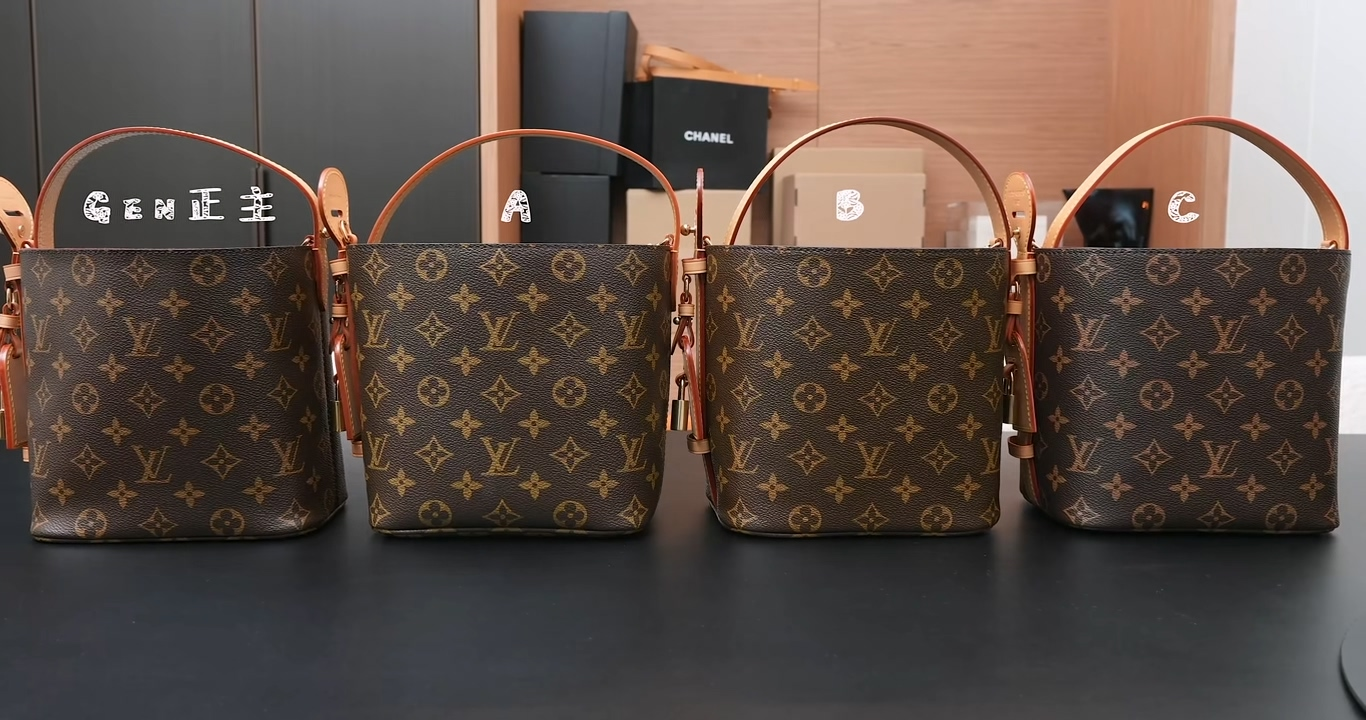
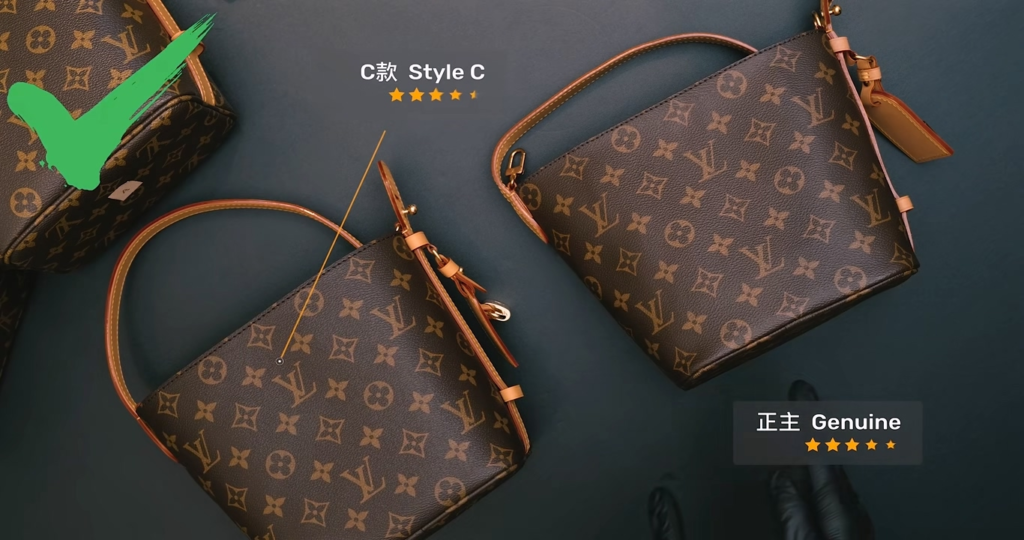
This comparison examines authentic Louis Vuitton craftsmanship alongside replica samples labelled Piece A, Piece B and Ultimate Piece C, focusing on canvas texture, hardware engraving, chip readings and physical weight. The observations belong to these samples; Top Tier and Ultimate Tier are market descriptions, not fixed technical grades. I use the differences to compare construction, not to set a universal authentication rule.
1. Redefining the Market Tiers: Top Tier vs. Ultimate Tier
Before diving into microscopic details, we must establish a precise taxonomy. We will analyze three specific grades of replicas that dominate the current underground market:
- Mass-Produced Top tier (Piece A & B): These represent the standard premium market. While heavily marketed, they often suffer from fundamental visual and structural flaws. For a deeper dive into what defines this category, refer to our foundational guide on understanding AAA replica bags and our analysis of LV AAA trends and top picks for 2026.
- TheUltimate Tier ( C): This tier is hailed as the ultimate ceiling of replication. It achieves an astonishing level of visual symmetry, matching the macro-symmetry of the Monogram and strap stitching so perfectly that it is nearly impossible to distinguish with the naked eye. It represents a massive leap in mold precision and manufacturing standards.
2. Material Science: The Canvas and The “Thief Light” Phenomenon
The tactile experience of Louis Vuitton’s proprietary Monogram canvas is notoriously difficult to replicate. The exact chemical composition, curing process, and texturing techniques are heavily guarded secrets. If you want to understand the base materials used across all collections, our Louis Vuitton materials guide provides an excellent prerequisite.
The Micro-Texture Analysis
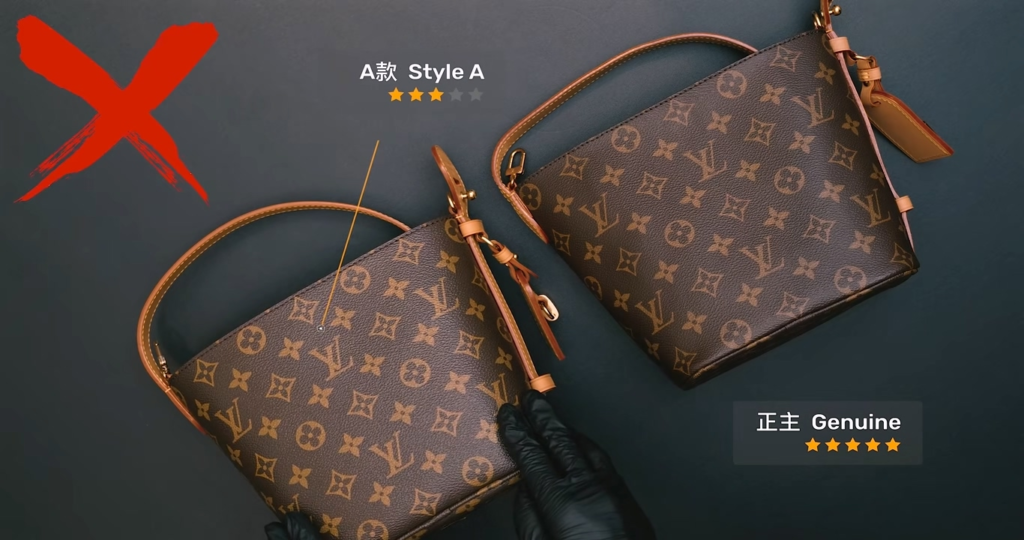
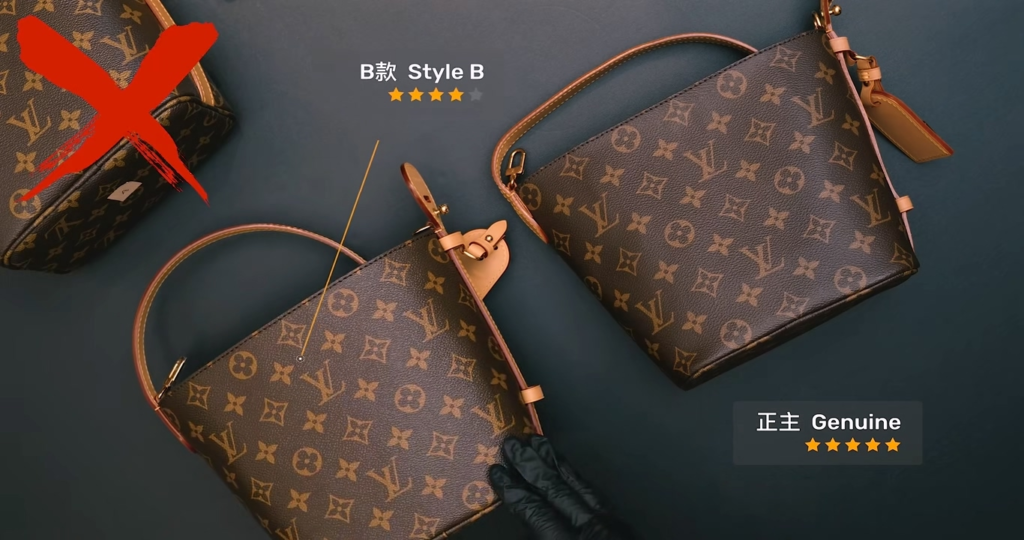
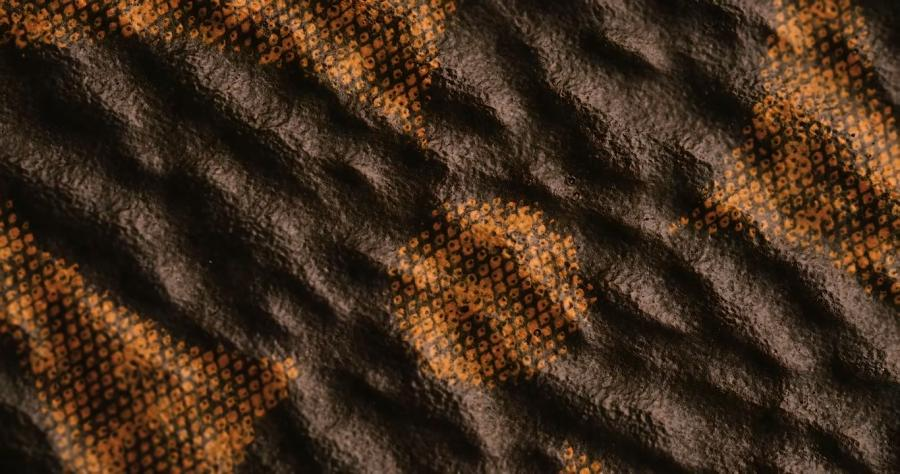
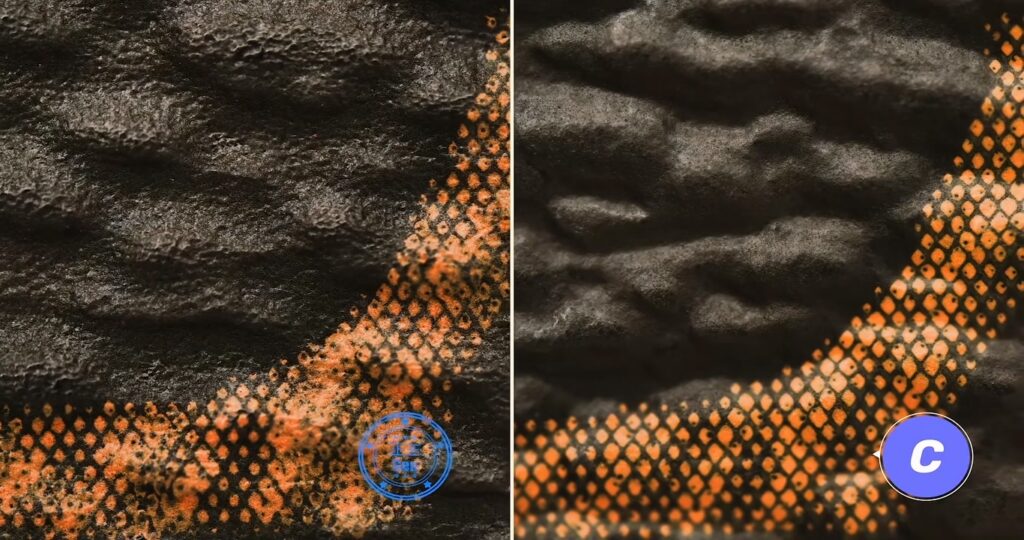
- Authentic Canvas: When examined under a macro lens, the reference sample’s coated canvas features deep, irregular pores and wrinkles that heavily resemble the surface of volcanic rock. This specific texture creates a diffuse reflection, ensuring the surface absorbs light rather than reflecting it harshly, resulting in a soft, restrained gloss.
- Mass-Produced Top tier ( Piece A & B): * Piece A: The surface is far too smooth, and the texture is stiff and lifeless. Under lighting, it produces a harsh, cheap glare—known in the industry as “thief light”—and exhibits a significant color discrepancy.
- Piece B: While it incorporates more wrinkles than Piece A and reduces the glare slightly, it remains noticeably brighter than the authentic finish.
- Ultimate Piece C: This tier successfully mimics the natural, rougher texture of the genuine article. The visual details are incredibly rich, allowing Piece C to achieve a color tone and matte gloss that is practically identical to the authentic bag.
3. The Micro-Geometry of the Monogram Print
When you magnify the iconic Monogram print, the differences between authentic production and even the best replicas become mathematically evident. This is particularly vital to inspect on classic LV bags, where the Monogram is the undisputed focal point.
The Yellow Dot Matrix
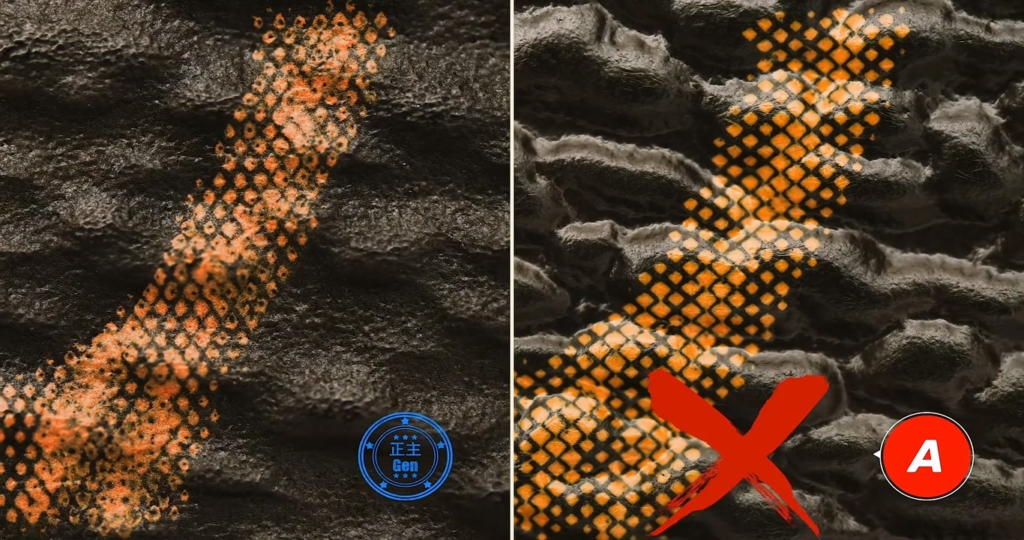
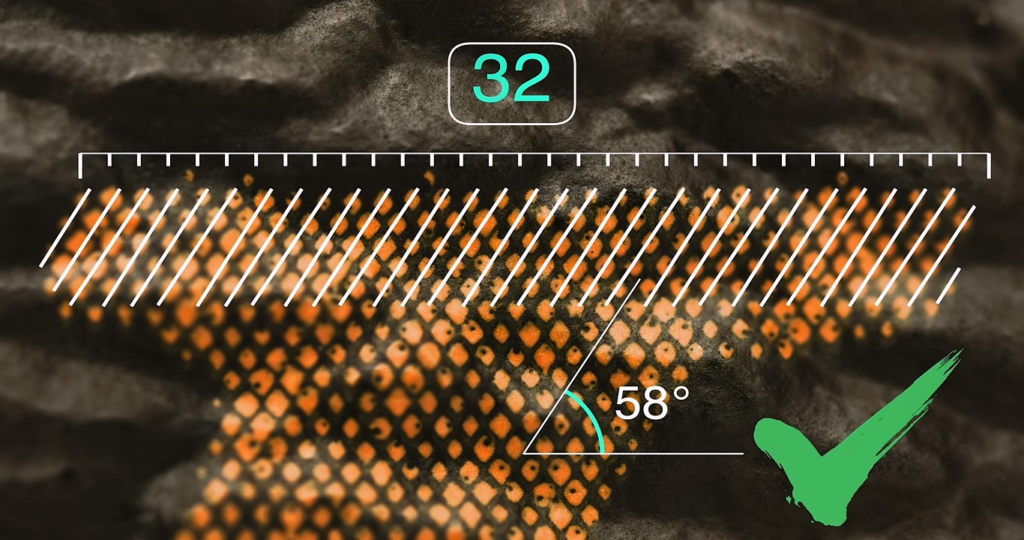
- Authentic: The yellow dots forming the Monogram are actually vertical diamonds. Meticulously, four of these small dots form a larger vertical diamond, and some individual dots feature a hollow black center. On the diagonal lines of the motifs, these dots are arranged in a distinct “staircase” gradient, transitioning perfectly from small to large. Interestingly, authentic printing isn’t clinically perfect; some dot clusters naturally “blur” together.
- Tiers A & B: These tiers fail spectacularly here. The yellow dots are horizontal, lack the hollow black centers entirely, and the diagonal lines show no staircase gradient or size variation.
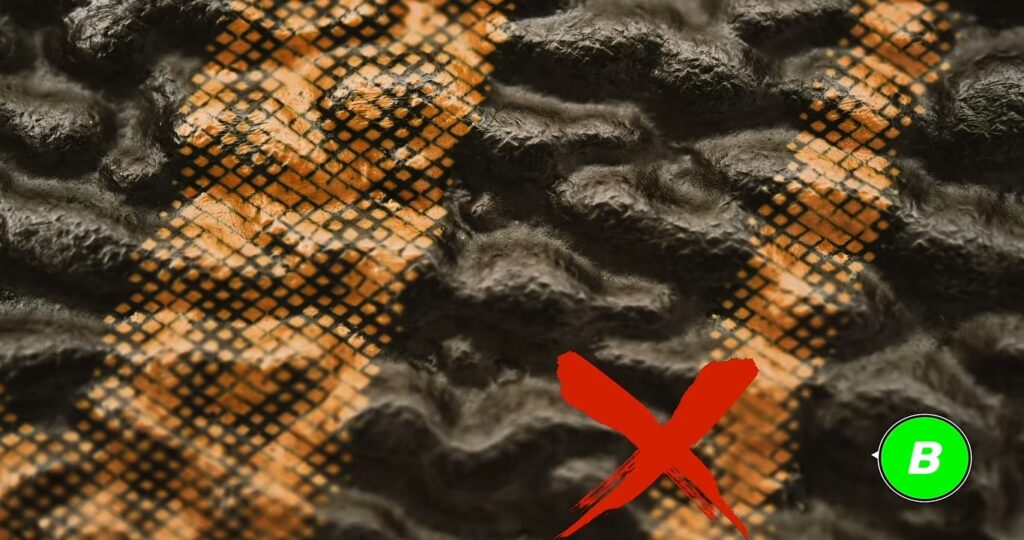
- Piece C: Replicates the vertical diamonds, the hollow black centers, and the specific staircase size gradient. However, its printing is too perfect; the dots are distributed far too evenly, missing the organic, slight blurring found in authentic pieces.
The Anatomy of the Letter “L”
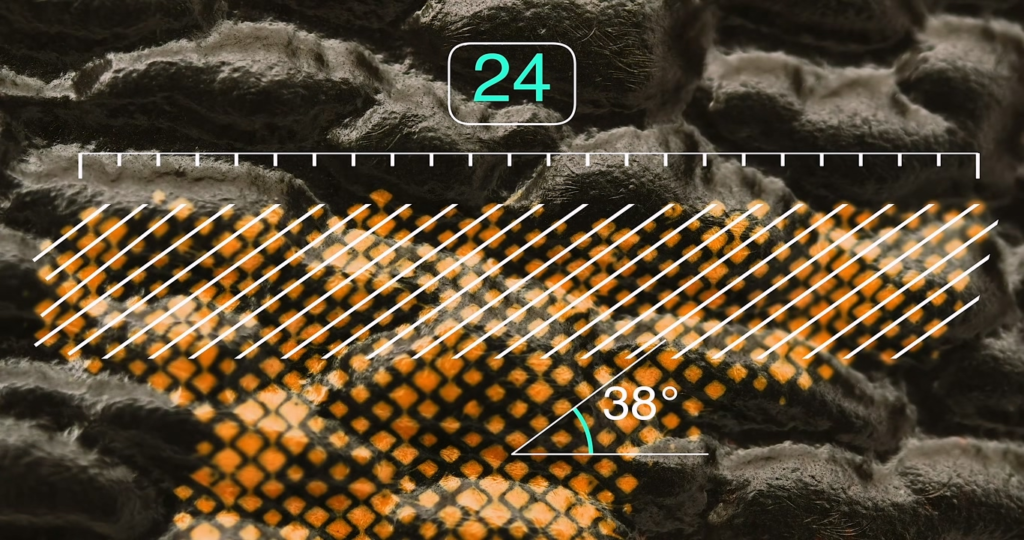
In this comparison, the dot arrangement at the top of the reference sample’s letter “L” is recorded as 32 rows at 58 degrees. I retain those details as sample-specific observations; they should not be treated as a fixed specification for every Louis Vuitton Monogram print.
- Authentic: Follows this 32-row, 58-degree mathematical rule perfectly. Additionally, the bottom-left hook of the “L” is not a flat cut; it features a microscopic rollback trace.
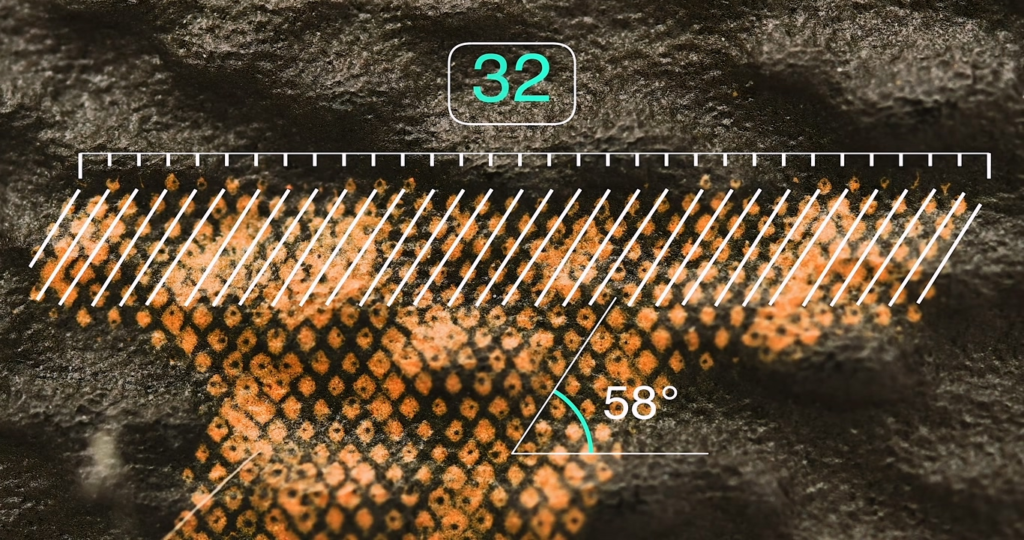
- Tiers A & B: The dots are chaotic, adhering to neither the 32-row count nor the 58-degree angle. Furthermore, they often use a straight, “one-cut” edge for the L’s hook.
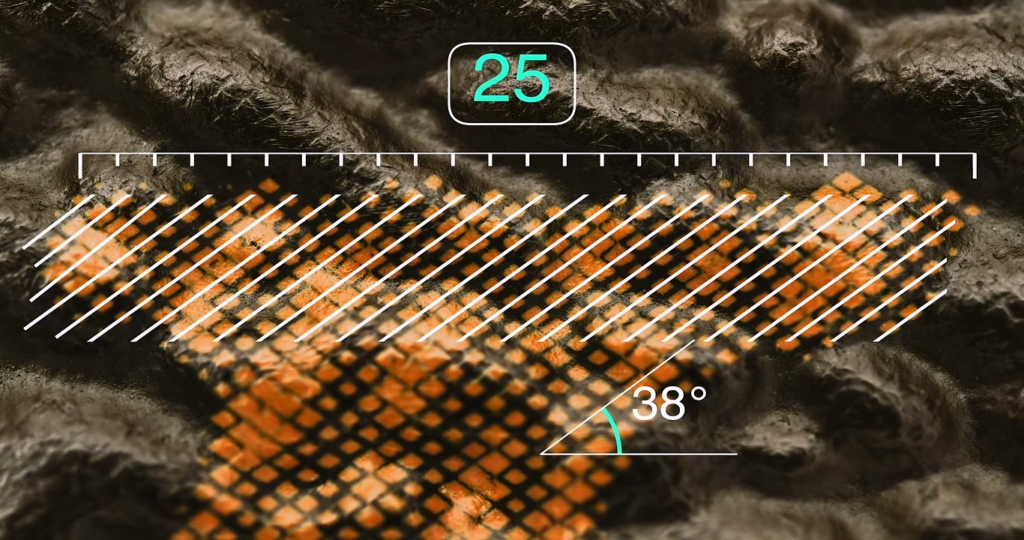
- Piece C: Astoundingly, Piece C completely cracks this hidden code, perfectly replicating the 32 rows and the 58-degree inclination.
The Interior Leather Tag Details
When checking the interior stamped logo, several geometric rules apply:
- The letter “S” has a smaller top circle and a larger bottom circle.
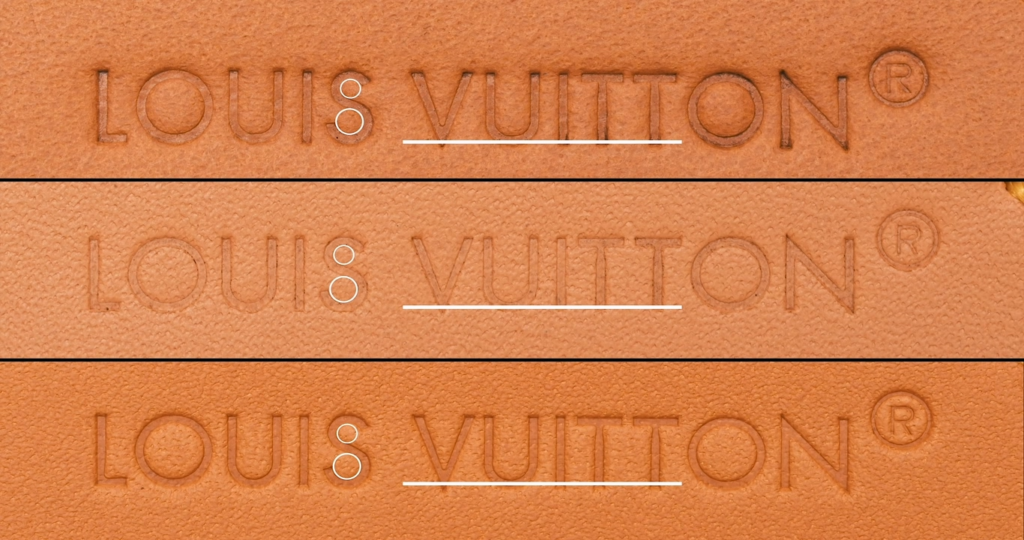
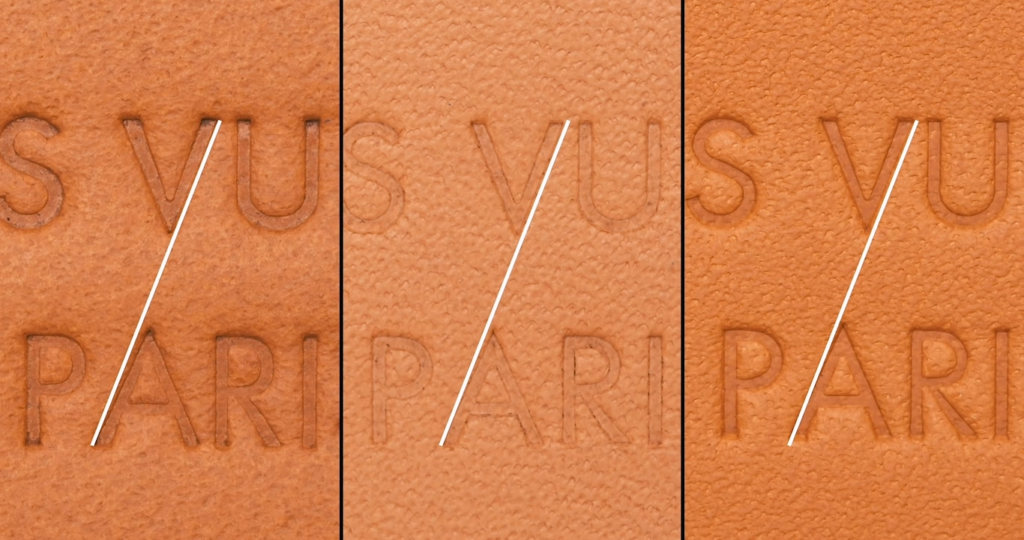
- The pointed angles of “V” and “A” protrude slightly higher than surrounding letters, and a line connecting the right side of “V” and the left side of “A” forms a straight line.
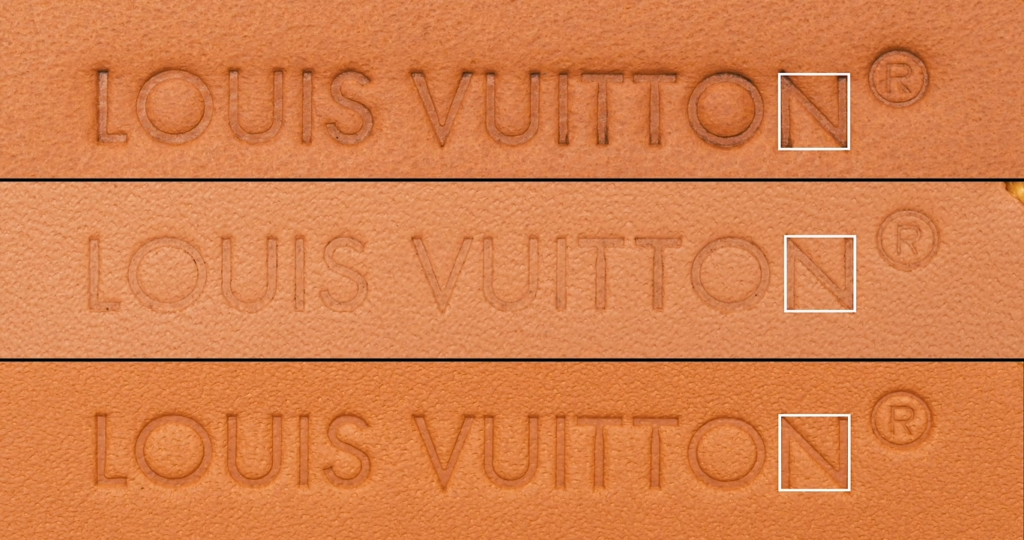
- The letter “N” has razor-sharp angles and an almost square overall shape.
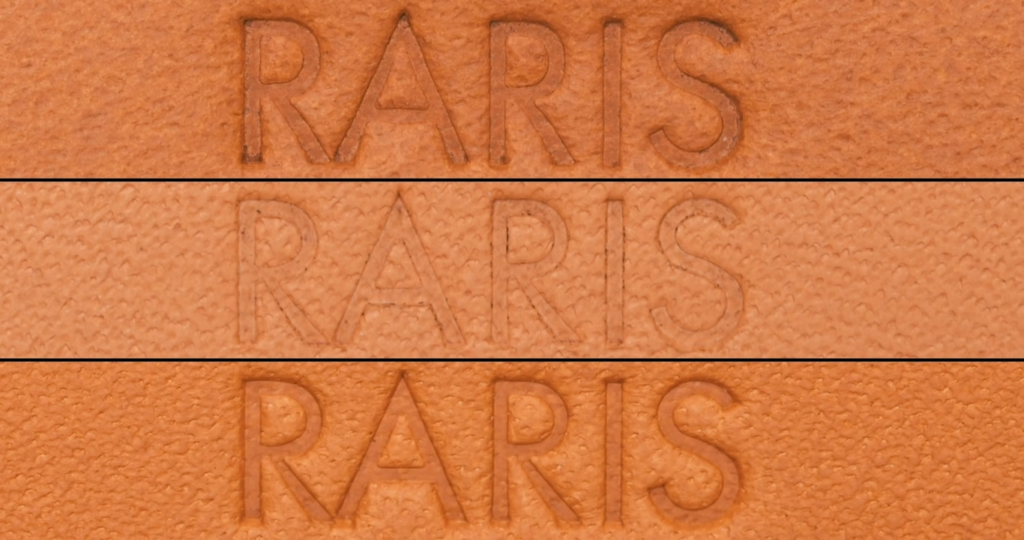
- The outer diameter of the “R” circle is smaller than the “O”.
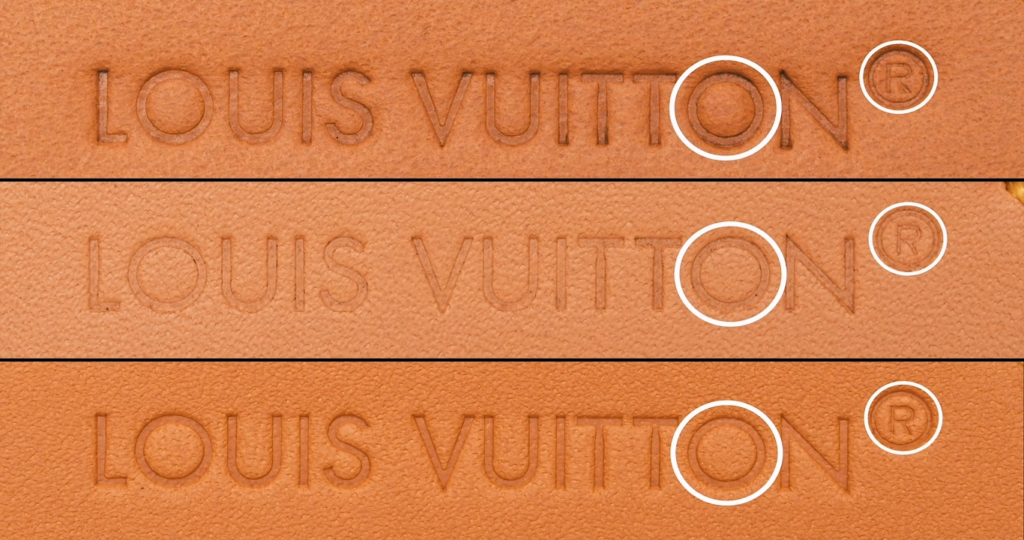
- If you add a leg to the letter “P”, it identically matches the “R”. While Piece B features a blurry stamp, Tiers A and C actually get these micro-details largely correct. For a broader understanding of how these details apply across different brands, bookmark our comprehensive LV bag authentication guide.
4. Hardware Engineering: The Ultimate Barrier to Entry
For the authentic and replica samples compared below, the hardware discussion focuses on visible engraving, edge finish, screw geometry and polishing marks. These observations do not, by themselves, establish alloy composition, manufacturing method or a bag’s authenticity.
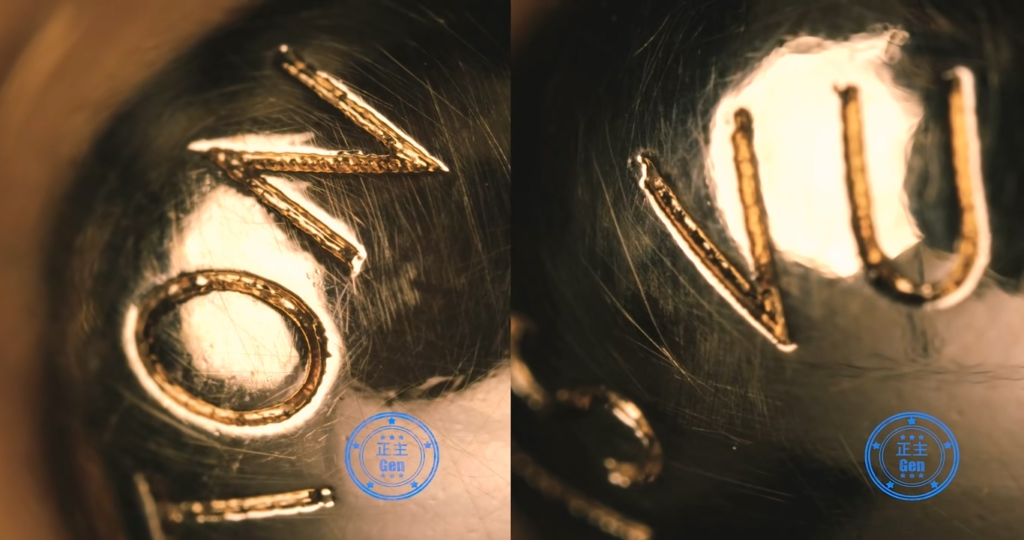
Engraving Techniques: Corrosion vs. Laser
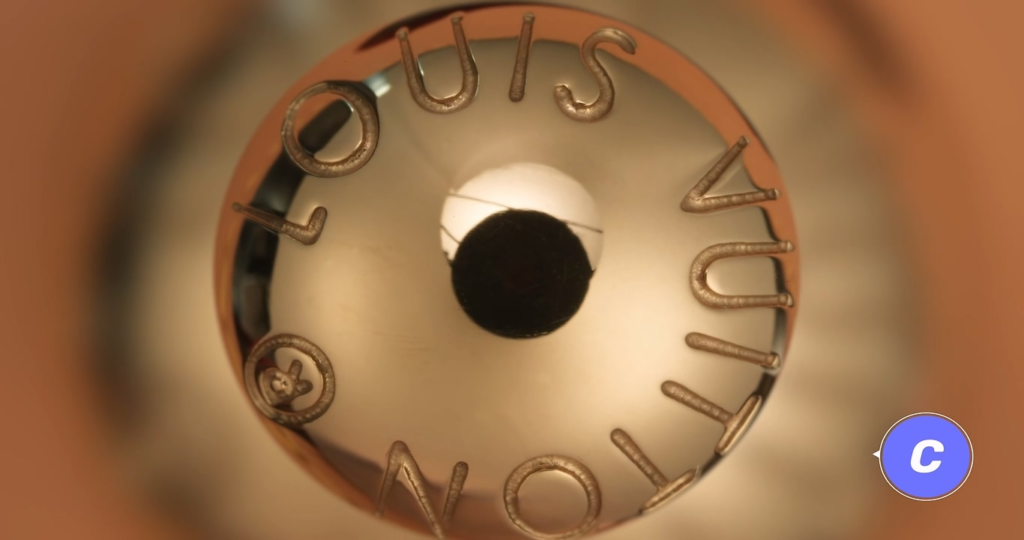
- Authentic: The inner angles of the letters, particularly N and V, look sharply defined. The engraving has a slightly pitted lower surface. On the padlock, the LV logo edges show stamping depressions, with a subtle, wavy tree-like texture below.
- Pieces A & B: Piece A has wider, blunt letters; Piece B has thinner letters, but their inner corners still look rounded beside the reference.
- Piece C: The N and V come closer to the reference, though their inner angles look a little softer. The lock logo has the tree-like texture but lacks the same visible stamping-edge depressions.
Structural Screws and Gear Bases
- Authentic: Uses a proprietary 6-petal Torx screw, and beneath it sits a gear-shaped base with distinct polishing marks. Furthermore, the back of the strap buckle features a specific gear shape with exactly 12 teeth carved into the base.
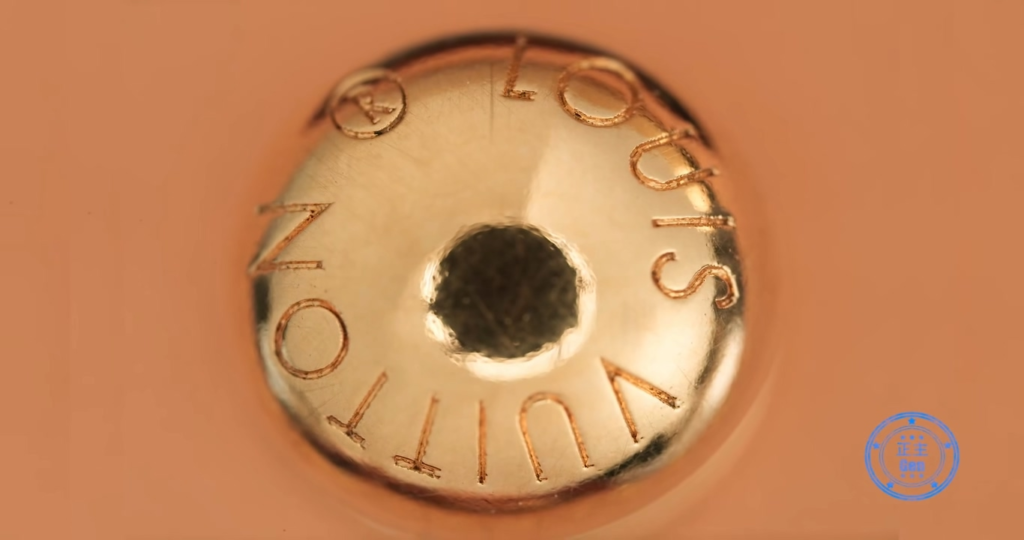
- Tiers A & B: Piece A uses standard internal hex screws with concentric circle marks and incorrectly places the 12 gear teeth on the rivet itself rather than the base. Piece B uses a fake Torx shape with a black pit at the bottom and lacks the 12-tooth gear completely.
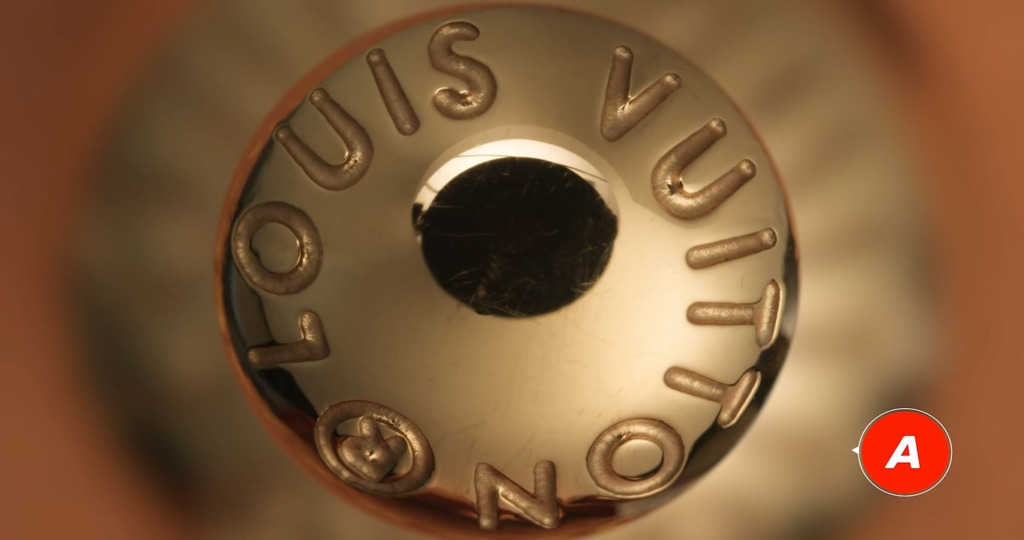
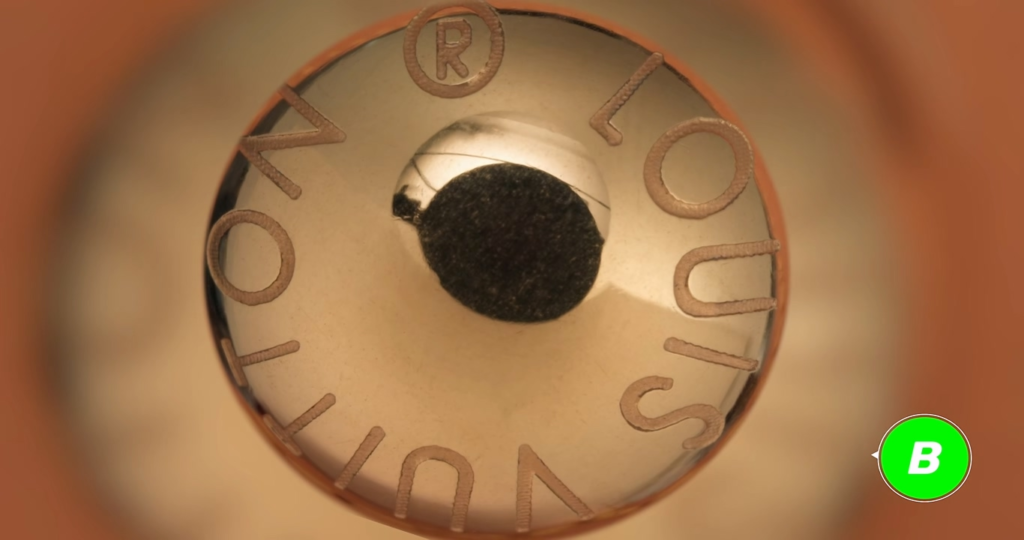
- Piece C: Features a polished, flat screw base that is remarkably precise. Most impressively, it perfectly replicates the 12 gear teeth carved directly into the strap buckle’s base.
The Magnetic Physics Test
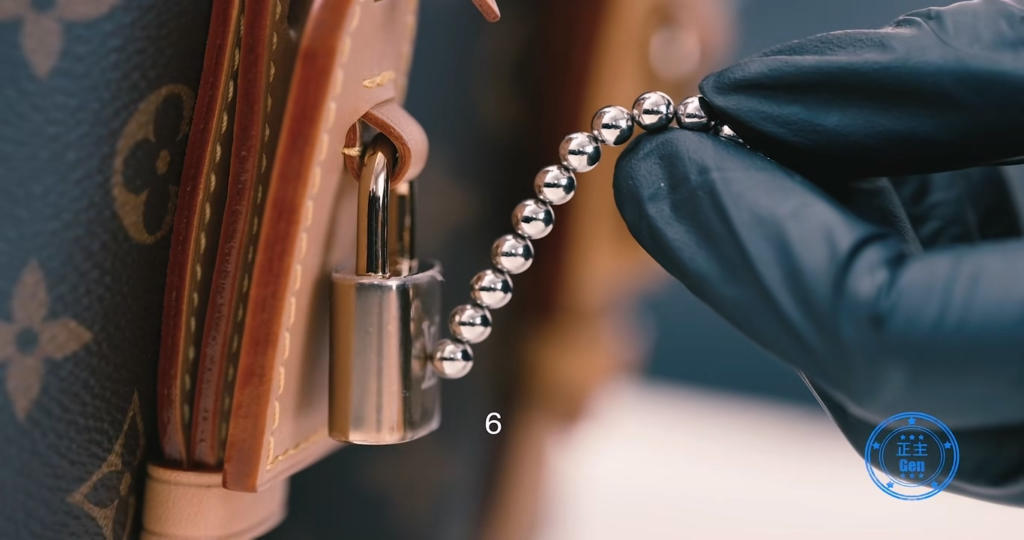
A common authentication method is testing magnetic attraction.
- Authentic & Piece C: The recorded comparison found a similarly weak magnetic pull at the padlock, no attraction at the strap rivets and buckles, and strong attraction at the internal rotational component.
Zippers and Clasps
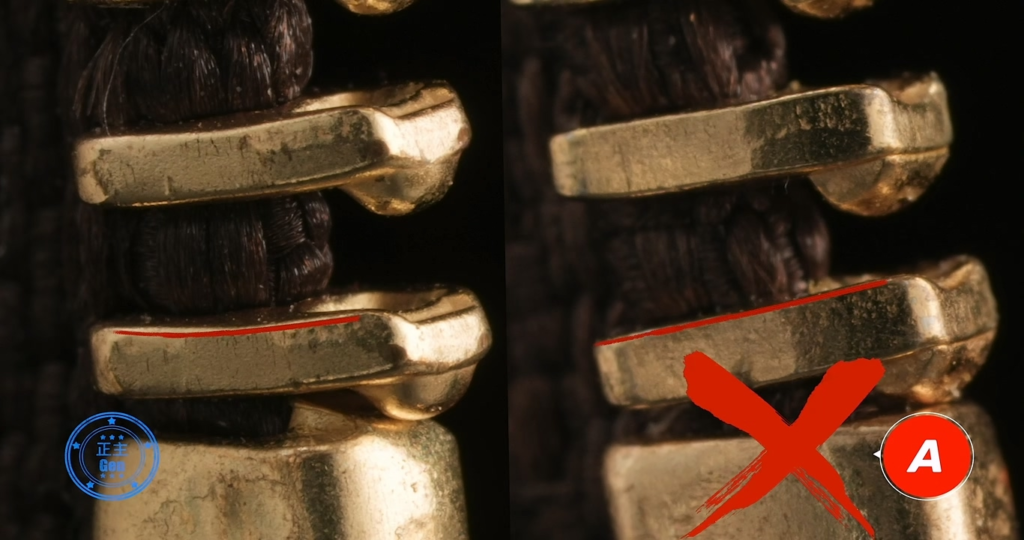
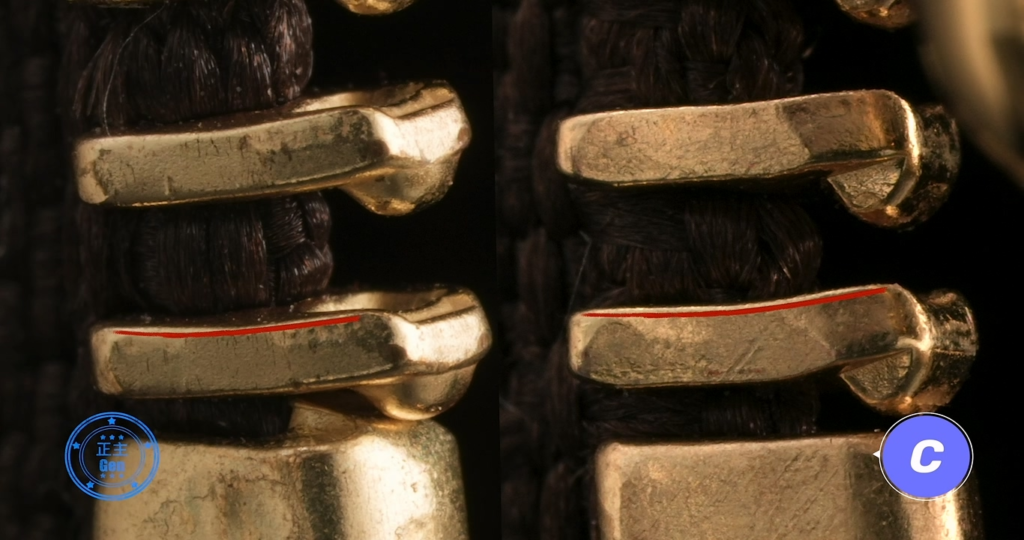
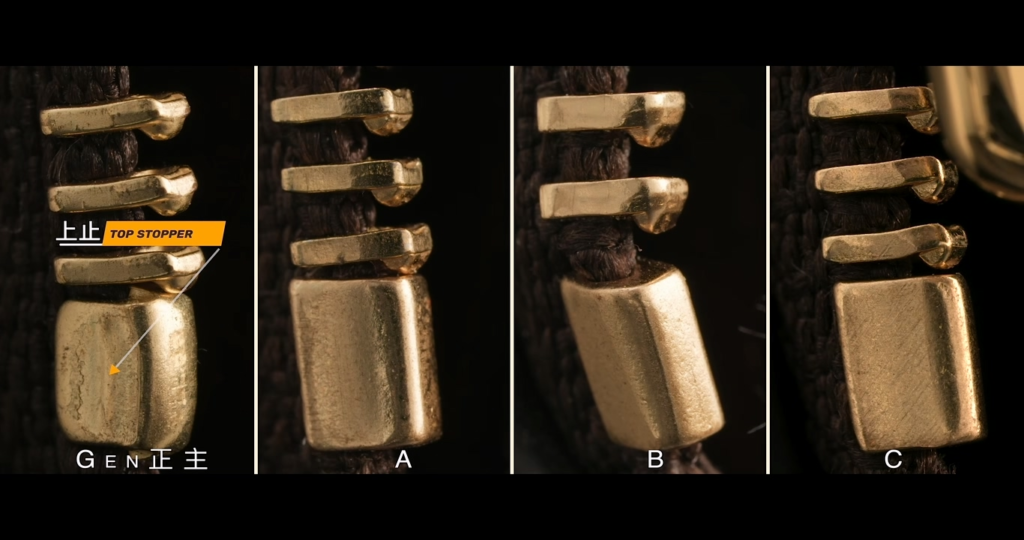
- Authentic: The zipper teeth have a distinct curved, rounded edge. The top zipper stop is the smallest and features a beautifully rounded, polished finish.
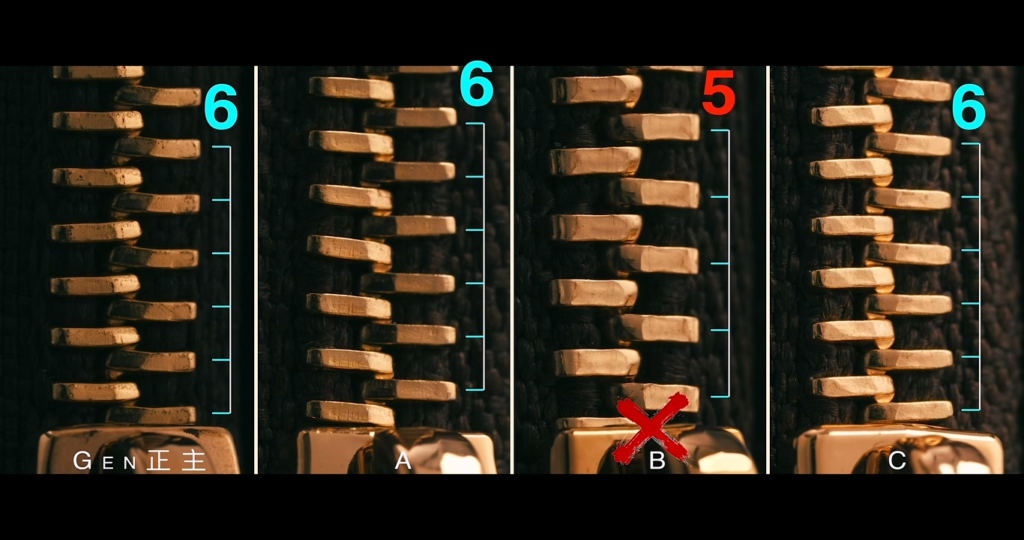
- Tiers A & B: Piece A has completely straight, flat zipper teeth. Piece B is structurally missing a tooth.
- Piece C: Achieves the curved, polyhedral structure of the authentic teeth, though the tips are not quite as perfectly rounded. Furthermore, Piece C successfully eliminates the cheap casting seams on the lobster clasp’s bite area, a massive improvement in hardware finishing.
5. The Tech Arms Race: Debunking the NFC Myth
Perhaps the most dangerous misconception in the modern luxury market is that scanning an NFC (Near Field Communication) chip guarantees authenticity. To see how tech integration varies across modern releases, view our modern LV icons review.
- The Authentic Standard: Scanning the embedded NFC chip yields an 18-digit code. The first 10 digits are fixed (e.g., 0163C01), while the last 8 digits are a dynamic, randomly generated code that refreshes upon every scan.
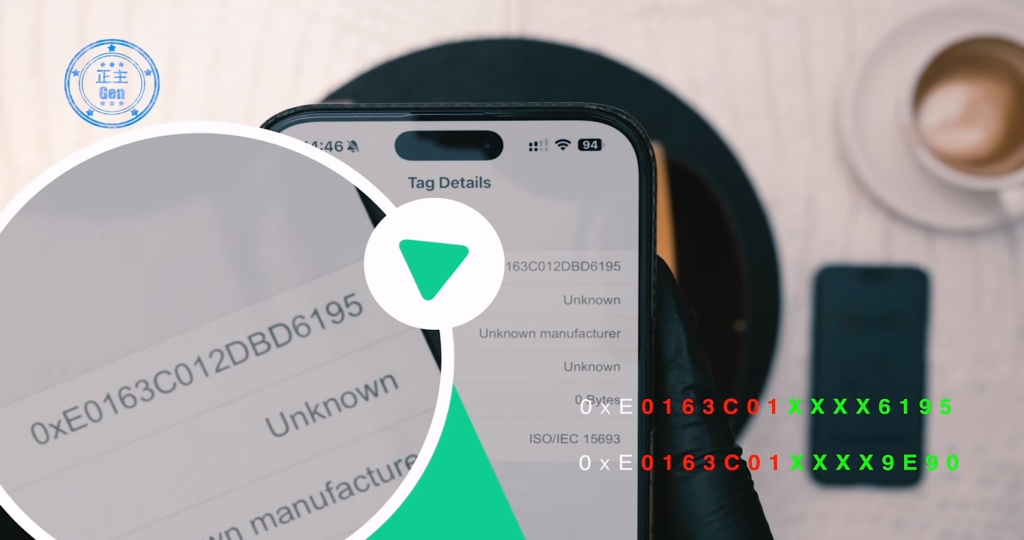
- Tiers A & B: These replicas have successfully programmed chips to output the correct 18-digit format, starting identically with 0163C01. However, their final 8 digits remain permanently static.
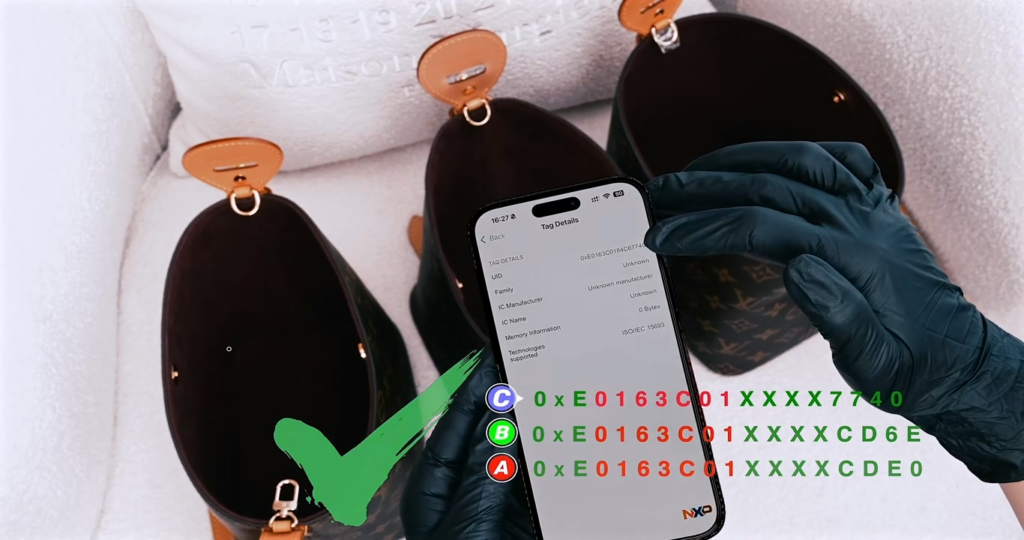
- The Ultimate Threat (Piece C): Piece C has entirely shattered the industry consensus that “fake bags cannot randomize codes”. In rigorous testing, the Piece C chip successfully generates the 0163C01 prefix and brilliantly executes the randomized, dynamic generation of the last 8 digits across multiple consecutive scans.
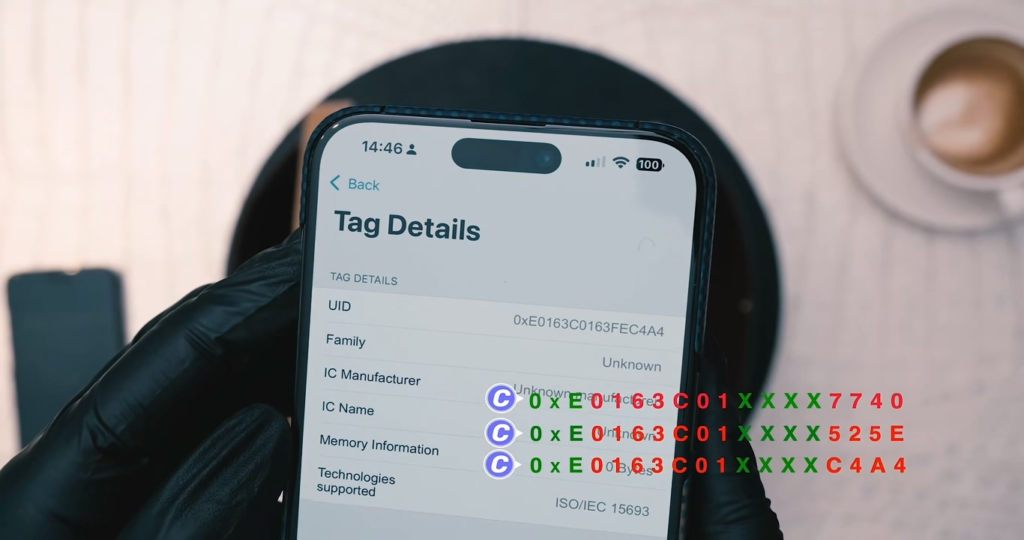
Conclusion: The NFC chip is no longer a standalone authentication tool. It must be combined with physical craftsmanship analysis.
6. Structural Integrity: The Digital Scale Test
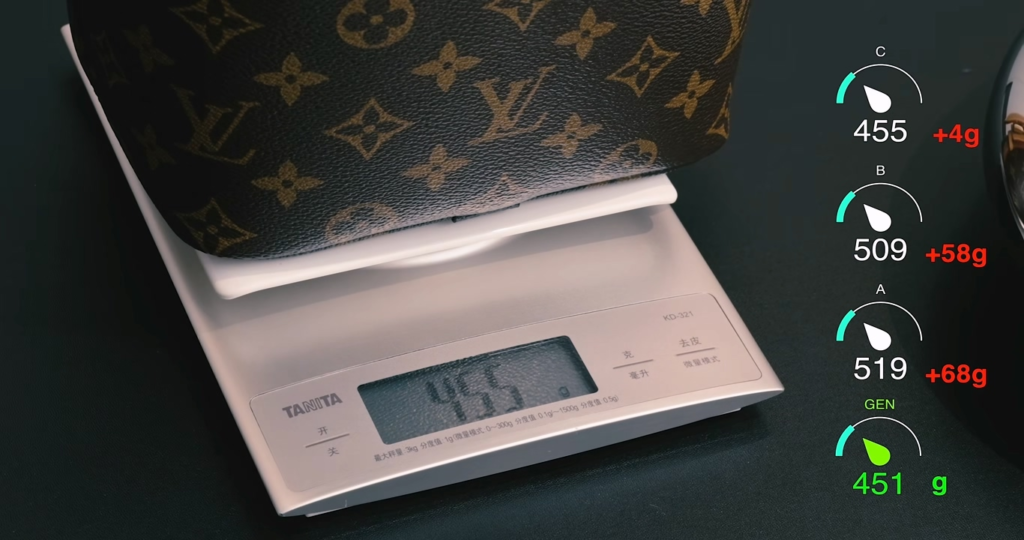
Read the recorded weights as a comparison of these samples. Match dimensions, included components and weighing conditions before using a gram difference as a QC clue; composition and manufacturing process require separate sourcing evidence.
| Quality Tier | Weight | Analysis & Structural Variance |
| Authentic | 451g | Reference sample weight for this comparison. |
| Top tier(Piece A) | 519g | 68g above the reference sample. |
| Top tier(Piece B) | 509g | 58g above the reference sample; compare construction and included components before interpreting the difference. |
| Ultimate Tier (Piece C) | 455g | The closest replica by recorded weight, 4g above the reference. |
7. The Intangibles: Construction and Hidden Flaws
Finally, we must look at the hidden construction techniques where even the best factories stumble.
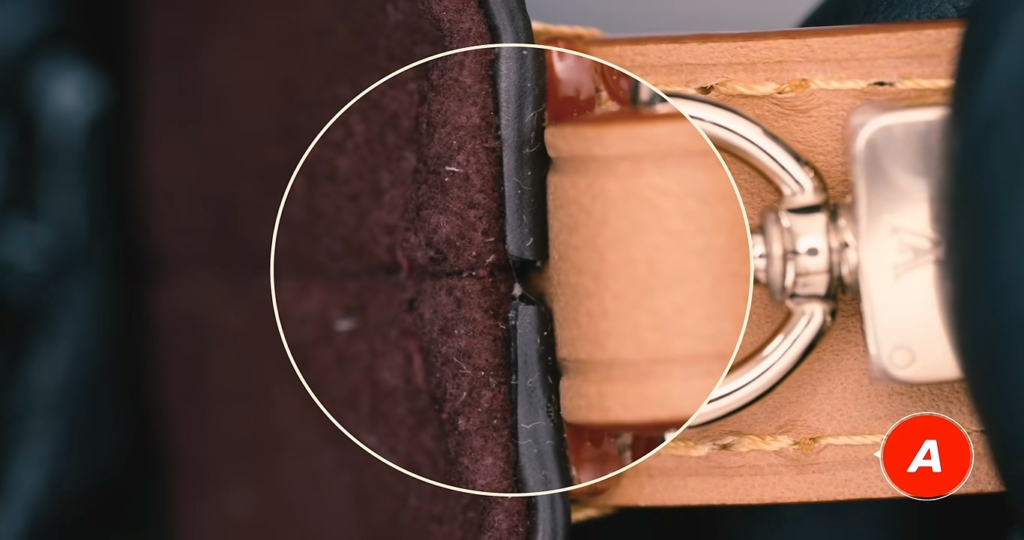
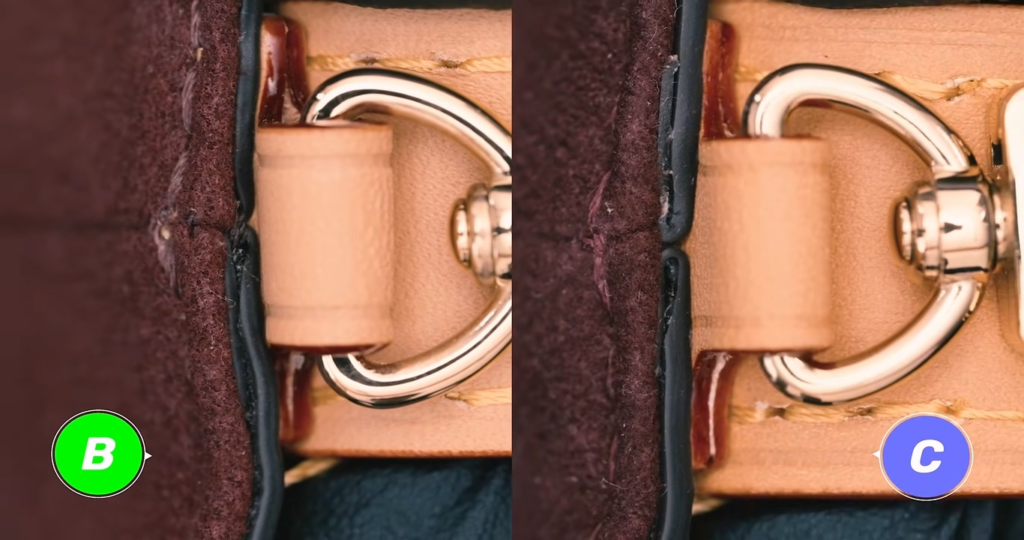
When observing how the leather connects to the strap buckles:
- Authentic: The artisan folds the leather first, ensuring the edges are pristine, and then stitches it firmly into place.
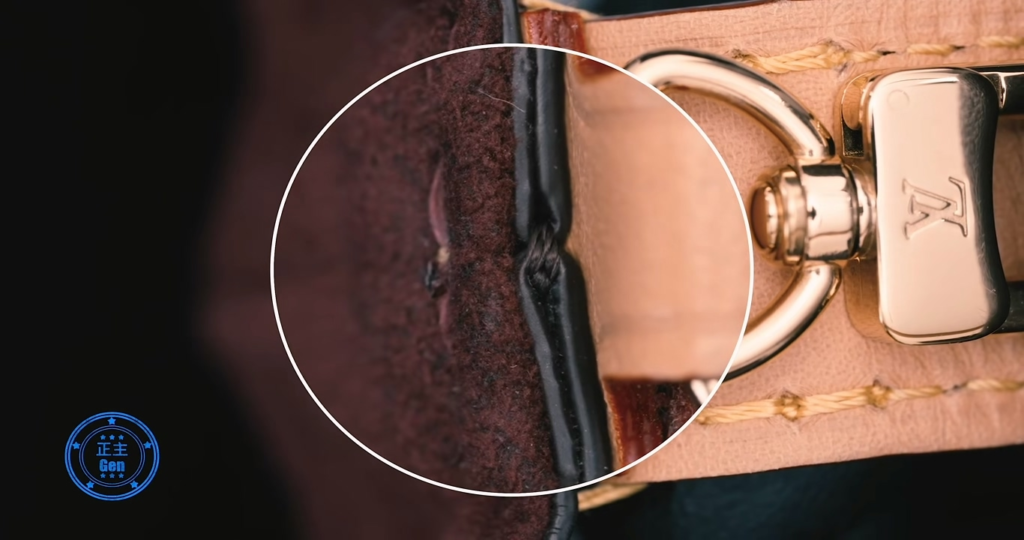
- Tiers A & B: Piece A completely skips the folding process and simply stitches flat leather together, reducing durability. Piece B attempts the fold but executes it roughly.
- Piece C: In a bizarre oversight, Piece C successfully mimics the complex leather fold but actually forgets to apply the stitching line entirely.
8. FAQ: Navigating the 2026 Luxury Authentication Landscape
Can I rely on an NFC chip scanner app to verify if my Louis Vuitton bag is authentic?
Absolutely not in 2026. While mass-produced Tiers A and B only output static 18-digit codes, the highest Mastercrafted tier (Tier C) has successfully reverse-engineered the dynamic variable algorithm. They can generate a completely randomized 8-digit suffix upon consecutive scans, flawlessly mimicking the authentic system. Tech is no longer a silver bullet; you must verify physical craftsmanship.
Why are top-tier replicas (Tier C) consistently closer in weight to authentic bags than AAA replicas?
Piece C is recorded at 455g against a 451g reference, while AAA samples A and B weigh 519g and 509g. Piece C is therefore 4g above the reference in this comparison. Check dimensions and included components alongside those numbers.
What is the most reliable physical telltale sign on modern LV hardware?
Compare letter shape, depth and surface finish. In these images, the inner corners of N and V distinguish the examples more clearly than a broad claim about the engraving process.
How does the “staircase effect” on Monogram prints help identify a replica?
On genuine Monogram canvas, the clusters of yellow dots aligned diagonally on floral motifs are deliberately printed as vertical diamonds that scale up from small to large, creating a perfect geometric “staircase.” AAA replicas completely fail this matrix by utilizing flat, horizontal digital dot prints. While Tier C perfectly captures the staircase layout, its printing is often too digitally perfect; it completely lacks the subtle, organic ink blending found on authentic screens.
Is it true that authentic Louis Vuitton bags are completely non-magnetic?
The recorded comparison found attraction at an internal rotational component. Keep that observation attached to the component and samples tested; I would compare it alongside the other construction details.
The ReinaLuxe Conclusion: Is the Gap Closing?
The era of easily spotting a replica from across the room is unequivocally over. While standard mass-produced Top tier bags still suffer from obvious textural flaws, incorrect zipper teeth, and static NFC codes, theUltimate Piece C represents a profound paradigm shift.
Piece C has successfully weaponized dynamic NFC tech, replicated the 32-row microscopic Monogram math, and brought the physical weight within a 4-gram margin of error. The gap is no longer macro; it is entirely micro. It exists in the slight unevenness of a zipper tip, the 4-gram weight discrepancy, and forgotten internal stitches.
The photographed Ultimate Tier example is a close visual comparison in several details discussed here. That observation is limited to this example; it does not establish that the whole tier is indistinguishable or predict what another viewer or authenticator will notice.
Disclaimer: This guide is purely for educational purposes and academic study of leathercraft and hardware mechanics. It is designed to protect consumers from fraud in the secondary market. For definitive authentication, always consult brand officials or certified third-party institutions.

25 comments
Incredible catch on the missing stitching line on the Tier C strap fold! How on earth do they spend thousands of dollars reverse-engineering a 32-row, 58-degree dot matrix print and then just… forget to stitch the leather fold down? 😂
Haha, it sounds ironic, doesn’t it? But it’s actually a classic symptom of underground production dynamics. The team running the serigraphy screens and print engineering is completely separate from the assembly studio handling the leather stitching. They focus so hard on cracking the visual “passwords” that trip up authenticators that basic quality control steps on the assembly line occasionally slip through. It proves that no matter how good the replication gets, it lacks the unified oversight of a heritage atelier.
Incredible catch on the missing stitching line on the Tier C strap fold! How on earth do they spend thousands of dollars reverse-engineering a 32-row, 58-degree dot matrix print and then just… forget to stitch the leather fold down? 😂
I’d separate two things here, Loupe_Life. I’d check this from actual measurements rather than a model name alone. For straps, compare the maximum strap drop and strap width with your height/clothing; for capacity, compare the opening and internal dimensions with the exact items you carry.
As someone who flips a lot of contemporary canvas pieces on secondary platforms, the “thief light” texture tip is worth its weight in gold. I’ve rejected so many bags purely because the canvas felt “plasticky” under our studio softboxes. Do you see the same reflection issues on the Damier Ebene canvas?
I’m glad you found that useful! Yes, the “thief light” phenomenon is arguably even more pronounced on Damier Ebene. Because DE relies on a checkerboard alternation of dark chocolate and muted brown squares, any excess gloss or cheap PVC topcoating turns the bag into a shiny mirror under studio lighting. Authentic DE has a distinct satin-matte waxiness that diffuses harsh studio lights seamlessly. Keep trusting your gut on that tactile, low-reflection finish!
As someone who flips a lot of contemporary canvas pieces on secondary platforms, the “thief light” texture tip is worth its weight in gold. I’ve rejected so many bags purely because the canvas felt “plasticky” under our studio softboxes. Do you see the same reflection issues on the Damier Ebene canvas?
Good question, Resale_Royalty. Print and surface texture can be useful, but they need a model-specific reference because scale, coating, panel placement and production variation matter. I’d judge the exact sample from high-resolution photos and handling evidence rather than assume one pattern rule proves the whole bag.
A 4-gram difference on a full bag is insane engineering. I’m a total data nerd and I’ve been weighing my collection for years. Quick question: Does that 455g on the Ultimate tier C include the long leather shoulder strap, or is that just the raw chassis weight?
Spoken like a true detail-connoisseur! That measurement was taken as the raw chassis weight of the bag entirely empty, without the detachable strap or internal pouch. The reason Tiers A and B miss the mark so badly (climbing over 500g) is that they use heavy cardboard interfacing to fake structural rigidity. Ultimate tier C utilizes accurate canvas tension and premium lightweight backing textiles. If you weigh the strap separately, look for micro-variations in the density of the lobster clasp alloy—that’s usually where the last 1–2 grams hide.
A 4-gram difference on a full bag is insane engineering. I’m a total data nerd and I’ve been weighing my collection for years. Quick question: Does that 455g on the Ultimate tier C include the long leather shoulder strap, or is that just the raw chassis weight?
Thanks for asking, WeightWatch_Lux. I’d check this from actual measurements rather than a model name alone. For straps, compare the maximum strap drop and strap width with your height/clothing; for capacity, compare the opening and internal dimensions with the exact items you carry.
The part about Tier C cracking the dynamic randomized NFC code is absolutely terrifying. I literally bought a pre-owned Nano Speedy last month and used a generic scanner app—it randomized, so I slept easy. Now I’m staring at my bag under a desk lamp questioning my entire life. Is there ANY software that can tell the difference yet?
I completely understand the anxiety, Luxury_Lab_99. It’s exactly why I published this report—relying solely on an app in 2026 is a massive gamble. Currently, proprietary brand software used internally at flagship boutiques can flag unauthorized cryptographic handshakes, but public third-party apps are completely fooled by Ultimate tier C chips. My advice? Forget the tech. Grab a 10x jeweler’s loupe and inspect the inner angles of the “N” and “V” hardware engravings. Chemical etching leaves microscopic structural tells that software simply can’t feel.
The part about Tier C cracking the dynamic randomized NFC code is absolutely terrifying. I literally bought a pre-owned Nano Speedy last month and used a generic scanner app—it randomized, so I slept easy. Now I’m staring at my bag under a desk lamp questioning my entire life. Is there ANY software that can tell the difference yet?
Good question, Luxury_Lab_99. I treat “AAA,” “mirror,” “superfake” and similar labels as unstandardized market language, not objective grades. The more reliable comparison is the actual sample: materials, geometry, construction, hardware, measurements and clear QC evidence.
I’m obsessed with the newer Loop and Boulogne bags. Do these micro-rules (like the 12-tooth gear base on the rivets) apply to the newer hardware silhouettes, or are they specific to the older classics?
Welcome, Monogram_Mami! The specific 12-tooth gear base rivet structure evaluated in this report is heavily utilized across modern structured icons like the OnTheGo and Loop series. However, for newer minimalist hardware silhouettes, the Maison has begun integrating ultra-flat, sunken rivet profiles that are entirely flush with the leather. The Ultimate tier factories are quick to adapt, but checking the absolute depth of the hardware stamp remains your best defense for newer releases.
I’m obsessed with the newer Loop and Boulogne bags. Do these micro-rules (like the 12-tooth gear base on the rivets) apply to the newer hardware silhouettes, or are they specific to the older classics?
Thanks for asking, Monogram_Mami. Hardware is useful evidence, but I don’t treat one screw, font or engraving detail as decisive. I compare tone, geometry, edge finishing, alignment and mechanism against a matched model/period reference and then combine that with the rest of the bag.
Great breakdown on the lipid oxidation process of the untreated Vachetta. Most blogs just say “it turns brown.” But I’ve noticed some high-end reps turn an ugly greyish-muddy color after a rainy day. Is that what you mean by the 5-year lipid gap?
Spot on, Vachetta_Vibes! You’ve hit on a massive industry secret. Authentic Louis Vuitton Vachetta is derived from cattle reared in specific French regions with controlled diets, yielding a very precise ratio of natural animal fats within the hide. When exposed to moisture or UV, it oxidizes into a rich, golden-amber amber hue. Ultimate tier C uses excellent European cowhide, but because the hide’s internal fat distribution isn’t an exact match, a rainy day can cause uneven oil pooling, resulting in that dull, muddy tone over time.
Great breakdown on the lipid oxidation process of the untreated Vachetta. Most blogs just say “it turns brown.” But I’ve noticed some high-end reps turn an ugly greyish-muddy color after a rainy day. Is that what you mean by the 5-year lipid gap?
That distinction matters, Vachetta_Vibes. Untreated vachetta normally changes with light, skin oils and use, but the rate and final tone vary widely. For a replica or second-hand bag, I wouldn’t assume the trim is equivalent to authentic vachetta just because it darkens; porosity, edge treatment and the way it ages are more informative together.
Editor’s question: which Louis Vuitton detail do you find least reliable from seller photos alone—canvas print, edge paint, hardware, stitching, or interior construction? If one issue comes up repeatedly, I’ll add a matched close-up comparison rather than another generic checklist.