
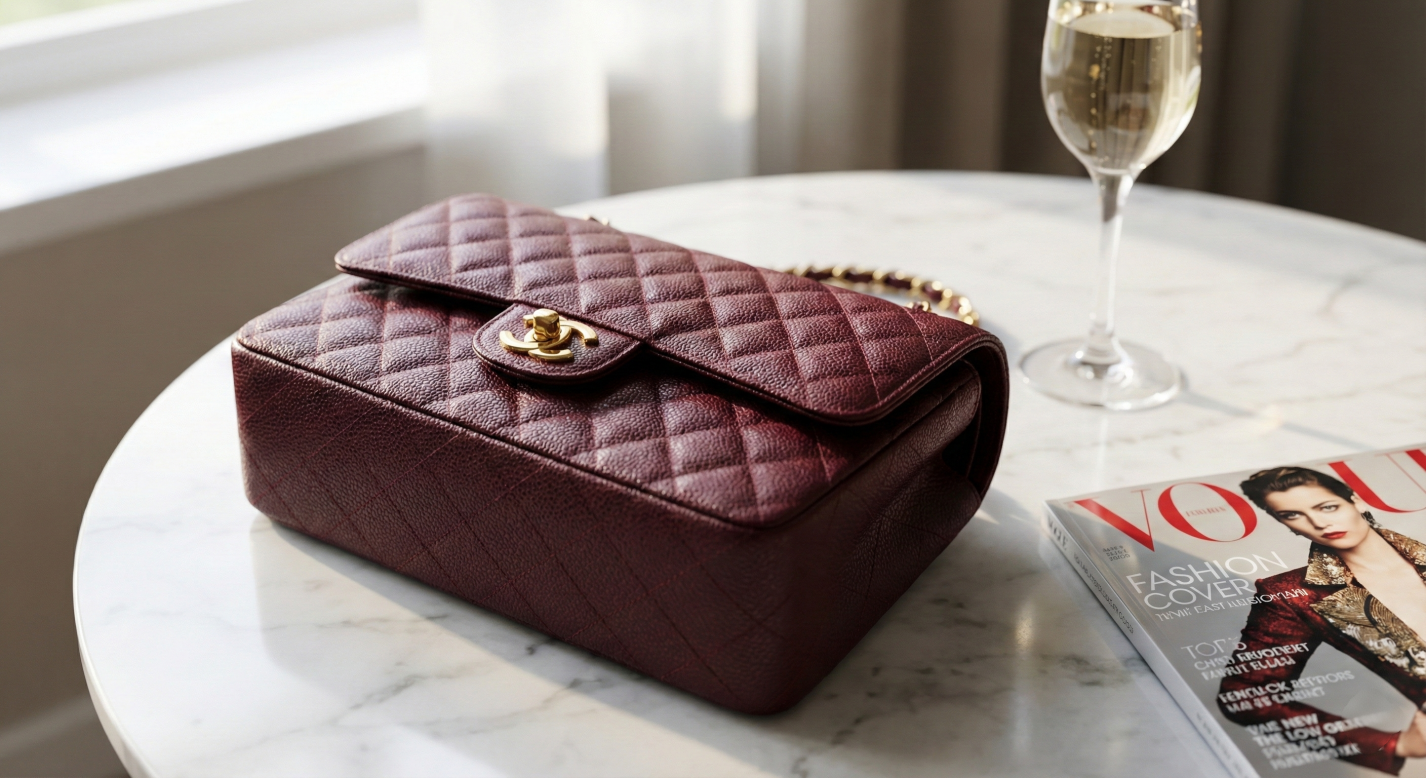
The Classic Flap, Chanel 22, and Chanel 19 represent three completely different design philosophies within Chanel. The Classic Flap is an icon of structured symmetry; the Chanel 22 is an exercise in casual slouch and leather drape; and the Chanel 19 bridges the gap with pillowy loft and chunky mixed hardware.
Because their construction goals are so distinct, judging them by the same criteria is a mistake. A Classic Flap that slouches is a failure, while a Chanel 22 that stands stiffly upright has missed the entire point of the bag. Here is how each bag actually behaves in hand, where replicas typically succeed or stumble, and which model fits your everyday lifestyle.
My bottom line before the details: 187 Factory and God Factory remain the benchmark reference names for the Classic Flap, while Xiao C is widely recognized for the softer loft of the Chanel 19 and 22. But beyond factory reputations, your decision should come down to how you carry a bag every day.
Table of Contents
Three Models, Three Different QC Focus Areas
In practice, the replica landscape is specialized: market-recognized workshop names such as 187 Factory, God Factory, Xiao C, and Shunyang each target specific models, leathers, or hardware finishes rather than competing across the whole Chanel catalog equally.
Much of the demand for high-tier Chanel alternatives is driven not merely by budget constraints, but by seasoned collectors who refuse to pay boutique premiums for retail pieces that increasingly exhibit uneven stitching, misaligned quilts, or lighter-weight hardware. This makes verifying model-specific construction far more important than chasing vague tier labels.
| Model | What defines it | Most revealing failure | Best evidence format |
|---|---|---|---|
| Classic Flap | Controlled geometry, continuous quilting, structured flap and chain | A bag that looks individually “nice” but loses alignment across panels or sits twisted | Square-on front/back photos plus side profiles and hardware macros |
| Chanel 22 | Supple shiny calfskin, drawstring movement and deliberate slouch | Leather that is either board-stiff or collapses into crushed, uneven panels | Short unfilled/partly filled video, including drawstring and chain movement |
| Chanel 19 | Soft leather, generous quilt loft, mixed-metal chain and top handle | Overstuffed balloon quilting, weak base, or hardware that overwhelms the body | Front, side and base photos plus a hanging video from both handle and chain |
Chanel’s current official references describe the Classic 11.12 in lambskin or grained calfskin, the Chanel 22 in shiny calfskin with gold-tone metal, and the Chanel 19 in shiny lambskin with gold-tone, silver-tone and ruthenium-finish metal. Those descriptions are a useful baseline, but they do not tell you whether a replica batch has the correct hand, structure or finish.
Classic Flap: Structure, Symmetry, and Quilt Alignment
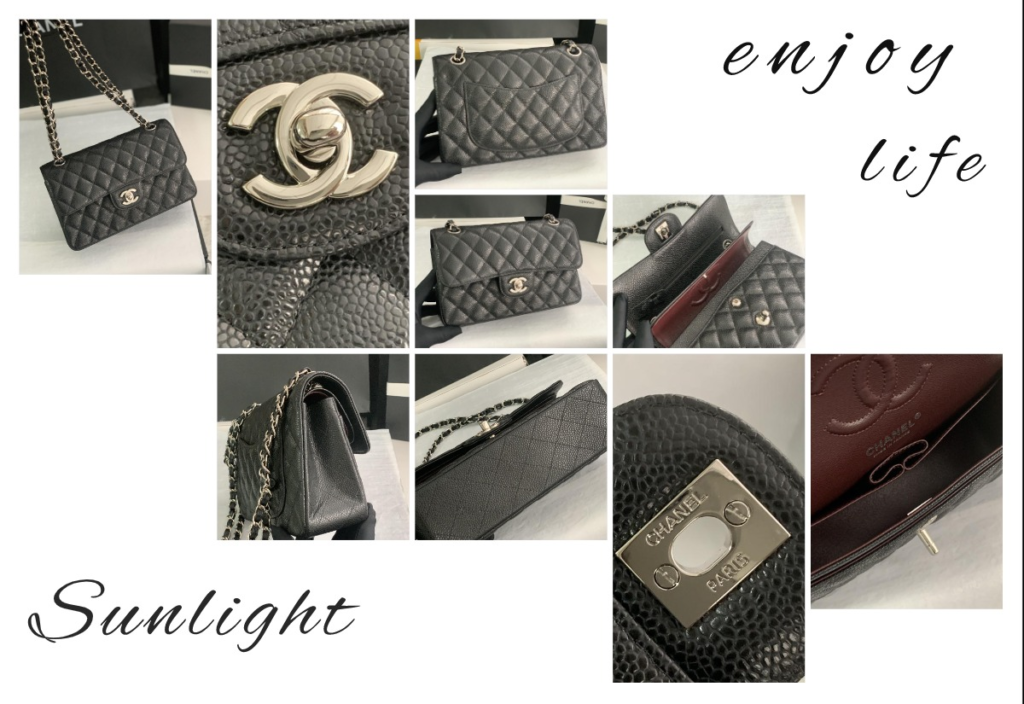
The Classic Flap is the easiest of the three to inspect in still images because its design gives you many alignment references. It is also the easiest bag to over-audit. A buyer can spend twenty minutes counting stitches and miss a skewed flap, an off-center turn-lock or a side panel that pulls the body out of square.
For an exhaustive breakdown of double flap geometry, burgundy lining tolerances, and turnlock weight, see our dedicated Chanel Classic Flap 25 review.
Start with the bag as one continuous object
I first draw an imaginary line through the center of the CC turn-lock, flap point and body. Then I follow several quilt lines from the flap into the front panel and around the side. The goal is not mathematical perfection; the goal is to identify whether one panel was cut, padded or assembled in a way that makes the whole bag read crooked.
- Front view: the flap should not rise on one side, and the turn-lock should not visually drag the center line left or right.
- Side views: compare both gussets. One side should not flare while the other collapses.
- Back view: the pocket should sit as part of the quilt system rather than looking pasted onto it.
- Base: check whether the corners land on the same plane. A bag can photograph well from the front while rocking on its base.
Why I no longer use one stitch count as a pass/fail rule
Community comparisons do count stitches per quilt, but the reported numbers vary by bag size, panel and reference piece. A single number is therefore a weak shortcut. I care more about whether the stitch angle remains consistent, whether the thread sits into the leather rather than floating on top, and whether tension changes abruptly around the flap edge or pocket.
This changes the practical request: instead of asking a seller to prove “nine stitches per diamond,” ask for a high-resolution square-on photograph of the same quilt line across the flap and body. That image reveals alignment, stitch rhythm, padding and camera distortion at the same time.
Leather: separate grain, finish and padding
“Caviar” is market shorthand, not one uniform surface. A batch may have plausible pebbling but still look wrong because the finish is too plastic, the peaks are too uniformly stamped, or the padding makes every diamond swell equally. Lambskin can fail in the opposite direction: a glossy photograph may hide a dry, coated hand or excessive stiffness.
For still photos, I compare grain scale across the flap, side and base. For video, I look for a soft change in reflection when the leather is tilted. A harsh, unchanging highlight often tells me more than a seller’s material description.
Hardware finish and function
Start with engraving placement, surface uniformity and a level turn-lock. A function clip adds the closure movement; handling notes add the chain weight and hinge resistance.
Classic Flap evidence request: front and back at the same camera height; both side profiles; open-flap interior; base; CC lock macro; chain-through-grommet macro; and a short clip showing the flap closing without hand-correcting its position.
While the Classic Flap demands millimeter-level geometric precision, the Chanel 22 exists on the opposite end of the spectrum: pure, effortless slouch. Evaluating the 22 requires a completely different mindset.
Chanel 22: Judge Movement, Not a Studio Pose
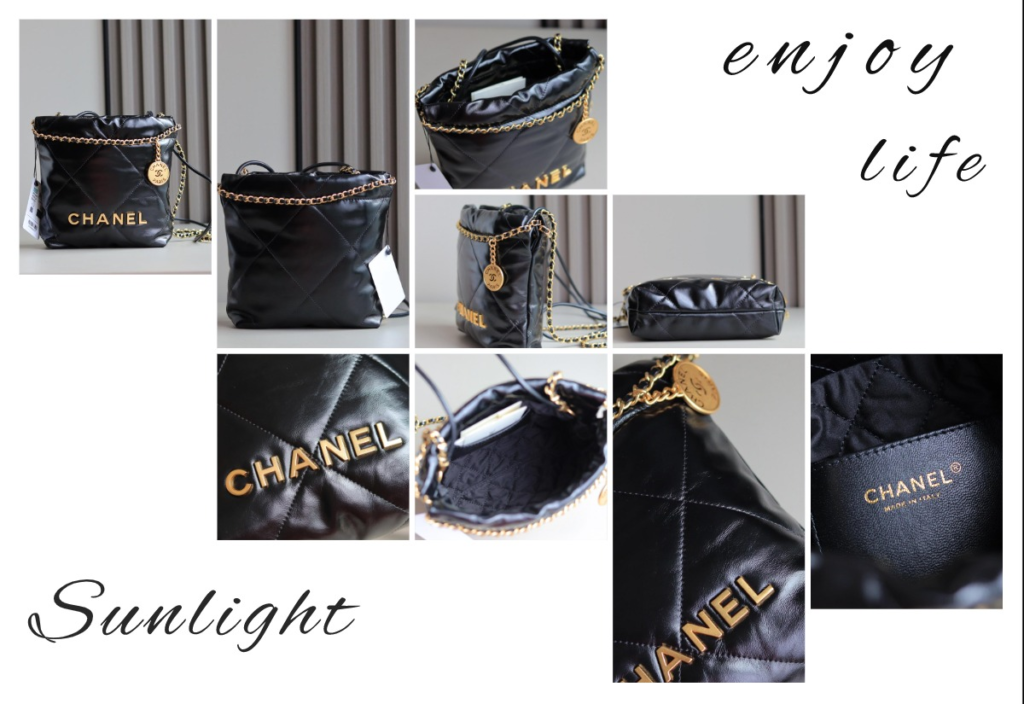
The Chanel 22 should not be evaluated with Classic Flap rules. Its appeal comes from controlled softness. A perfectly upright, heavily stuffed factory photo may hide the most important question: what happens when the bag is empty, lightly filled and carried by the chain?
For detailed base plate measurements, coin medallion engravings, and drawstring travel testing, refer to our in-hand Chanel 22 Mini review.
The useful slouch is distributed, not crushed
Buyer reports describe both ends of the problem. Some bags arrive unexpectedly stiff and need use before they relax; others show deep wrinkles or crushed quilt areas immediately. Neither “stiff” nor “soft” is automatically correct. I look for whether the body relaxes evenly and whether the lower corners, back panel and chain channels age at similar rates.
A seller can make almost any Chanel 22 look acceptable by packing it firmly. The better test is a three-part video:
- show the bag empty on a flat surface;
- add a light everyday load and pull the drawstring once;
- lift it by the chain, rotate it, and set it down without reshaping it by hand.
That sequence reveals whether the leather has natural drape, whether the base disappears completely, and whether one side is being pulled harder by the chain assembly.
Inspect the Chain System, Shoulder Drop, and Weight Distribution
The chain, leather interlacing, eyelets and drawstring are not separate decorative details. They transmit load through the top of the bag. Unequal eyelet height, a twisted chain section or uneven drawstring resistance can create the lopsided shape that only appears after the bag is carried.
- Compare the height and angle of the left and right eyelets.
- Check that the leather threaded through the chain is not bunched at one transition.
- Ask the seller to run the drawstring fully open and closed once on video.
- Look at the bag from above while it hangs; the opening should not torque into a spiral.
Front lettering and medallion: alignment before shine
The front CHANEL letters are individual metal elements, so I check their baseline, spacing and vertical angle before judging color. A single tilted letter is more visible in daily use than a small difference in gold tone. The medallion should also hang freely rather than being positioned for one photograph.
Chanel 22 evidence request: empty front/back photos; top-down view; close-ups of both eyelet groups; front lettering at eye level; medallion front/back; base corners; and the unfilled/filled movement video described above.
If the Classic Flap feels too formal and the 22 feels too casual, the Chanel 19 was designed specifically to bridge that divide, combining large-scale pillowy quilting with chunky mixed-metal hardware.
Chanel 19: Balance Loft, Softness and Hardware
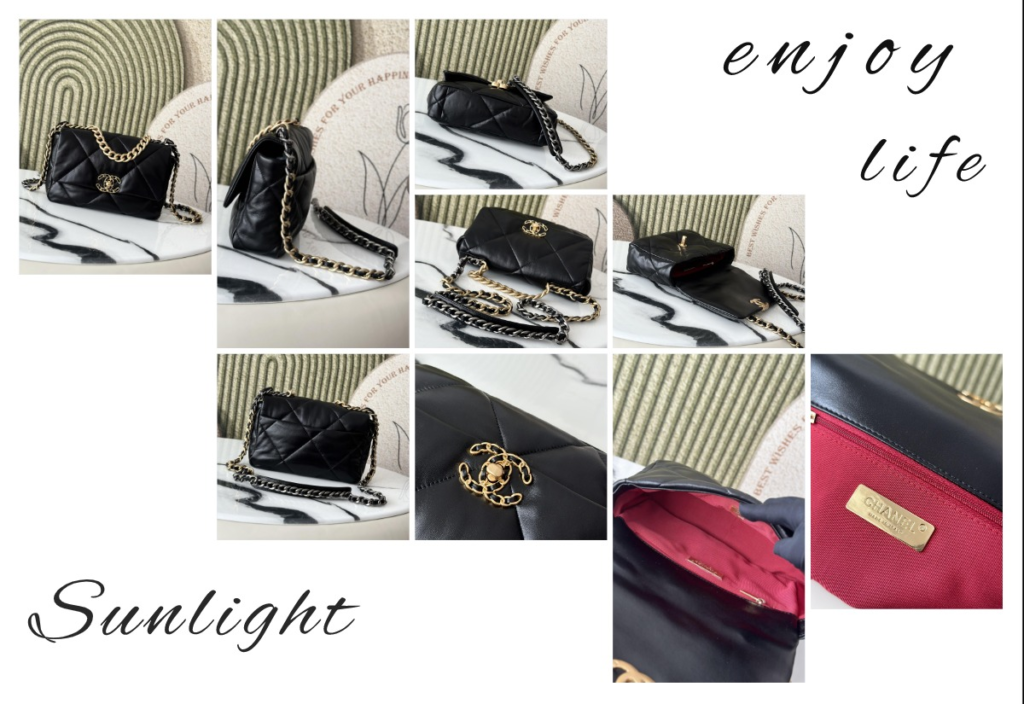
The Chanel 19 is often reduced to one question—“Are the quilts puffy enough?”—but maximum puffiness is not the target. The bag has to support a large chain, a top handle, a soft flap and a relatively relaxed body without looking inflated in the front and exhausted at the base.
Read quilt loft as a pattern
I compare the center quilts with those near the flap edge, sides and lower corners. Some compression is expected where panels fold and hardware pulls. A red flag is a patchwork effect: very round central diamonds beside dead, thin areas that do not correspond to construction or use.
The side photograph is often more useful than the front. It shows whether the flap padding transitions smoothly into the body and whether the bag is leaning because the top handle or chain is pulling from one side.
Mixed metal should look intentionally mixed
Chanel’s official description explicitly combines gold-tone, silver-tone and ruthenium-finish metal. The replica challenge is therefore not to make every link match. It is to create a deliberate transition in tone and finish. I look for links that appear accidentally plated, overly glossy dark hardware, or abrupt color changes that make the chain look assembled from unrelated parts.
Top handle and front CC are stress points
The top handle should form a stable arc when the bag is at rest and should not twist the flap when lifted. At the front CC closure, the leather interlacing must sit cleanly through the metal without thick glue residue or uneven edge paint. These areas deserve close-ups because they combine leather cutting, hardware placement and hand finishing in one small space.
Do not score shape retention without considering use
Community reference posts also show that authentic Chanel 19 bags can soften and lose shape depending on storage, load and whether a base shaper is used. That means “the replica is firmer than an older authentic” is not automatically a defect. Compare new-to-new references where possible, and separate initial construction from later wear.
Chanel 19 evidence request: square-on front and back; both sides; base; handle roots; mixed-metal chain in neutral light; CC interlacing macro; and a clip showing the bag hanging first from the top handle and then from the shoulder chain.
What Community Discussion Actually Changes in My Recommendation
Community evidence is most valuable when it changes what I ask for—not when it is used to repeat a factory leaderboard.
| Recurring buyer signal | What it means | My concrete action |
|---|---|---|
| 187 and God Factory are repeatedly discussed as high-tier Chanel reference sources. | The names are useful for narrowing the market, especially for classics, but they do not eliminate batch variation. | Keep the source name in the record, then judge the actual item against the model-specific evidence pack. |
| Classic Flap comparisons report small differences in stitch rhythm, grain, hardness and quilt height even within respected sources. | A “correct factory” can still produce a bag whose balance is wrong for the buyer’s preferred reference. | Compare the exact PSPs with one chosen reference bag rather than mixing several seasons and sizes. |
| Chanel 22 reviews describe both excessive stiffness and overly wrinkled or crushed panels. | Still photos can conceal the functional behavior that defines this model. | Require movement footage before making a judgment; do not score the 22 from a packed studio pose alone. |
| Chanel 19 comparisons often debate Xiao C, OF and leather “upgrades.” | Source vocabulary changes and may not map cleanly to one stable material specification. | Ask what the seller can actually document for the current batch, then evaluate leather, loft and hardware independently. |
| Some high-tier sources or sellers have limited exchange flexibility after PSPs. | The value of QC depends on what can still be changed. | Clarify the exchange or defect policy before payment, not after finding a problem. |
This is the point I want fixed in the wider ReinaLuxe framework: community research must end in a changed decision rule or a changed evidence request. A factory mention without a practical consequence is not information gain.
Key Photos and Checks to Request Before Deciding
The most efficient QC process is not “send more photos.” It is a controlled set of views that makes left/right and front/back comparisons possible.
| Evidence | How it should be captured | What it can reveal |
|---|---|---|
| Square-on front and back | Camera centered at bag height; no wide-angle close-up | Panel symmetry, flap level, logo/lock centering, pocket placement |
| Matched side profiles | Same distance and camera height on both sides | Gusset asymmetry, flare, collapse, handle pull |
| Top and base | Bag unheld on a level surface | Twist, corner height, opening symmetry, base distortion |
| Hardware macros | Diffuse neutral light; one straight-on and one angled view | Engraving, plating coverage, alignment, edge finishing |
| Motion clip | One continuous clip without cuts or hand reshaping | Closure behavior, drawstring resistance, chain twist, drape |
| Reference label | Record model, size, material/color, claimed source and date | Prevents comparisons across mismatched variants |
Three categories of findings
I separate findings before deciding:
- Structural red flags: skewed panels, severe left/right asymmetry, twisted load-bearing chain, mis-seated hardware, or a base that will not sit level. These are difficult to dismiss as normal variation.
- Reference-dependent variation: grain size, quilt height, gold tone and softness. These require a matched authentic or trusted reference from the same model, size and material family.
- Unknown from PSPs: smell, hand feel, actual chain weight, long-term plating wear and how the bag behaves after weeks of use. These should remain explicit unknowns.
This classification prevents false certainty. It also stops a minor tone difference from receiving more attention than a structural problem.
Buying Verdict: Which Chanel Fits Your Wardrobe?
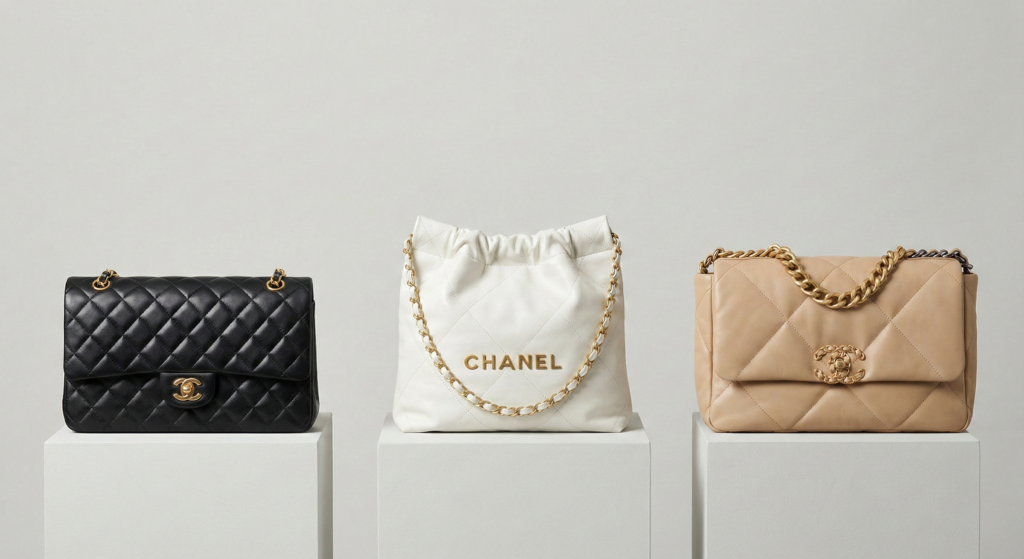
Choosing between the Classic Flap, Chanel 22, and Chanel 19 is not about finding an absolute winner—it is about matching the bag’s structural character to how you actually dress and live:
| Model | Best fit | Main compromise | My minimum proof |
|---|---|---|---|
| Classic Flap | A buyer who wants structure and is willing to compare geometry carefully | Many small details invite over-auditing; leather feel remains hard to prove remotely | Matched front/back/sides, base, CC lock and chain-grommet close-ups |
| Chanel 22 | A buyer who values capacity, casual use and visible slouch | Creasing and shape change are part of the design, so “perfect” still photos are misleading | Empty and lightly filled movement video plus both eyelet groups and lettering |
| Chanel 19 | A buyer who likes soft leather, statement hardware and a less rigid silhouette | Weight, long-term softness and shape retention vary with use | Side/base views, handle roots, chain transitions and hanging video |
Classic Flap Verdict: Choose the Classic Flap if you want an architectural, timeless silhouette for dinners, formal events, and polished daywear. Sourced from 187 or God Factory in Caviar leather, it is the most durable and visually convincing piece in the catalog, provided you accept its rigid capacity limits.
Chanel 22 Verdict: Choose the Chanel 22 if you live in denim, knitwear, and sneakers, and need a lightweight tote that swallows a laptop, water bottle, and pouches. Sourced from Xiao C or Shunyang in shiny aged calfskin, its beauty lies in how effortlessly it drapes over your shoulder.
Chanel 19 Verdict: Choose the Chanel 19 if you want modern luxury with relaxed comfort. Its pillowy quilts and bold mixed-metal chains give it immediate presence while remaining far softer and more casual than a traditional Classic Flap.
Sizing Advice for Petite Frames (Under 160 cm / 5’3″): Chain drop and body volume interact very differently on smaller proportions. The full-size Chanel 22 (Medium) and Maxi/Large Chanel 19 easily overwhelm a petite torso and can bounce awkwardly against the thigh when walking. If you are under 160 cm, the Chanel 22 Mini is the sweet spot: it gives you the relaxed slouch and shiny calfskin drape without swallowing your silhouette. For the Classic Flap, the Medium (25 cm) or Small (23 cm) is ideal—wear it with the chain doubled on the shoulder to keep the base resting neatly at the high hip. For the Chanel 19, stick strictly to the Small (26 cm): its chunky tri-metal chain delivers bold impact without dragging down your shoulder line or dwarfing your frame.
Frequently Asked Questions: Choosing Between Classic Flap, 22, and 19
Which of the three models is best suited as an everyday workhorse bag?
The Chanel 22 is easily the best daily workhorse. Unlike the rigid double flap of the Classic Flap, the 22 opens wide, weighs substantially less, and comfortably accommodates larger essentials like tablets, water bottles, and pouches without stressing the seams.
Which model is the most forgiving in terms of replica accuracy?
The Chanel 19 and Chanel 22 are significantly more forgiving than the Classic Flap. The Classic Flap requires absolute millimeter-precision symmetry across diamond quilts, rear pockets, and the turnlock bevel. The 19 and 22 rely on soft slouch and pillowy drape, where minor variance looks natural rather than flawed.
How does shoulder chain comfort compare across the three bags?
The Chanel 22 and Chanel 19 are notably more comfortable under load than the Classic Flap. Both the 22 and 19 feature wider leather shoulder pads that distribute weight across your shoulder. The Classic Flap’s narrower leather-threaded chain can bite into your shoulder when fully packed.
Does the Chanel 19 hold its shape over time compared to the Classic Flap?
No, and it is not designed to. The Chanel 19 is inherently soft-sided and will naturally relax and develop a gentle slouch with regular use. If rigid, upright shape retention is your priority, a Classic Flap in Caviar leather is the much better choice.
Which leather configuration should I choose for each model?
For the Classic Flap, Caviar leather is the definitive recommendation for everyday durability and structure. For the Chanel 22, shiny aged calfskin is essential for authentic drape and luster. For the Chanel 19, Goatskin offers greater scratch resistance while Lambskin provides the softest, cloud-like puffiness.

7 comments
Great article! I’m confused about the Caviar leather though. I bought a ‘mirror’ replica from another site last year and the leather felt like plastic—really dry and stiff. Does your AAA grade actually feel moisturized like the authentic? I want the Classic Flap but I’m picky about the touch.
For the Classic Flap, I would request a panel-movement video and close views of the grain in neutral light. Keep the leather specification separate from the visual comparison; softness is something to assess on the actual example.
I’ve been eyeing the Chanel 22 in white for months, but I’m terrified of it getting seized by customs here in the US. I’ve heard horror stories. How does your shipping specifically handle this for 2025 orders? Also, does the white leather get dirty easily?
For shipping, ask the seller for the current service and written loss or seizure terms. For a white Chanel 22, I would be particularly careful around dark denim and check the actual leather finish and care instructions before choosing it.
I actually own a real Jumbo Flap, but I want a replica for travel so I don’t have to baby it. Honestly, looking at your comparison photos of the hardware screws, it looks identical to mine. Does the gold hardware have that yellowish vintage tone or is it too yellow?
Use your Jumbo as a reference only if the model, material and hardware version match. Ask for neutral-light views of the current hardware and compare several components together. Warm lighting can make a subtle gold look much yellower.
Editor’s question: among the Classic Flap, Chanel 22, and Chanel 19, which one do you think is hardest to judge from static photos? My experience is that movement and structure can matter more than a single close-up, so I’m considering adding more use-behavior comparisons.